Showing posts with label Book Review. Show all posts

Thursday, June 4, 2026

After Everything, I Wrote This

I wrote a book. Not just started one or thought about one—I finished it, and I've decided to share it.

It's a memoir about growing up Mormon, coming out young, building a life that never quite fit, and eventually finding my way out. It's about identity, loss, and becoming.

I chose to self-publish on Amazon because I didn't want to wait for permission to tell my story. I wanted control over how it exists in the world—and I wanted it to be real, not stuck in drafts forever.

And honestly, it was far more doable than I expected.

If the idea of self-publishing feels overwhelming, here's what it actually looked like for me:

  • I formatted my manuscript in Word using Amazon's guidelines
  • I designed a cover in Canva
  • I uploaded everything through Amazon KDP and followed their step-by-step process
  • I made a few adjustments, clicked publish, and that was it
It took effort, but it wasn't complicated—and I didn't need specialized skills.

If you've ever thought about writing something—your story, your ideas, anything—you don't have to wait. It's more accessible than it seems, and your voice is enough.

For a long time, I didn't think I would ever tell this story. Not just writing it—but figuring our how to say it honestly, and in my own words. 

If you would like to read it, you can find it here: https://a.co/d/07Hk2ydJ

If someone reads this and recognizes even a small part of themselves in it, that's enough. 

You're not alone.


aB . All Rights Reserved . 2026

Monday, March 30, 2026

The Odyssey: The Original Road-Trip-Gone-Wrong (and It's Modern Echo in O Brother Where Art Thou?)

I just finished listening to the audiobook of The Odyssey, and honestly, it’s wild how this ancient epic poem, written nearly 3,000 years ago by Homer, still reads like the ultimate “road trip gone wrong.” Odysseus’s journey home after the Trojan War lasts ten years, and along the way, he encounters gods with grudges, monsters with big appetites, shipwrecks, curses, temptations, and, let’s be honest, a whole lot of consequences for pride.

At its heart, The Odyssey is the story of a man trying to get back home to his wife, Penelope, and his son Telemachus. But every time he gets close, something gets in the way. Sometimes the obstacles come from petty gods. Sometimes from Odysseus himself. And sometimes from his crew, who seem constitutionally incapable of making good choices.

Here is a quick run-through of Odysseus's very bad travel itinerary.

The Cicones
Right after leaving Troy, his crew raids a city, overstays their welcome, and gets attacked. This is our first sign that Odysseus cannot control his men, and that their bad decisions will be a recurring theme.

The Lotus-Eaters
They land in a place where eating the lotus flower makes you forget everything you care about. Odysseus has to drag his zoned‑out sailors back onto the ship.

The Cyclops (Polyphemus)
A giant one‑eyed monster eats several of Odysseus’s men. They escape by blinding him, but Odysseus, being Odysseus, can’t resist bragging as he sails away. Unfortunately, Polyphemus’s dad is Poseidon, who hears the boast and curses him.
This is why the trip takes ten years. Pride: 1, Odysseus: 0.

Circe
A witch-goddess turns the men into pigs. Odysseus outsmarts her, and she ends up being a helpful host… and his lover… for an entire year.

The Underworld
Odysseus consults the prophet Tiresias, who basically tells him that things will get worse before they get better and that trouble awaits him at home, too.

The Sirens
Their haunting singing drives sailors mad, so the crew plugs their ears with wax and ties Odysseus to the mast so he can safely listen without leaping to his doom.

Scylla & Charybdis
A six‑headed monster on one side, a deadly whirlpool on the other. Odysseus navigates between them and loses more men in the process.

The Cattle of the Sun God
Odysseus warns his crew not to touch the sacred cattle. They do it anyway. Zeus punishes them by destroying the ship and killing everyone except Odysseus.

Calypso
A nymph falls in love with him and keeps him captive for seven years. He eventually gets released, but only because the gods intervene.

The Phaeacians
They find Odysseus washed up on the shore, listen to his whole story, and finally bring him home to Ithaca.

Meanwhile, back in Ithica...

Odysseus’s home is falling apart: Over 100 suitors have moved into the palace. They’re eating all the food and demanding Penelope pick a new husband. Telemachus, now grown, is trying to hold things together but is outnumbered.

When Odysseus returns, he disguises himself as a beggar. He reunites with Telemachus and a few loyal servants, then, in true epic fashion, slaughters every suitor in an unforgettable dramatic showdown. Peace is restored. The family is reunited. The kingdom is his again.

Hollywood
loves The Odyssey, and one of the smartest, funniest adaptations is the Coen Brothers’ O Brother, Where Art Thou?

It’s not set in ancient Greece at all; it takes place in 1930s Mississippi during the Great Depression, but it mirrors the epic so closely that once you see the parallels, you can’t unsee them.

The core setup is the same. A man wants to return home to his wife. He travels with companions who cause trouble. He encounters strange, magical-feeling characters. Monsters become folk figures. Gods become mysterious forces, fate, and coincidence.

Everett = Odysseus
Smooth talker, clever but flawed, way too proud, obsessed with his hair (a modern stand‑in for heroic vanity).

Penny = Penelope
She has suitors courting her, and as Everett tries to get home, he must prove himself to win her back.

Delmar & Pete = Odysseus’s crew
Loyal, impulsive, and constantly causing detours.

Here are some of their adventures as they try to get Everett home.

The Sirens: Three women washing clothes in the river hypnotize the men with singing.
The Cyclops: A one‑eyed, violent Bible salesman (John Goodman) robs them and beats them.
The Lotus-Eaters: Everett’s companions get baptized, lose sight of the mission, and forget their purpose, just like Odysseus’s men.

It’s not a literal adaptation, but it brilliantly transforms the mythic structure into American folklore, blues, and rural Southern storytelling. Gods and monsters become con men, sirens, corrupt politicians, and religious movements.

At its heart, The Odyssey is about longing for home, facing trials, battling your own flaws, and fighting to reclaim your place in the world. That’s why it still resonates with filmmakers, with writers, and with any of us who’ve ever felt lost, off‑course, or determined to rebuild our lives.

And maybe that’s why modern retellings like O Brother, Where Art Thou? feel so timeless. They remind us that every journey, whether across the sea or across the American South, is about finding your way back to yourself.

aB . All Rights Reserved . 2026

Friday, March 27, 2026

Pageboy by Elliot Page

I recently listened to the audiobook Pageboy, written and narrated by Elliot Page, and it’s one of those memoirs that stays with you long after the final chapter. I’ve admired Elliot Page as an actor for years. Whip It remains one of my all‑time favorite films, and his role in The Umbrella Academy is beautifully done, yet I realized when his book came out that I knew almost nothing about his personal journey. Hearing Pageboy in his own voice made the experience feel intimate, raw, and deeply human.

Growing up, my relationship with queerness felt fractured. I was raised in a strict Christian home, taught that being gay was a sin, but I also grew up in Europe, where the world outside my front door was far more open and accepting. It created this strange dual reality: I saw freedom all around me, yet I was told at home that who I might be was forbidden. I remember once hinting to my mother that I might like girls; the conversation ended immediately. I didn’t bring it up again. The feelings never disappeared; I learned to hide them. It wasn’t until 2022 that I could finally say the words out loud to myself: I’m gay, and it’s okay. Saying it to others took longer. Fear has a way of lingering, even when the truth feels like relief.

Listening to Elliot tell his story felt like someone turning on a light I didn’t know I needed. He speaks with incredible honesty about growing up, performing roles, both onscreen and in life, and struggling to live in a body that didn’t reflect who he was. So many of his descriptions echoed my own quiet, private discomfort. At one point, he reflects on how he saw himself before transitioning: how wearing feminine clothes felt unbearable, how summer made layering impossible, how he constantly tried to hide his chest or avoid his own reflection. When he said, “I couldn’t look at pictures because I was never there,” it stopped me. I knew exactly what he meant. I’ve lived that sensation, the disconnect between the person others see and the person you know yourself to be.

Pageboy is more than a memoir; it’s a liberation story. Elliot doesn’t shy away from the painful parts: dysphoria, shame, repression, survival. But woven through the heaviness is something bright, permission. Permission to exist, to take up space, to be whole. Listening to him articulate his truth gave me a quiet, steady reassurance that mine matters too.

For anyone who has ever questioned their gender, sexuality, or the rules they grew up with, Pageboy is a gift. For those who’ve hidden parts of themselves to stay safe, or stayed silent to keep the peace, or felt out of step with who the world told them to be, this book offers connection, understanding, and courage. Elliot doesn’t just tell you it’s okay to be yourself; he helps you believe it.

If you’re part of the LGBTQ+ community, or if you love someone who is, or if you’re simply trying to understand queer experience with more compassion, Pageboy is absolutely worth reading. Don’t hide who you are. Don’t shrink yourself. You deserve to live fully, honestly, and without apology. And as Elliot Page reminds us, that journey, difficult as it may be, is worth everything.


aB . All Right Reserved . 2026

Thursday, December 18, 2025

Women Talking: A Story That Demands to Be Heard

When I first read Women Talking by Miriam Toews in May 2024, I was struck by its raw honesty and the depth of its questions about faith, obedience, and freedom. It’s a story that lingers long after the last page—a story about women who have been silenced for generations, told they must submit to men to gain salvation and entry into heaven. Their entire lives were built on obedience, on the belief that speaking up was forbidden.

This weekend, I finally watched the film adaptation. I had heard that the movie changed the portrayal of the women, and indeed, the setting felt different. The book takes place in Bolivia, and in my mind, I pictured women with darker skin living in an isolated colony, far removed from the world—perhaps deep in the Amazon. The movie, however, felt like Pennsylvania farmland, with women who looked like those in traditional U.S. Mennonite communities. At first, this shift unsettled me. I thought the setting would matter more. But as the story unfolded, the location faded away. What remained was the truth—the voices of women who had been denied their humanity.

Both the book and the movie are powerful because they center on the same question: What do you do when your faith demands forgiveness, but your soul cries out for justice? The women gather in a hayloft to decide their future: stay and submit, fight, or leave. Their conversations are urgent, tender, and revolutionary.

One line from the book has stayed with me:
“Freedom is good... it’s better than slavery. And forgiveness is good, better than revenge. And hope for the unknown is good, better than hatred of the familiar.”
This quote captures the tension between hope and fear, between the comfort of what we know and the terrifying possibility of change.

The movie echoes this theme with a line that reflects Mennonite pacifism:
“It is a part of our faith to forgive. We have always forgiven those who have wronged us. Why not now?”
But the women ask: Is forgiveness that is coerced true forgiveness? And what does it mean to forgive when the violence is unspeakable?

When the credits rolled, I sat in silence, just as I had after finishing the book. The story is not just about Mennonite women—it’s about all women who have been silenced, treated as property, denied agency. It’s about the courage to speak, to dream, to choose freedom even when the cost is everything you’ve ever known.

This story needs to be shared because oppression thrives in silence. And when women talk—really talk—they begin to change the world.

aB . All Right Reserved . 2025

Wednesday, December 10, 2025

Faith, Doubt, and Devilish Insight: Rereading The Screwtape Letters Through a New Lens

This post contains personal reflections on The Screwtape Letters by C.S. Lewis, including interpretations from both religious and secular viewpoints.

The Screwtape Letters is one of my favorite books and has been for a long time. I end up picking it up every few years to read again, as I seem to find something new to ponder each time. The first time I read it, I was quite religious, and the book felt like a lifeline, a reminder that faith can endure even through confusion, temptation, and suffering. I read it after my divorce, and it gave me insights into the pitfalls of life and how humans can be deceived so easily. Three years ago, I went through a faith crisis and now consider myself to be agnostic. I am open to spiritual ideas but uncertain about the existence or nature of a higher power. Religion still fascinates me, but from an academic viewpoint. Reading The Screwtape Letters after going through a faith crisis made me see the book in an entirely different light, and it was amazing.

C.S. Lewis portrays spiritual warfare through the eyes of a demon advising his nephew. The premises are clever and affirming to many. The books’ brilliance did not fade after my faith crisis; it shifted instead. Lewis’s insights into human psychology, self-deception, and moral complexity still resonate, but now I appreciate them as literary and philosophical reflections rather than spiritual truths.

What struck me most this time around was how well Lewis captured the subtle ways people rationalize their choices, drift from their values, and become strangers to themselves. The “devil” in this book became less of a literal being and more a metaphor for the internal voices that lead us away from authenticity, compassion, and clarity.

Reading the Screwtape Letters as both a Christian and a skeptic has been a rare and rewarding experience. It shows me that Lewis’s writing skills speak volumes across different world views. Whether you see it as a spiritual allegory or psychological satire, it is a work that invites reflection. I will return to this book every few years, like I have done in the past. I know next time I will find new meaning in the same old words that Lewis penned over 80 years ago.

Published: 1942
Last Read: September 19, 2024

aB . All Rights Reserved . 2025

Thursday, November 20, 2025

History and Heart: Why The Briar Club Captivated Me

This review contains plot details from The Briar Club by Kate Quinn. If you haven't read the book yet and want to experience the mystery firsthand, consider saving this post for later!

I just finished listening to the audiobook of The Briar Club by Kate Quinn, and I absolutely loved it. From the very beginning, I was drawn in by the rich historical details seamlessly woven into the lives of the fictional characters. As someone who is passionate about history, I am always on the lookout for books that get historical facts right while still telling a compelling story. The Briar Club delivered on both of those fronts.

What amazed me most was how the author brought real historical details into the narrative. The book is set in Washington, D.C., during the early 1950s. It captures the paranoia of the Red Scare (Communism) and the political repression during the McCarthy era. The women's stories in the book reflect real-life events such as the decline of the All-American Girls Professional Baseball League, the first birth control pill trial, and the tension between domestic expectations and personal ambition. There are unspoken, but prevalent tensions in the book when it comes to depicting LGBTQ individuals and the struggle to keep their lives secret. Racial prejudice is also touched on to show how many individuals had to deal with that during those years. The post-World War II era, with many refugees trying to find their place in a new country, was also masterfully integrated, echoing realistic events involving displaced persons and all they lost when they had to leave their homes.

Listening to the audiobook added another layer of immersion. The narrator brought each character to life, and the pacing made it easy to stay engaged. I found myself looking forward to my bus ride to work so that I could tune in to see what was happening next. After the audiobook ended, there was a bonus interview with author Kate Quinn and the narrator Saskia Maarleveld. Quinn shared insights into how each character was inspired by real historical archetypes, and how she wanted to give a voice to women whose stories were often overlooked back in the 1950s. Listening to her describe her favorite moments and how the book came into existence made me appreciate each character more.

The prologue of the book opens on a murder scene at the Briar House. 

"The house had a lot of blood and two dead bodies, one upstairs and one down, with 17 suspects who have had too much rum punch." 

The story rewinds four years to tell the different tales leading up to that fateful night. The book is extremely character-driven, and each section goes into detail about a different character who lives in the house. Slowly, with each character, you are getting more of the story until ultimately we land back at that fateful time the murders occurred among all of them.

I loved getting to know each of the characters. Quinn masterfully placed puzzle pieces together, and slowly, the entire story appears. When all of their stories are told, the ending makes perfect sense, and you can finally see the big picture. Each character that lives in the house has their own secrets that you are getting glimpses of throughout the book. I started to root for certain characters as I learned their story and as they themselves were forming friendships together. The final secret at the end was wonderfully crafted, as I did not see it coming.

The Briar Club is more than just a historical fiction; it is a story full of secrets, sisterhood, and survival. It is a beautiful reminder of how history shapes us, and how personal stories can illuminate broader truths. 

Published: July 8, 2024
Read: October 22, 2025

aB . All Rights Reserved . 2025

Friday, November 14, 2025

Words of Worship: How Cultish Changed the Way I See Influence

This post discusses key ideas and examples from Cultish by Amanda Montell. While it doesn’t reveal every detail, it may shift your perspective before you read the book yourself.

In February of this year, I read Cultish by Amanda Montell. My daughter recommended it to me, and it completely reframed how I think about language, persuasion, and power. I went in expecting a deep dive into religious cults, and while those are definitely covered, the book goes way beyond that. Montell explores how cult-like language permeates everything from multi-marketing schemes to the fitness community. She reveals how words can be used to manipulate, isolate, and control individuals.

While reading, I was struck by the many groups I had never considered to be “cultish” that started to fit the mold that Montell was describing. The book is filled with examples that are both fascinating and terrifying. Charismatic leaders and corporate brands use language to build loyalty, suppress dissent, and create a sense of belonging that can be hard to escape.

“Language doesn’t work to manipulate people into believing things they don’t want to believe; instead, it gives them license to believe ideas they’re already open to.”

Cultish language doesn’t force belief, it nurtures it. It’s the subtle but powerful distinction that certain slogans, phrases, and speech patterns can feel so familiar and persuasive.

Montell’s arguments are well researched and very compelling, making Cultish especially powerful. The book is not just great for academics but also for your book club, as it is conversational, witty, and deeply thought-provoking. I found myself reexamining everything from corporate slogans to influencer catchphrases with a more critical eye. Why do people get drawn into extreme belief systems, or why do some brands or communities just feel off? This book covers those questions and more. It is not just about cults but about the culture, language, and subtle ways we are shaped by the words around us.

Published: June 15, 2021
Read: February 18, 2025

aB . All Rights Reserved . 2025

Monday, November 10, 2025

Two Voices, One Crisis: Comparing Know My Name and Missoula

This post discusses sexual assault and its aftermath, as portrayed in Know My Name by Chanel Miller and Missoula by Jon Krakauer.

In the past year, I’ve read two books that profoundly shaped my understanding of sexual assault and the systems that fail survivors. I’ve long admired Jon Krakauer’s work, so I picked up Missoula knowing it would be thoroughly researched and thoughtfully written. Then, earlier this year, Know My Name was recommended by my coworkers, and since memoirs are my favorite genre, I decided to read it. Both books are powerful and necessary, approaching the same subject from very different angles. Together, they offer a fuller picture of the crisis facing college campuses and the justice system when it comes to sexual assault.

Know My Name is a memoir by Chanel Miller. She writes with emotional depth and poetic clarity, recounting her experience as the survivor of sexual assault on Stanford University’s campus. Her story is intimate, raw, and deeply human. She invites readers into her pain, her healing, and her fight to reclaim her identity. One quote that stayed with me is:

“I survived because I remained soft, because I listened, because I wrote. Because I huddled close to my truth, protected it like a tiny flame in a terrible storm... Stay tender with your power. Never fight to injure, fight to uplift. Fight because you know that in this life, you deserve safety, joy, and freedom.”

This quote captures the emotional core of Miller’s memoir. Her strength lies not in revenge, but in vulnerability and truth.

Missoula, written by Jon Krakauer, is a work of investigative journalism. He examines multiple cases of sexual assault at the University of Montana, revealing systemic failures in law enforcement, university administration, and public perception. His writing is meticulous and fact-driven. Krakauer exposes how institutions protect perpetrators and retraumatize victims—all under the guise of due process.

Reading Know My Name felt like sitting beside someone as they shared their story. Reading Missoula felt like being in the courtroom, watching the system unfold. Both are emotionally intense: Miller’s memoir is personal and lyrical, while Krakauer’s account is analytical and expansive. Together, they highlight the same truth—sexual assault is not just an individual trauma; it is a societal failure. Survivors are often doubted, silenced, and retraumatized by the very systems meant to protect them.

If you’re looking to understand both the emotional and systemic realities of sexual assault, I highly recommend reading Know My Name and Missoula. One gives voice to the survivor, the other holds a mirror to the system—and both insist that we do better.

Know My Name Published: September 24, 2019
Read: March 5, 2025

Missoula Published: April 21, 2015
Read: January 19, 2024

aB . All Rights Reserved . 2025

Thursday, November 6, 2025

“Blades, Realms, and Souls: My Journey Through Mai Corland’s Fantasy Saga”

This post contains reflections and quotes from all three books in Mai Corland’s fantasy trilogy: Five Broken Blades, Four Ruined Realms, and Three Shattered Souls. If you haven’t read them yet, consider bookmarking this post and returning after you’ve finished the series!

In February of this year, my co-worker recommended that I read Five Broken Blades by Mai Corland. I am slowly diving into the world of fantasy books, and so I decided to give it a try. Once I discovered the world Mai Corland had created, I knew I wanted to read the other books in this series. Book two was already published, but the third, and last, book in the trilogy would not come out until the Summer. 


I started with Five Broken Blades. The book is an adventure fantasy packed with corruption, betrayal, and mythic intrigue. The cast of characters is unforgettable. A thief, a strongman, a spy, an assassin, a nobleman, and an exiled prince. Corland’s character development captivated me and nearly made it impossible to put the book down, so I finished it in two days. The balance of humor, romance, and intense fight scenes sets the stage for a vast world that is both thrilling and emotionally rich.


I raced through Four Ruined Realms even faster than the first. The short chapters dedicated to specific characters and their shifting perspectives kept the momentum high and intriguing. New characters were added, involving mystery and complexity to an already great storyline. Corland expanded her world in this book, blending action, romance, and heartbreak in a way that felt seamless. Favorite characters started to form in my mind as I felt myself rooting for their success as the second part of the story came to a close.


The wait for Three Shattered Souls was worth it, as the story seamlessly picks up where I had left my heroes only a few months before. The stunning conclusion wraps up the trilogy with emotional intensity and gripping tension. Royo, my favorite character, shines in this installment. His journey through the books is raw, complex, and beautifully written. Corland has a gift for weaving pain and hope together, and this book proves it.

Two quotes from the final book especially stayed with me:

“Broken hearts grow thorns as they stitch themselves back together.”

“There are weights you bear alone, because the truth will crush someone you love.”

These lines reflect the emotional depth and poetic beauty that define the series. While I did not want Three Shattered Souls to be the last book in this series, it elevated it and left me feeling emotionally drained from this amazing world I had stumbled upon only months earlier.

Mai Corland’s trilogy is a masterclass in fantasy storytelling. It blends epic adventure with intimate emotions. The series left me heartbroken, but grateful, that I was able to live in that world for a short while. I didn’t want the story to end with book three, and I am keeping my fingers crossed that Corland will add to this amazing fantasy world she has created over time.

Five Broken Blades Published: May 7, 2024
Read: February 14, 2025

Four Ruined Realms Published: January 7, 2025
Read: February 18, 2025

Three Shattered Souls Published: July 15, 2025
Read: August 26, 2025

aB . All Rights Reserved . 2025

Saturday, November 1, 2025

Darkly by Marisha Pessl - A Game of Secrets and Shadows

This review contains plot details from Darkly by Marisha Pessl. If you haven't read the book yet and want to experience the mystery firsthand, consider saving this post for later!

What would you kill for?

Darkly was my first experience reading Marisha Pessl, and it left me eager to explore more of her work. Known for her adult novels with a cult-media vibe and eerie undertones, Pessl brings the same energy to her second YA novel, blending gothic charm, psychological intrigue, and a dash of horror.

The story follows Arcadia "Dia" Gannon, a 17-year-old who runs her mother's antique shop and finds companionship in her two elderly coworkers, Agatha and Basil. Dia is obsessed with the mysterious board games known as Darklys, created by the enigmatic Louisiana Veda. After Veda's suspicious death, Dia is selected for a secretive internship with the Darkly company, joining six other teens equally obsessed with Veda's legacy.

They're transported to a remote island where Veda supposedly created her games, and from there, the mystery deepens. Pessl crafts a world that's immersive and unsettling, filled with impossible puzzles, hidden truths, and a protagonist determined to uncover it all.

The characters are memorable, and while I wished for more development of the supporting cast, Dia's voice carries the story with strength and vulnerability. The love triangle adds emotional tension without overshadowing the central mystery. Pessl's writing is atmospheric and layered, weaving together multiple threads that kept me guessing until the end.

Darkly is more than a creepy board game mystery - it's a story about obsession, legacy, and the lengths we go to uncover the truth. Pessl's world-building is masterful, and the novel's eerie tone lingers long after the final page.

Published: November 26, 2024
Read: October 2025

Wednesday, October 29, 2025

Walking into Dystopia: Comparing Stephen King’s The Long Walk to Its Movie Adaptation

This post contains reflections on the plot and ending of The Long Walk by Stephen King (writing as Richard Bachman), as well as thoughts on the movie adaptation. If you haven’t read the book or seen the movie, you may want to return later.

In July of this year, I read The Long Walk by Stephen King, technically, it is by his alter ego Richard Bachman, and it left me haunted. I had seen that a movie adaptation was going to be released, and I wanted to read the book first. This was my first time reading anything under King’s Bachman persona, and I am glad I did.

The book is a relentless journey into the heart of dystopia, where psychological tension builds with every step. The story slowly unravels its characters, especially Ray Garraty. The emotional weight of the walk, the shifting dynamics between the characters, and the creeping dread of the inevitable end for most of them made it impossible to put down.

The ending of the book left a deep impression on me. I had to ponder it for a while, but I finally realized that I interpreted the final figure that Garraty sees as death itself. This reinforced to me that no one makes it out of the Long Walk alive. Even the so-called winner is just the last one to die. That bleak inevitability gave the story a chilling resonance that stuck with me even after it ended.

I saw the movie adaptation with my daughter, who had not read the book, and I loved most of it. I was okay with the smaller changes the movie incorporated as they made sense for the medium and pacing, but the ending left me feeling jaded.

In the movie, Garraty’s motives for the walk change from curiosity and a desire for wealth to revenge on the Major, whom he blames for his father’s death. Garraty’s girlfriend from the book is completely left out, and his mother becomes his emotional anchor instead. Scramm, a character who develops pneumonia and has a pregnant wife, is completely cut from the movie, and his traits are instead split between Olsen and Stebbins, two other participants. The number of walkers in the book, 100, is cut to 50 in the movie. This makes a lot of sense for production reasons.

Peter McVries also has a different backstory, which changes his entire narrative. In the book, he is sarcastic, philosophical, and emotionally raw. He serves as a moral compass for Garraty while he contemplates death and knows the futility of the walk. He is not trying to win the race but openly questions it. Eventually, he decides to sit down, as a symbolic act of defiance, which leads to his death. In the movie, McVries is more emotionally stable and supportive. The bond Garraty and he develop is central to the movie’s emotional arc. McVries becomes a co-lead in the movie and ends up winning the walk after Garraty sacrifices himself. McVries becomes the heart of the story, and his survival is framed as a victory not just over the walk but over the system itself.

The completely different ending of the movie is what left me baffled, as that was the most powerful part in the book for me. In the book, Garraty wins the walk, but he is mentally broken. He sees a dark figure and continues to walk even after his win. King leaves you to interpret the ending yourself, as you can draw many different conclusions from its meaning. As I mentioned earlier, the ending of the book left a deep impression on me as I interpreted the figure Garraty sees as death itself. The inevitability of no one surviving the walk gives off dystopian vibes, as the walk is just there to keep people in line and away from revolting against the suppressive regime they live in. Spectators of the walk are forced to watch and cheer. Knowing that they also cannot escape death, but instead need to remain obedient. There is a line in the movie from Garraty that stands out in this instance:

“The only guarantee you have as a human being is that you are going to die. And, if you're lucky, you get to choose how you spend those last moments.”

It is a poignant quote that captures the existential weight of the story as told in the book and the movie.

I listened to the audiobook of The Long Walk, narrated by Kirby Heyborn. His performance brought the characters to life in a way that made the emotional intensity more intense. His voice carried the exhaustion, fear, and fleeting hope that the walkers exhibited, leaving me contemplating King’s meaning of the story for a long time afterwards.

The Long Walk is more than a dystopian thriller; it’s a meditation on morality, obedience, and the cost of survival. Whether through the slow unraveling of Garraty’s psyche in the book or the emotional arc of McVries in the film, the story leaves a lasting impression. While I preferred the book’s haunting ambiguity, I appreciated the film’s emotional clarity. Both versions offer something powerful, and together they deepen the impact of King’s chilling vision.


Book Published: July 1979
Read: July 30, 2025

Movie Premiere: September 12, 2025
Seen: September 16, 2025

aB . All Rights Reserved . 2025

Monday, October 27, 2025

Housing, Humanity, and Hope: Reflecting on Evicted by Matthew Desmond

This post discusses key themes and quotes from Evicted by Matthew Desmond. While it doesn’t reveal every detail, it may touch on moments you’d prefer to discover on your own.

In August of this year, I read Evicted by Matthew Desmond. I had this book sitting on my nightstand for almost a year before I finally decided to see what all the hype was about. My sister-in-law had loaned me her copy and suggested I read it. She knew my love of Sociology and Politics would have me enjoying this book. She was absolutely right, as it left a lasting impression on me.

This book isn’t just filled with statistics and policy critiques; it’s a deeply human narrative that follows eight families in Milwaukee as they navigate the brutal realities of poverty and housing insecurity. Desmond writes with compassion and emotion as he doesn’t just present data, but tells the stories associated with it. 

One quote that especially stayed with me was:

“Whatever our way out of this mess, one thing is certain. This degree of inequality, this withdrawal of opportunity, this cold denial of basic needs, this endorsement of pointless suffering—by no American value is this situation justified. No moral code or ethical principle, no piece of scripture or holy teaching, can be summoned to defend what we have allowed our country to become.”

This passage encapsulates the moral urgency of the book. Desmond demonstrates that eviction is not just a symptom of poverty, but rather the cause. The families he profiles are caught in the never-ending cycle where losing a home leads to losing jobs, education, health, and dignity. The current system punishes the vulnerable and rewards exploitation.

Reading Evicted made me reflect on the fact that housing is not just a commodity; it is a human right. Desmond challenges readers to see beyond stereotypes and statistics. He wants us all to recognize the structural forces that shape people’s lives. This is definitely a topic worth discussing, and a book more people should read.

Published: March 1, 2016
Read: August 25, 2025

aB . All Rights Reserved . 2025

Thursday, October 23, 2025

“Secrets Behind the Walls: Exploring Never Lie and The Housemaid”

This post contains plot details and key twists from Never Lie and The Housemaid by Freida McFadden. If you haven’t read these books yet and want to experience the suspense firsthand, consider bookmarking this post and coming back after you’ve finished reading!

I first heard of Freida McFadden when I picked up Never Lie in September 2023. This psychological thriller had me hooked from its first page. I love reading suspense novels, and the twists, tension, and eerie setting of Never Lie were everything I had hoped for. Later, I picked up a copy of The Housemaid, but it remained on my shelf at home until this month. I am so glad I finally got around to reading it, as both books are masterclasses in domestic suspense, unreliable narrators, filled with secrets, and jaw-dropping twists.

Never Lie is about newlyweds Tricia and Ethan. They are trapped in a snowstorm inside the mansion of a missing psychiatrist. Tricia finds therapy recordings in the home, and she begins to suspect something awful happened inside his house. The suspense in the novel builds with every tape she listens to, slowly blurring the line between deception and truth.

“I believe that any human being is capable of terrible things if you push them hard enough.”

This quote from the book encapsulates the central theme: the hidden capacity for darkness inside us all. While Tricia searches for clues to solve a mystery, she is also confronting her own secrets. Another one of my favorite quotes from this book shows how McFadden keeps the readers on edge, constantly questioning who they can trust.

“My mother always says the only way two people can keep a secret is if one of them is dead.”

In The Housemaid, Millie is desperate for work after her release from prison. She accepts a live-in job with the Winchester family, and her dream job quickly turns into a psychological nightmare. Nina Winchester is manipulative, volatile, and clearly hiding something sinister.

“I hired her to kill him. She just doesn’t know it.”

McFadden flips the narrative and shocks readers with lines like this. The tension is relentless, and Millie’s resilience becomes the heart of the story. The story of Nina and Millie is raw, terrifying, and has you wondering what is hiding behind the perfect picture of domestic perfection.

Both novels explore secrecy, power dynamics, and female resilience. While Tricia and Millie are completely different women, they each face psychological manipulation and danger. Tricia is introspective and haunted by her past. Facing this, she tries to uncover the truth that lies hidden in the home. Millie is scrappy, defiant, and also trying to escape her past. She confronts her terror with cleverness, wit, and determination. The female resilience in both thrusts them into dangerous situations, but McFadden turns her heroines into resourceful, compelling, and relatable characters. In the end, both are survivors, even if their journeys are so different.

McFadden has a gift for creating thrillers that are both emotionally intense and psychologically layered. Never Lie and The Housemaid showcase her ability to turn ordinary settings into pressure cookers of suspense. Every character has something to hide, and every moment could be a turning point. Never Lie has been my go-to book when someone asks for a recommendation, but I might need to add The Housemaid to that list as well. When I heard that a movie was being adapted from that book, I knew now would be the perfect time to finally read it, and I am so glad that I did.

Never Lie Published: September 19, 2022
Read: September 11, 2023

The Housemaid Published: April 26, 2022
Read: October 18, 2025

aB . All Rights Reserved . 2025

Wednesday, October 15, 2025

Love, Legacy, and the Truth We Hide: Two Powerful Stories by Taylor Jenkins Reid

This post contains detailed plot points and character development from The Seven Husbands of Evelyn Hugo and Atmosphere by Taylor Jenkins Reid. If you haven’t read these books yet and want to experience the stories without spoilers, consider bookmarking this post and coming back after you’ve finished reading!

The first book I read by Taylor Jenkins Reid was The Seven Husbands of Evelyn Hugo. Set in the 1950s, the story follows Evelyn, who is now older and living in New York, as she recounts her life to journalist Monique Grant for a memoir. Evelyn’s journey from rags to riches is raw and unfiltered – she shares the sacrifices, heartbreaks, and secrets that shaped her rise to fame.

What makes Evelyn’s story unforgettable is its emotional depth. As a bisexual Cuban woman in a time of intense social repression, Evelyn’s relationships are complex and deeply human. Her love for Celia St. James, the woman she could never publicly love, is the heart of the novel. Their devotion, despite societal constraints, is tender, painful, and real. Reid weaves historical events like the Stonewall Riots, grounding Evelyn’s personal story to a broader struggle for identity and acceptance. It’s more than a romantic historical fiction – it's a story of self-love, truth, and the cost of hiding who you are.

“People think that intimacy is about sex. But intimacy is about truth. When you realize you can tell someone your truth, when you can show yourself to them, when you stand in front of them bare and their response is ‘you’re safe with me’ – that’s intimacy.”

Published: June 13, 2017
Read: January 2024

After finishing Evelyn Hugo, I tried Daisy Jones & The Six, but couldn’t get into it. Carrie Soto is Back, and Malibu Rising are still on my list, and maybe I’ll give Daisy Jones another shot after those. But when I heard Reid was releasing a new book, I was excited – and Atmosphere did not disappoint.

Atmosphere
is a moving queer romance that blends historical fiction with emotional intimacy. Joan Goodwin, the protagonist, is a NASA trainee in the 1980s, fiercely devoted to her niece Frances, whom she helped raise. Their bond is central to the story, but everything shifts when Joan meets Vanessa. Their love story is breathtaking – quiet, powerful, and deeply emotional. Reid balances the romance with Joan’s relationship with Frances, never letting one overshadow the other. Instead, both stories elevate each other.

“I was circling two hundred miles above the Earth, and all I wanted was to get home and see you. Do you understand that? Do you understand that I don't care how big or small this world is, that you are the center of mine? Do you understand that, to someone, you are everything that matters on this entire planet?”

The dual timeline - Joan’s NASA training and a spaceflight disaster in 1984 – adds tension and realism. Reid’s research shines through, making the technical details compelling even for someone who’s never been drawn to space stories. Joan and Vanessa must keep their relationship secret to stay in the program, and the emotional weight of that secrecy is palpable. The ending left me breathless and in tears. At first, I wanted more – a longer ending, an epilogue, a traditional wrap-up. But then I realized: their story was never traditional, and the quiet moments throughout had given me the closure I needed.

Published: June 3, 2025
Read: October 2025 (Audiobook narrated by Julia Whelan and Kristin DiMercurio)

Saturday, October 11, 2025

Educated: A Memoir That Helped Me Reclaim My Voice

This post contains detailed reflections and commentary on Educated by Tara Westover, including key themes and events from the memoir. If you haven’t read the book yet and prefer to experience it without prior knowledge, you may want to bookmark this and return after reading.

    If you haven’t read this book or heard about it, you’re missing out on one of the most talked-about memoirs in recent years. For the last few years, I have had lots of people recommend this book to me. I had put it on my list but just never got to it. I don't think this book would have hit me as hard as it did if I would have read it a few years earlier.

    Educated is a powerful memoir of Tara Westover. She chronicles her journey from growing up in a strict survivalist family in rural Idaho to eventually earning her PhD from Cambridge University.

    Her family, Mormon fundamentalists, believed the end of the world was near. They homeschooled their children, practiced herbal medicine, and distrusted public institutions like the government, schools, and hospitals.

    Westover’s story is rich with themes that resonate deeply, especially for those who’ve experienced trauma or transformation.

    Education is a major theme of Westover’s book as she portrays it as the transformative force that allowed her to finally understand the world and gave her the strength to break free from her family’s control. Abuse is another central theme - one her family continues to deny. This has made it difficult for Westover to trust many of her own experiences as she has had to grapple with the knowledge that memory can be unstable and subjective. Westover experienced physical and emotional abuse at the hands of her family, and it was her family dynamics, and her identity as a loyal daughter that kept her trapped in this abusive cycle of silence and denial for a long time. When Westover finally decides to trust her own voice and experiences, even though they contradict with her family, her journey of self-discovery and trust in her own intuition is radical and empowering. The raw honesty with which she wrote this memoir made it one of the best books of the year in 2018 according to The New York Times, Time, and NPR.

    I decided to listen to the audiobook, and it was difficult at times to continue as the author kept justifying why her life was the way it was and to blame herself for so much of it. I cringed every time she returned to the toxic life she had escaped, only to be hurt again. When I read this in 2021, it had been almost 2 years since I decided to leave a very toxic relationship where I constantly blamed myself for everything. I justified everything done to me as normal and had accepted this to be my lot in life. As time has gone past, I have learned to slowly stop blaming myself for not seeing what is so apparent now, and to move on. It gets easier with time and distance, but years of being manipulated to think and feel a certain way are very hard "habits" to break. I could see myself in how the author described her mom who kept justifying everything her dad did. I still carry guilt for the times I didn’t stand up for my girls when they needed me most.

    This book was exactly what I needed to remind myself that some things are/were beyond my control. I can't change someone or make others see what I saw, all I can do is to be here now to pick up the pieces I let fall. I need to be happy with my progress and not look back, no matter how hard it is.

    I need to focus on the future now and not on the 'what ifs' anymore. I can't change the past. I can't wonder what if I would have spoken up sooner or found my courage earlier on... All I have is the here and now and what I do with my life from this moment forward.

    Thank you, Tara, for letting me read your story - to understand mine a little better, to make peace with my past, and to see my future a little brighter. If you’ve ever struggled to break free from a painful past, I highly recommend this book. It’s not just Tara’s story – it’s a mirror for so many of us.

Published: February 2018
Read: February 2021

aB . 2025 . All Right Reserved

Thursday, October 9, 2025

Two Women, Two Trails, One Shared Spirit: A Reflection on Grandma Gatewood's Walk and Wild


I’m an avid hiker and have always dreamed of hiking the Appalachian Trail. After going through a divorce following a 20-year emotionally abusive marriage, my sister recommended I read Grandma Gatewood’s Walk. I found the audiobook and was hooked immediately—I loved every minute of it. Emma Gatewood is absolutely amazing, and one day I hope to be just like her. Hearing all she endured gave me hope for my own life. Every avid—and even aspiring—hiker should read or listen to her incredible story. Hiking the Appalachian Trail remains on my bucket list, and I’m more determined than ever to follow in her footsteps. A year later, I was introduced to Wild by Cheryl Strayed and absolutely fell in love with that story as well.

Emma “Grandma” Gatewood was the first woman to solo thru-hike the Appalachian Trail. She did so in Keds, without a tent, carrying only a denim shoulder sack she sewed herself—all at the age of 67. The trail stretches 2,168 miles from Georgia to Maine. In Grandma Gatewood’s Walk, Ben Montgomery beautifully recounts her early life, the hardships she faced, and her brutal trek along the trail in 1955. Gatewood endured 30 years of physical, emotional, and sexual abuse from her husband while raising 11 children, running a household, and working the fields. In a time when divorce wasn’t considered an option, she found solace in long walks, sometimes with her children in tow. After reading about the trail in a 1949 issue of National Geographic, she attempted her first hike in 1954 but got lost in Maine. She tried again in 1955 and succeeded, completing the trail in 146 days. She went on to hike the trail two more times and even walked 2,000 miles of the Oregon Trail in 1959. Her hikes brought media attention to the poor condition of the Appalachian Trail, and her influence helped inspire the passage of the National Trails System Act of 1968, ensuring trails remain accessible to people of all ages and abilities.

In contrast, Wild by Cheryl Strayed is a memoir chronicling her 1,100-mile solo hike on the Pacific Crest Trail as a journey of personal healing. At 26, Strayed was grieving the sudden death of her mother, coping with a fractured family, and struggling with addiction and the collapse of her marriage. Feeling broken and lost, she decided to hike the PCT—despite having no prior hiking experience. She began in the Mojave Desert and hiked through California and Oregon, ending at the Bridge of the Gods in Washington. Along the way, she faced harsh weather, exhaustion, wildlife, strangers, and emotional reckonings. Strayed’s story is raw, honest, and deeply emotional, resonating with readers everywhere. She was more prepared than Gatewood, carrying modern gear and relying on resupply boxes she mailed ahead.

Both women undertook long-distance hikes alone, which was rare and groundbreaking in their respective eras. Their stories brought national attention to the trails they hiked—Gatewood to the Appalachian Trail and Strayed to the Pacific Crest Trail. Each hike was a form of healing and empowerment: Gatewood left behind an abusive marriage, while Strayed confronted grief and addiction. Their journeys inspired bestselling books, and in Strayed’s case, a film adaptation starring Reese Witherspoon.

Publication & Adaptation Details

  • Wild by Cheryl Strayed: Published March 2012
  • Wild (film): Released December 2014
  • Grandma Gatewood’s Walk by Ben Montgomery: Published April 2014

aB . All Rights Reserved . 2025

Saturday, February 1, 2025

Lighter by Yung Pueblo Book Review

I am usually not one for self-help books. I have tried a bunch over the years and I just cannot get into them for some reason. A few of them I have faithfully read/listened to until the end and then still have not liked, while some I have just stopped listening to altogether cause I could never get into them. 

The audiobook for this book is read by the author and he is slightly monotone as he reads. I wasn't sure I would like his calm steady voice and it got to me slightly at certain times especially since it was 7 hours of the same voice without a lot of inflection. I almost stopped the book and picked something different but then it got good. I was not too far into it when all of a sudden I was paying really good attention and nodding along as he explained how he was trying to work through trauma to love himself. I found myself relating to his story even though we both experienced completely different things. After a little bit, I couldn't put it down and I had to continue to listen to what else profound he would utter next. I replayed certain parts that were very inspiring to me personally and wrote down some of the things he said so I could remember them. Even though I have now listened to the book and finished it, I think I will buy a hard copy of it so I can really read through it again and again. 

I enjoyed the entire book from beginning to end and was impressed by his knowledge and way of communicating all his thoughts and feelings. One part really stuck out to me so I made sure to write it down.

"We crave for our loved ones to live their lives in certain ways and make decisions that align with how we would decide things for ourselves. The love we have for our dear ones is often tarnished by our inner push to control them even when we know that real love is supporting their freedom."

I don't really have a problem supporting my kids in anything they do but my extended family is having a hard time with my "faith crisis" and feel that I am making a big mistake. I would love to convey to them that even though I am not following their path in life, I am in fact following my own path and it is still a good one. Maybe one day they will see that even though my path is different from theirs it is not any less valid or right.

I actually enjoyed it even though it was a self-help book.

aB . 2025 . All Rights Reserved

Thursday, December 12, 2024

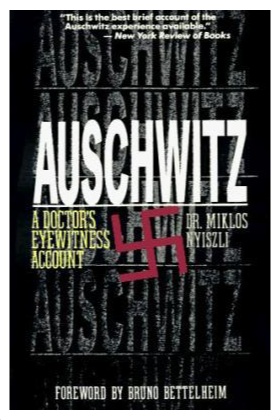
Auschwitz: a Doctor's Eyewitness Account

 
    Many of the readings this semester have stuck with me, but none as much as the one of Dr. Miklos Nyiszli. Reading books where the stories are non-fiction are a lot easier for me. I am reading actual events that someone describes in their own words, and I can usually picture the events happening in my head as I cannot seem to turn the pages fast enough. The words written by those who experienced the events hold power that no one can take away from them, but only if they choose to write them down. In class, we discussed how difficult it was for survivors of the Holocaust to talk about their experiences after the war. Many never mentioned what they went through or only gave a glimpse of the brutality they suffered as it was too difficult to relive it all again. Those who were brave enough to write down what they went through in detail gave the generations after them a history that they would have otherwise never have been able to gain an indepth understanding of. While we read many short accounts of survivors during class, and I personally have read multiple other stories over the years, Dr. Nyiszli’s words were different in many ways. Reading his account during the course of this class enlightened me to outrageous ideas of a demented doctor Mengele, the innerworkings of concentration camps such as Auschwitz, and the determination that led some to hold on for as long as possible to survive in unspeakable conditions until help arrived.

    Dr. Nyiszli, by pure luck or grim fate, was spared the harsh realities of life in Auschwitz when he volunteered his expertise as a medical pathologist to the “Angel of Death” Dr. Josef Mengele not realizing what was laid in store for him. “Among malefactors and criminals, the most dangerous type is the ‘criminal doctor’ especially when he is armed with powers such as those granted to Dr. Mengele. He sent millions of people to death merely because, according to a racial theory, they were inferior beings and therefore detrimental to mankind.” (Nyiszli, 60) Nyiszli was put to work performing autopsies on twins and dwarfs all so that Mengele could send their findings on to a larger Nazi research institution. Nyiszli’s attention to detail and skills made him a valuable asset to Mengele who in return gave him more freedoms and luxuries than any other Jewish prisoner experienced while at Auschwitz.

    Nyiszli learned the intimate details of the crematoriums and the men that were forced to work inside. He described in detail the liquidation of entire camps and the emotional toll it took on all involved. While he tried to do what he could to help those around him, he knew he also had to be careful to watch his own back as he was not immune to the endgame of all those who entered the gates of Auschwitz. He was able to share medicine, cigarettes, blankets, and more with others to make their short time in Auschwitz a little better. With the help of Mengele, he was able to find his wife and daughter and warn them to transfer to another camp before their entire section was liquidated. He befriended soldiers, guards, and prisoners alike and treated them all with the same respect. The constant fear that his turn was next as he saw comrades come and go kept him vigilant and determined to somehow survive. The Sonderkommando’s life expectancy was short at Auschwitz, and that terror hovered over their heads daily. They experienced a few months of better living conditions, but in the end their fate was the same as everyone else. “Death stalked our every move, in the form of the lethal machine guns manned by our guards. We wanted to live. We wanted to get out of there. But even if most of us failed to make it, even if only one or two escaped, we would still have won out, for there would be someone to tell the world about the dark mysteries of these death factories.” (Nyiszli,130) Outside of Auschwitz other survivors described similar experiences. “After the second mass-murder all of us were certain that the Germans made no difference between one Jew and another... They deceived the Judenrat and the Jewish Police when they promised them that they would stay alive if they helped to carry out the slaughter, and in the end they killed them too.” (Jaffe, 24-25, 70-72) A short reprieve for some that eventually ended in a similar fashion.

    With the end of the war in sight, many German troops were unsure what their orders were. We can read about this from survivor Edi Weinstein: “Several days passed without transports. The workers cleaned the platform, covered it with ashes, and laid fresh branches along the fence. But the stench of charred corpses hung in the air. In the barracks at night we bolstered one another’s morale, trying to construe the changes as an indication that the ordeal was about to end and our release was imminent.” (Weinstein, 51) Feelings of uncertainty and fear were widespread as many were still unsure of what their future was supposed to look like. Nyiszli talks about this same uncertainty when he explained his recollection of events towards the end. “A new life began in the KZ. There were no more violent deaths, but the bloody past had to be hidden. The crematoriums had to be demolished, the pyre ditches filled in, and any witnesses to or participants in the horrors perpetrated here had to disappear.” (Nyiszli, 191) Nyiszli was able to cheat death once again when he escaped the annihilation of every man working the crematoriums at that time. As the Allies drew closer, Mengele had fled, the SS had fled, and the Russian saviors were still too far away, so Nyiszli decided to join the other prisoners and lose himself in the crowd fleeing Auschwitz. “My eyes had followed countless innocent souls to the gas chambers, witnessed the unbelievable spectacle of the funeral pyres. And I myself, carrying out the orders of a demented doctor, had dissected hundreds of bodies, so that a science based on false theories might benefit from the deaths of those millions of victims.” (Nyiszli, 220-221) After eight months, Nyiszli was able to physically walk away from it, but mentally he would never be able to hold a scalpel again.

    While I have read the many great words of Viktor Frankl, Anne Frank, Edith Eger, Corrie Ten Boom, Art Spiegelman, and William Styron, Dr. Miklos Nyiszli took me on a different journey altogether. He was able to take me behind the scenes and into the mind of Dr. Mengele. He was able to describe in frightening detail the innerworkings of the crematoriums at Auschwitz. His attention to detail when it came to the emotional way he described his interactions with his comrades showed his empathy for them and his desire to compasionatly portray even the worst of them. His determination to not give up hope, to try to make it home - not knowing if anyone would be there to greet him - all so that he could be the one to tell the world about the death factory called Auschwitz. While it must have been very hard for Nyiszli to write down his story and relive all those moments of terror and emotional trauma, his words need to be out there as a reminder of what happens when we allow prejudice and hatred to go unchecked.

Sources:

J. Jaffe, Partizanim ("Partisans"), Tel Aviv, 1951.

Miklos Nyiszli, Auschwitz: A Doctor’s Eyewitness Account (New York: Arcade Publishing, 1993).

Edi Weinstein, Quenched Steel. The Story of an Escape From Treblinka, Yad Vashem, Jerusalem 2002.


[Written for HIST 4130 class UVU Fall 2024]
aB . All Right Reserved . 2024

Thursday, May 16, 2024

Cry, The Beloved Country

Cry, The Beloved Country

    
There were 3 themes that stood out to me while reading this beautiful novel. The difference in culture between the European settlers and the native population, the extreme poverty of the natives living in South Africa, and the idea that larger cities would provide more opportunities for the native population.

    This novel was written in the 1940s when apartheid was very prominent and separation of the races was ongoing. The train ride that Kumalo takes to Johannesburg was divided depending on your race. Kumalo had to ride in the carriage that was for non-Europeans and would not have been allowed to travel in any other carriage. Mr. Jarvis on the other hand had many options for travel as he was white, rich, and more privileged. During his son’s trial, Kumalo also described how the courts were segregated with seats for the Europeans on one side and the non-Europeans on the other side. As Kumalo made it to Johannesburg he was surrounded by new things that he was not familiar with. His simple life in Natal was completely different from the one he encountered in the big city. So in order to blend in more he watched what others did, and used the things likewise. Kumalo met up with his brother who he believed to be a humble carpenter but in reality John had grown accustomed to the European way of life in Johannesburg and was then a prominent politician instead. He had left the culture he grew up in behind so that could make his way in the big city. John tells his brother that their customs are different here. Kumalo was very much still a native as he even called his family his tribe when he was reunited with his sister Gertrude. The European settlers in Johannesburg treated the natives differently as well as they discussed separation and laws that didn’t seem to work. There was talk about cutting up South Africa where white could live without black. Our natives today produce criminals and prostitutes and drunkards, not because it is their nature to do so, but because their simple system of order and tradition and convention has been destroyed. The differences between the city and the countryside were very extreme and even Kumalo pointed out that he and his wife lived out their lives in innocence, not knowing what their son was going through in the city.  Kumalo also described the ways a chief was now known in the villages. Who would be chief over this desolation? It was a thing the white man had done, knocked the chiefs down, and put them up again, to hold the pieces together. But the white men had taken most of the pieces away. And some chiefs sat with ignorance and blood-shot eyes, rulers of pitiful kingdoms that had no meaning at all. It seemed that culture was easily lost when one left their native home to make a new life in the city.

    Poverty was another prevalent theme that was discussed many times throughout the book. We started out already by seeing an old priest having to use his savings for a trip to Johannesburg. He had to forgo buying a new suit and a stove for his wife for this trip. The province he lived in year by year had less food in reserves as the fields were eroded and barren and too many cattle trampled the grounds. There was no milk to even feed the children and so many of them died because of this. Why is there no milk in Ndotsheni? It is because the people are poor. When he reached the city he saw the poverty in great detail as he was told that he should not take the bus because the black people were on strike to lower the price of their fare back to something more manageable. Many people walked great distances daily and avoided the bus to make their point known to the government. The government also took most of the profits the mines made and they were staffed with natives who worked hard for a very small paycheck each day. Kumalo’s brother John was very vocal when it came to native rights and made many speeches about the injustice of the pay the natives received for the hard work they provided. He simply asked for their fair share as they did the backbreaking labor each day. It is we that must be kept poor so that others may stay rich. When Kumalo arrived back home where he felt more at peace, Mr. Jarvis hired a man to teach the natives how to farm so that they could grow more food and live a better life. There was no reason why this valley should not be what it was before. But it will not happen quickly, not in a day. If God wills, said Kumalo humbly, before I die. For I have lived my life in destruction.

    The scene of poverty is set really well when Paton described the Shanty Towns in great detail in chapter 9. All roads lead to Johannesburg. If there are any problems in your life, just leave them behind and come to Johannesburg. There were no places to live and more and more people came in every day looking for a bed to sleep in, but it’s Johannesburg. Why did we leave the land of our people? There is not much here, but it is better than here. There is not much food there, but it is shared by all together. If all are poor, it is not so bad to be poor.  There was work in Johannesburg, there was gold found which could make you rich. Even Mr. Jarvis moved to Johannesburg to be closer to his daughter in law and grandkids after his wife died and he was left alone. The native villages housed less and less young people as they all wanted to go to the big city in search of something better.

    While the story was fictional, I could still sense the injustices that ran throughout the entire book. Paton described segregation and apartheid in a very poignant way. Reading how the natives were treated as second class citizens in their own country was heartbreaking but a real part of history. I enjoyed reading this classic and learning more about the way life was for those living in South Africa many years ago.

Bibliography: Paton, Alan, Cry, the Beloved Country. New York, C. Scribner’s Sons. 1948
 

[Written for HIST 3540 class UVU Summer 2023]
aB . All Right Reserved . 2024