Showing posts with label Religion. Show all posts

Friday, December 12, 2025

Mennonite Peace Theology: A Radical Witness

For my major project in my Religion, Violence, and Peacebuilding class, we worked in groups to research a tradition connected to peace theology. My group was assigned Mennonite Peace Theology. Together, we wrote a comprehensive paper and gave a 20-minute presentation to the class summarising our findings. After completing the group work, each of us was asked to write an individual reflection on what we learned. I am sharing my personal reflection to give a glimpse into what stood out to me during this project.

When I began researching Mennonite peace theology for our group project, I expected to find a simple commitment to pacifism. Instead, I discovered a tradition that challenges the very foundations of how we think about power, justice, and faith. Mennonites don't just advocate for peace; they embody it in ways that push against cultural norms and even mainstream Christian ethics. Their approach is not abstract theory; it's a lived practice that demands courage and conviction.

For my part, I explored the historical roots and the literal interpretation of Jesus' teachings that shape this theology. What I learned reframed my understanding of discipleship and raised questions about what it means to follow Christ in a world marked with violence.

Below is the reflection paper I wrote for class, which dives deeper into these ideas:

Working on our group project about Mennonite peace theology gave me a deeper appreciation for how radically this tradition interprets scripture. Before this assignment, I understood pacifism in broad strokes, but I had never explored a faith community that takes Jesus’ teachings on peace and violence so literally.

My role in the project was to provide background and explain how Mennonites ground their theology in the Sermon on the Mount, particularly the call to “love your enemies” and “turn the other cheek.” This was not just theory for them; it was a way of life.

As I researched, I was intrigued by the diversity within Mennonite peace traditions. I learned about models such as Historical Nonresistance, Apolitical Nonresistance, Realist Pacifism, Liberation Pacifism, and Neo-Sectarian Pacifism. Each represents a different way of engaging with the world while holding fast to the principles of nonviolence. What struck me most was that being Mennonite today looks very different than in the 16th century, yet the core commitment remains: to reject violence and embody peace.

One idea that resonated deeply with me came from Donal Dorr: “Walk humbly with thy God.” This phrase captures the spirit of Mennonite theology, a humility that shapes their response to conflict. Historically, some Mennonites practiced nonresistance by withdrawing from society, avoiding political involvement, and refusing military service. While this stance protected their integrity, it often meant doing nothing in the face of injustice. Today, many Mennonites challenge this passive approach. They seek to transform their tradition into one that not only resists violence but actively promotes justice and reconciliation. This shift inspired me because it shows how faith can evolve to meet the needs of a broken world.

Engaging with these ideas raised important questions for me: What does it mean to follow Jesus’ teachings on peace in a violent world? Is pacifism practical, or even possible, when injustice demands action? Mennonite theology suggests that peace is not passive, it is a radical, costly commitment. It requires creativity, courage, and a willingness to suffer for the sake of love. This challenges my own assumptions about conflict. I often think in terms of defense or retaliation, but Mennonite thought invites me to imagine alternatives: dialogue instead of domination, forgiveness instead of revenge.

This project also made me reflect on the role of religion in shaping ethics. I have a complicated relationship with religion, yet I cannot deny its power to inspire hope and resistance to violence. Mennonite communities remind me that faith can be a force for good when it prioritizes compassion over control. Their example raises a profound question: How can we build a world where peace is not just an ideal but a lived reality?

In the end, this assignment was more than an academic exercise, it was a personal challenge. It pushed me to consider what I believe about violence, justice, and forgiveness. It reminded me that peace is not easy, but it is possible when people commit to it with humility and courage. Mennonite theology may seem radical, but perhaps that is exactly what our world needs.

This research left me with a sense of awe and discomfort, the kind that sparks growth. Mennonite peace theology isn't about avoidance of conflict; it's about active engagement through love, justice, and vulnerability. In a society that often equates strength with domination, this tradition insists that true strength looks like humility and reconciliation. It asks hard questions: Can peace exist without coercion? What does radical obedience look like today?

As Donal Dorr reminds us, the call to "walk humbly with thy God" is not a slogan but a summons to transformation. For Mennonites, that means building communities that reflect God's kingdom here and now, a vision that continues to challenge violence and inspire hope.

Sources:

Burkholder, John Richard, and Barbara Nelson Gingerich, eds. Mennonite Peace Theology: A Panorama of Types. Elkhart, IN: Institute of Mennonite Studies, 1991.

Ewert, Lowell, Mary Lou Klassen, and Derek Suderman. “Justice, Mercy, and Faithfulness: Human Rights and Mennonite Faith in the Context of Peacebuilding Practice.” In A Pilgrimage of Justice and Peace: Global Mennonite Perspectives on Peacebuilding and Nonviolence, edited by Fernando Enns, Nina Schroeder-van ’t Schip, and AndrĂ©s Pacheco-Lozano, Wipf & Stock, 2023.

[Written for PHIL 366G class UVU Fall 2025]
aB . All Rights Reserved . 2025

Tuesday, December 9, 2025

Faith, Fear and the Aftermath of 9/11: Religion in a Time of Crisis

The fourth week of November's material took us back to one of the most defining moments of modern history, the September 11 attacks, and explored how religion shaped both the violence and the response. The readings and documentary challenged me to think about the intersection of faith, fear, and ethics in times of crisis.

Andrew Sullivan's essay This is a Religious War argues that 9/11 was not just a political act but a theological one. The attackers framed their violence as a sacred duty, rooted in a radical interpretation of Islam. Sullivan warns that ignoring the religious dimension of terrorism oversimplifies the problem and blinds us to the ideological struggle at its core.

Helen Whitney's documentary Faith and Doubt at Ground Zero gave voice to the spiritual turmoil that followed the attacks. Survivors, first responders, and families wrestled with profound questions: where was God? How could faith survive such evil? Some found solace in prayer; others lost belief entirely. The film reminded me that violence doesn't just destroy lives, it shakes the foundations of meaning.

Khaled Abou El Fadl's essay The Place of Tolerance in Islam counters extremist narratives by reclaiming the Qur'an's emphasis on justice and compassion. He argues that intolerance stems from misreading scripture, not from Islam itself. This perspective is crucial because it shows that religious texts can be interpreted toward peace rather than violence.

Finally, John Esposito's chapter on Jihad clarified that the term means "struggle", not holy war. While extremists distort it to justify terror, many Muslims understand jihad as an inner moral effort. Esposito's work underscored how language and theology can be weaponized, or redeemed.

The key takeaway for me this week is how religion can be both a source of violence and a wellspring of resilience. After 9/11, faith communities faced a choice: retreat into fear or embrace tolerance and dialogue. That choice still matters today.

Sources:

Abou El Fadl, K. (2001, December 23). The place of tolerance in Islam. Boston Review.

Esposito, J. L. (2002). Jihad and the struggle for Islam. In Unholy war: Terror in the name of Islam (pp. 26–70). Oxford University Press.

Sullivan, A. (2001, October 7). This is a religious war. The New York Times Magazine.

Whitney, H. (Director). (2002). Faith and doubt at Ground Zero [Film]. PBS Frontline.

Written for PHIL 366G class UVU Fall 2025]
aB . All Rights Reserved . 2025

Monday, December 8, 2025

Exam Reflections: Ethics, Peace, and the Power of Ideas

The third week of November marked a milestone in my Religion, Violence, and Peacebuilding class. I completed my second exam and earned a perfect score. The exam consisted of four short essay questions, each designed to test how well I've grasped the complex interplay between faith, ethics, and justice. Here's what I learned through answering them.

1. Abraham's Dilemma and Divine Command Ethics

The Akedah, the binding of Isaac, remains one of the most challenging stories in scripture. It forces us to ask: should morality depend on divine command? Robert Adams argues that obedience cannot be blind; divine commands must align with God's loving nature. This tension between faith and ethics is at the heart of Abraham's dilemma and continues to shape debates about moral responsibility in religion.

2. Just War Theory: Traditionalist vs. Revisionist

Matthew Gaudet's account of Just War Theory reveals a deep divide. Traditionalists defend the moral foundations of international law and the legitimacy of state authority, while revisionists challenge these assumptions, emphasizing individual rights and rejecting moral equality among combatants. This debate isn't just theoretical; it shapes how we think about justice in times of war.

3. Negative Peace vs. Positive Peace

Ira Chernus highlights Martin Luther King Jr.'s powerful distinction: negative peace is the absence of conflict, while positive peace is the presence of justice. King's civil rights activism embodies positive peace, using nonviolence not as passive resistance but as a transformative force for equality and dignity.

4. The Doctrine of Discovery and Vitoria's Response

The Doctrine of Discovery justified colonial conquest under the guise of Christian mission. Francisco de Vitoria challenged this, affirming indigenous sovereignty and rejecting religious differences as a cause for war. His ideas laid early foundations for human rights and international law.

This exam reminded me that religion is never just about belief; it shapes ethics, politics, and global history. From Abraham's dilemma to King's vision of justice, these questions push us to wrestle with the moral responsibilities of faith in a fractured world.

Sources:


Adams, R. M. (1999). Finite and infinite goods: A framework for ethics. Oxford University Press. (See chapter “Abraham’s Dilemma”).

Chernus, I. (2011). Religion and nonviolence in American history. In A. R. Murphy (Ed.), The Blackwell companion to religion and violence (pp. 538–567). Wiley-Blackwell.

Gaudet, M. J. (2011). Restoring peace: Toward a conversation between the just war and reconciliation traditions. Journal of the Society of Christian Ethics, 31(2), 37–55.

Vitoria, F. de. (1991). Political writings (A. Pagden & J. Lawrance, Eds.). Cambridge University Press. (Original lectures delivered 1538–1539).

[Written for PHIL 366G class UVU Fall 2025]
aB . All Rights Reserved . 2025

Friday, December 5, 2025

Faith, Prophecy, and Politics: Religion's Role in the Israeli-Palestinian Conflict

The second week of November, our focus shifted to one of the most enduring and complex conflicts in modern history: Israel and Palestine. At first glance, the struggle seems primarily political, a dispute over land, sovereignty, and security. But as our readings and discussions revealed, religion is deeply woven into the fabric of this conflict, shaping identities, fueling passions, and influencing global actors.

Dov Waxman's chapters (Religion and the Israeli-Palestinian Conflict and The Basics) emphasize that while political and territorial issues dominate headlines, religious narratives often intensify the stakes. For many Jews, the land of Israel is not just a homeland, it's a covenantal promise. For many Muslims, Jerusalem is a sacred trust. These beliefs make compromise extraordinarily difficult because they frame the conflict in absolute, transcendent terms.

Heather Gregg's chapter on Zionism explores the battle to define Jewish nationhood and statehood. Zionism began as a political movement, but it drew heavily on religious symbolism and messianic hopes. This fusion of faith and nationalism created a powerful identity marker, one that continues to shape Israeli politics and Palestinian resistance.

Our weekly reading, Yaakov Ariel’s Doomsday in Jerusalem, adds another layer: global religious actors. Ariel shows how Christian messianic groups, especially evangelical premillennialists, view the rebuilding of the Jewish Temple as a sign of Christ’s return. These beliefs translate into political and financial support for Israel, but they also raise security concerns. Attempts to alter the Temple Mount, a site sacred to Jews, Muslims, and Christians, could ignite catastrophic violence. Ariel warns that theology, when tied to political action, can turn Jerusalem into a flashpoint for global conflict.

What I found most illuminating is how this conflict is not just about borders, it’s about competing sacred narratives. Land becomes holy ground, and political decisions carry eternal significance. That makes peacebuilding far more complex than diplomacy alone can handle. It requires addressing the religious visions that animate both sides, and the global actors who amplify them.

Sources:

Ariel, Y. (2000). Doomsday in Jerusalem? Christian messianic groups and the rebuilding of the Temple. Journal of Contemporary Religion, 15(1), 43–58.

Gregg, H. (2016). Zion: The battle to define the Jewish nation and state. In The path to salvation: Religious Zionism and the Israeli-Palestinian conflict (pp. 145–168). Georgetown University Press.

Waxman, D. (2013). Religion and the Israeli-Palestinian conflict. In C. Seiple, D. Hoover, & P. Otis (Eds.), The Routledge handbook of religion and security (pp. 238–248). Routledge.

Waxman, D. (2019). The Israeli-Palestinian conflict: What everyone needs to know (Chapter 1: The Basics). Oxford University Press.

[Written for PHIL 366G class UVU Fall 2025]
aB . All Rights Reserved . 2025

Thursday, December 4, 2025

Is It Really About Religion? Understanding the Conflict in Northern Ireland

The first week of November, we turned our attention to Northern Ireland, a region where religion, politics, and identity collide in ways that defy simple explanations. At first glance, the decades-long conflict between Catholics and Protestants seems like a religious war. However, as our readings and class discussion revealed, the reality is far more complicated.

Patrick Grant's chapter, Northern Ireland, Religion and the Peace Process, explores how religion shaped both division and reconciliation. Churches were not neutral observers; they influenced political identities and, later, played roles in peacebuilding. Yet Grant also shows that faith communities often struggled to rise above entrenched loyalties.

Liam O'Dowd, in Does Religion Still Matter?, pushes us to question whether religion is truly the driving force behind the conflict. He argues that while religious labels matter, they often mask deeper issues, national identity, political power, and economic inequality. In other words, being Catholic or Protestant in Northern Ireland is as much about belonging to a cultural and political camp as it is about theology.

Claire Mitchell's chapter, Religious Ideology and Politics, adds another layer: religion provided language and symbols that reinforced political agendas. For unionists and loyalists, Protestant identity closely aligned with British sovereignty. For nationalists and republicans, Catholic identity intertwined with aspirations for Irish unity. These identities were not purely spiritual; they were social, economic, and historical.

In class, we debated whether the conflict was "really" religious. The consensus? Religion mattered, but not in isolation. It was a marker of identity, a way to draw boundaries between "us" and "them." Behind those boundaries lay struggles over land, governance, and equality. Nationalists versus unionists, republicans versus loyalists, the labels tell a story of competing visions for the future.

What struck me most is how religion can both divide and heal. The same faith traditions that fueled mistrust also inspired peace efforts, from grassroots dialogue to the Good Friday Agreement. This dual role reminds us that religion is never just a private belief system; it's woven into the fabric of society, for better or worse.

Northern Ireland teaches us that conflicts labeled "religious" often hide deeper fractures. Understanding those layers is essential if we hope to build peace that lasts.

Sources:

Grant, P. (2000). Northern Ireland, religion and the peace process. In H. Coward & G. S. Smith (Eds.), Religion and peacebuilding (pp. 245–262). Albany: State University of New York Press.

Mitchell, C. (2006). Religious ideology and politics. In Religion, identity and politics in Northern Ireland: Boundaries of belonging and belief (pp. 123–148).

O’Dowd, L. (2021). Does religion still matter? Comparative lessons from the ethno-national conflict in Northern Ireland. In N. N. Rouhana & N. Shalhoub-Kevorkian (Eds.), When politics are sacralized: Comparative perspectives on religious claims and nationalism (pp. 337–362). Cambridge University Press.

Written for PHIL 366G class UVU Fall 2025]
aB . All Rights Reserved . 2025

Wednesday, December 3, 2025

Beyond Violence: Religion's Role in Nonviolent Movements

The last of October's readings and discussion challenged the way we think about religion and its relationship to peace and justice. Too often, religion is portrayed as a source of conflict, but the truth is far more complex-and hopeful.

Patrick Mason's article, Violent and Nonviolent Religious Militancy, asks us to rethink what "militancy" means. We usually associate the term with extremism and violence, but Mason argues that militancy is simply deep commitment to a cause. That commitment can be expressed through peace as powerfully as through war. The civil rights movement is a prime example: Martin Luther King Jr. was militant in his beliefs, but his weapon was nonviolence. Mason reminds us that ignoring these peaceful forms of militancy distorts the picture of religion's role in society.

Mason also introduces the concept of justpeace-peace that includes justice. It's not enough to stop violence; true peace requires fairness, dignity, and equality. This idea resonates with other readings, like Maria Pilar Aquino's chapter on religious peacebuilding, which emphasises that faith communities must confront harmful traditions and actively work towards reconciliation and justice. Ira Cherus' chapter on nonviolence in American history shows how religious convictions fueled movements like abolition, suffrage, and civil rights, proving that faith can be a force for liberation rather than oppression.

In class, we explored principles of nonviolence through figures like Gandhi, King, and the Dalai Lama, as well as traditions like Buddhism, Quakerism, and Anabaptism. These movements share a belief that peace begins within, through spiritual growth-and extends outward to transform society. King's distinction between negative peace (the absence of tension) and positive peace (the presence of justice) captures this perfectly. Nonviolence isn't passive; it's active resistance to injustice without resorting to harm.

What struck me most this week is how often we overlook the courage it takes to be nonviolent. It's easy to see violence as strength, but history shows that nonviolence requires ever greater resolve. Religious militancy, in Mason's sense, can be a radical commitment to peace-a willingness to suffer without striking back, to love in the face of hate.

If we want a world of justpeace, religious communities must lead the way by challenging violence within their own traditions and embodying the principles they preach. Religion can be a source of division, yes, but it can also be the heartbeat of movements that change the world without firing a shot.

Sources:

Aquino, M. P. (2011). Religious peacebuilding. In A. R. Murphy (Ed.), The Blackwell companion to religion and violence (pp. 568–593). Wiley-Blackwell.

Chernus, I. (2011). Religion and nonviolence in American history. In A. R. Murphy (Ed.), The Blackwell companion to religion and violence (pp. 538–567). Wiley-Blackwell.

Mason, P. Q. (2015). Violent and nonviolent religious militancy. In R. A. Scott & S. M. Kosslyn (Eds.), The Oxford handbook of religion, conflict, and peacebuilding (pp. 212–235). Oxford University Press.

[Written for PHIL 366G class UVU Fall 2025]
aB . All Rights Reserved . 2025

Tuesday, October 28, 2025

History Meets Ethics: Reframing Peacebuilding Through Time

This week in my Religion, Violence, and Peacebuilding class, we explored the complex and often contentious relationship between pacifism and just war theory. What made this week especially compelling was the interdisciplinary approach - philosophy, theology, and history all came into the conversation, challenging us to think not just about what happened in the past, but how we ethically interpret it.

We began with Restoring Peace: Towards a Conversation between Just War and Reconcilitation Traditions by Matthew J. Gaudet and William R. O'Neill. The authors argue that these two traditions, often seen as opposites, can actually inform and enrich each other. Reconciliation, they suggest, is not just what happens after war, but it can be a framework that shapes how we think about conflict itself. This idea laid the groundwork for the rest of the week: what if pacifists and just war theorists aren't enemies, but uneasy allies in the pursuit of peace?

Later in the week, we welcomed a guest lecturer, a history professor at UVU who specializes in peacebuilding. His presence shifted the tone of the class from theoretical to historical. He challenged us to consider how historians often focus on events and outcomes, but neglect the ethical questions that underlie them. Why did people choose violence? What alternatives were available? What moral frameworks shaped their decisions?

To prepare for this class period, we read several historical documents: Benjamin Franklin's Plain Truth (1747), John Smith's Doctrine of Christianity (1748), and Jessica Choppin Roney's Ready to Act in Defiance of Government. These texts centered around the 1747 Militia Crisis in colonial America, a moment when civic duty, religious conviction, and political unrest collided. We also read Pacifist Claptrap, a Washington Post article published shortly after 9/11, which criticized pacifism as naive and dangerous. The juxtaposition of these texts, spanning centuries, highlighted how debates about violence and peace are never just academic. They are deeply personal, political, and moral.

For our weekly assignment, we read Reconciling Pacifist and Just War Theorists by James Sterba. Sterba argues that pacifism and just war theory can be reconciled when interpreted in their most morally defensible forms. He critiques rigid versions of pacifism, nonviolent and nonlethal, and proposes anti-war pacifism, which opposes participation in the massive use of lethal force, especially when nonviolent alternatives are underutilized.

Sterba's most compelling contribution is his defense of the moral distinction between intended and foreseen harm. Using Counterfactual and Nonexplanation Tests, he argues that collateral damage (foreseen harm) is morally less severe than intentional harm. This distinction, he claims, is crucial for evaluating wartime actions. While he acknowledges exceptions to the prohibition on intentional harm, he maintains that a strong presumption against it is morally preferable.

Ultimately, Sterba concludes that anti-war pacifists and just war theorists can agree on many cases of justified defense, especially when proportionality and restraint are emphasized. The reconciliation lies in refining both views to prioritize minimizing harm and respecting human dignity, even in extreme circumstances.

Reflecting on this week, I am struck by how much richer our understanding of peace becomes when we allow disciplines to speak to one another. Philosophy gives us the tools to evaluate moral claims. History gives us the context to understand how those claims were lived out. Theology offers a vision of human dignity that can guide both. 

Our guest lecturer reminded us that peacebuilding isn't just about preventing war; it is about asking better questions. What does justice look like before violence erupts? How do we honor the humanity of our enemies? And how can we learn from the past without repeating its ethical blind spots?

This week didn't offer easy answers. But it did offer a framework for thinking more deeply, and more compassionately, about the choices we make in the face of conflict.

Sources:

Franklin, B. (1747, November 17). Plain truth: Or, serious considerations on the present state of the city of Philadelphia, and province of Pennsylvania. Printed by Benjamin Franklin. 

Gaudet, M. J., & O’Neill, W. R. (2011). Restoring peace: Toward a conversation between the just war and reconciliation traditions. Journal of the Society of Christian Ethics, 31(1), 37–55.

Kelly, Michael. (2001, September). Pacifist claptrap. The Washington Post.

Roney, J. C. (2010). “Ready to act in defiance of Government”: Colonial Philadelphia voluntary culture and the Defense Association of 1747–1748. Early American Studies: An Interdisciplinary Journal, 8(2), 358–385.

Smith, J. (1748). The doctrine of Christianity as held by the people called Quakers, vindicated: In answer to Gilbert Tennent’s sermon on the lawfulness of war. Printed by Benjamin Franklin and David Hall. 

Sterba, J. P. (1992). Reconciling pacifists and just war theorists. Social Theory and Practice, 18(1), 21–38.


[Written for PHIL 366G class UVU Fall 2025]
aB . All Rights Reserved . 2025


Friday, October 24, 2025

Faith, Violence, and the Ethics of War: Reflections from Fall Break Readings

Even during Fall Break week, the readings for PHIL 366R offered a powerful lens into the intersection of religion and violence. From personal memoirs to theological treatises, each piece challenged me to think more deeply about how faith traditions grapple with conflict, justice, and moral responsibility.

We read To Hearken or Not by Brian Birch (my professor for the class). This essay examines the tension between obedience and moral authority within religious traditions. Birch's work made me think about how religious followers navigate commands that may conflict with personal or societal ethics. It's especially relevant in contexts where violence is justified by appeals to divine authority.

I have read Under the Banner of Heaven by Jon Krakauer in its entirety multiple times. We were asked to read the prologue for this week as Krakauer introduces the story of religiously motivated violence within fundamentalist Mormonism. The prologue sets a chilling tone, showing how sincere belief can be twisted into justification for horrific acts. It raises questions about the boundaries of religious freedom and the role of institutions in curbing extremism.

We also read an article titled Radical Mormon Jihad by Eric Peterson which was published in the Salt Lake City Weekly on July 30, 2014. It features an interview with Dan Lafferty, one of the brothers convicted in the 1984 murders of Brenda Lafferty and her infant daughter Erica. In the article, Dan Lafferty shares his apocalyptic beliefs, including a prophecy about escaping prison and calling down fire from heaven, likening his future actions to those of the biblical prophet Elijah. This piece offers a chilling look into religious extremism and how fringe theological interpretations can fuel violent ideologies. It's a powerful complement to Krakauer's Under the Banner of Heaven, which explores the Lafferty case from a broader investigative and narrative perspective.

Eric Peterson and Jon Krakauer approach the same disturbing subject - religiously motivated violence - through different lenses. Peterson's article is a journalistic profile, grounded in direct interview and observation. He presents Dan Lafferty in his own words, allowing readers to confront the raw extremism of Lafferty's beliefs without much editorial framing. Peterson is able to access Lafferty's mindet at the time of the murders, his current beliefs now, and his life in prison. Peterson's piece feels like a warning - an unfiltered glimpse into the persistence of radical ideology decades after the crime. It's stark, factual, and disturbing in its restraints. Krakauer's book is written as a narrative nonfiction book. He blends investigative journalism with literary storytelling. He contexualizes the Lafferty murders within broader questions about Mormon history, revelation, and religious violence. Krakauer discusses deep historical and theological topics, and shows an emotional and psychological insight into the perpetrators. His literary style draws the reader into the story. Krakauer's work is also more interpretive, inviting readers to consider how religious belief can evolve into fanaticism. His storytelling makes the horror feel personal and systemic. Reading both pieces side by side is like seeing two sides of the same coin. Peterson shows us the present-day reality of a man still consumed by his beliefs, while Krakauer traces the roots of those beliefs and their consequences. Together, they raise urgent questions: How do we recognize and respond to religious extremism? What responsibility do religious communities bear in preventing violence? Can faith be both a source of peace and a catalyst for destruction?

Next, we read a chapter by James Turner Johnson titled The Idea of Just War in Christian Thought. This chapter outlines the historical development of Just War theory in Christian theology. Johnson's overview helped me understand how Christian thinkers have tried to reconcile the teachings of Jesus with the realities of political conflict. It's a sobering reminder that even peace-oriented religions have developed frameworks for war.

Thomas Aquinas provides criteria for when war can be considered morally just, and so we read his words. Aquinas's clarity and structure are striking. His criteria still influence modern debates about military intervention. Yet I wonder how his ideas hold up in today's world of asymmetric warfare and non-state actors.

These readings collectively highlight the tension between faith and violence. Whether through personal testimony or theological argument, they ask us to consider how religious traditions can both justify and resist violence. As I continue this course, I'm left asking: Can religion truly be a force for peace in a world so often torn by its name?

Sources: 

Aquinas, T. (2011). Whether it is always sinful to wage war? In M. Juergensmeyer & M. Kitts (Eds.), Princeton readings in religion and violence (pp. 41–44). Princeton University Press.

Birch, B. D. (2016, October). To Hearken or Not: Divine Commands & Ethical Dissonance. Paper presented at the Conference on Peacemaking: Ethical Perspectives in and Around Mormonism, Utah Valley University.

Johnson, J. T. (2009). The idea of just war in Christian thought. In R. D. Bainton (Ed.), The Cambridge companion to religion and war (pp. 207–227). Cambridge University Press.

Krakauer, J. (2004). Under the banner of heaven: A story of violent faith. Anchor Books.

Peterson, E. S. (2014, July 30). Radical Mormon jihad. Salt Lake City Weekly. https://www.cityweekly.net/utah/radical-mormon-jihad/Content?oid=2477964

[Written for PHIL 366G class UVU Fall 2025]
aB . All Right Reserved . 2025

Friday, October 17, 2025

Four Questions, Four Essays: A Test of Thought in Religion and Violence

I had my first test in my Religion, Violence, and Peacebuilding class, and it wasn’t about memorizing facts — it was about thinking deeply. We were given four short essay questions, each asking us to engage with complex ideas from the readings and discussions so far. Each response was around 200 to 300 words, and together they formed a kind of intellectual checkpoint: What have I learned? What do I still wrestle with?

The first question: According to Philip Jenkins, how has the conquest of Canaan narrative shaped Christian and Jewish approaches to divinely sanctioned violence? (Answer in 200-250 words) Philip Jenkins’ work helped me see how scripture has been used to justify violence—and how those justifications evolve across history and context. Below is my short reply of 221 words:

Philip Jenkins argues that the biblical conquest of Canaan – especially in the Book of Joshua – has profoundly shaped Jewish and Christian views of divinely sanctioned violence. The narrative, in which God commands the Israelites to destroy entire populations, has historically been used to justify violence under the banner of divine will. From the crusades to colonial expansion, this story has served as a theological framework for portraying conquest and extermination as righteous acts. Yet Jenkins highlights the discomfort this narrative provokes, prompting many interpretations to spiritualize or allegorize the violence. It’s continued presence in liturgy and scripture forces religious communities to grapple with the moral implications of sacred texts. This story illustrates how scripture can inspire faith while also legitimizing violence. Figures like R.A. Torrey, founder of American Fundamentalism, interpreted the slaughter of the Canaanites as a necessary act: “The Canaanites had become a moral cancer threatening the very life of the whole human race… Cutting out a cancer is a delicate operation, but often it is the kindest thing a surgeon can do… The kindest thing that God could do… was to cut out every root and fiber of these grossly wicked people.” Jenkins’s analysis challenges us to consider how religious communities interpret difficult texts and whether sacred violence can ever be reconciled with modern ethical commitments.

The second: Why was the execution of Michael Servetus a key event in the development of debates over religious toleration? (Answer in 200-250 words) I explored how his death exposed the limits of Reformation-era freedom and sparked debates that still echo today. Below is my short reply of 240 words:

The execution of Michael Servetus in 1553 was a pivotal moment in the history of religious toleration, exposing the limits of reform-era pluralism. Condemned for heresy by both Catholic and Protestant authorities, Servetus was ultimately burned at the stake in Geneva under John Calvin’s leadership. His death revealed that even within emerging Protestant movements, dissenting theological views were not tolerated. The brutality of his execution sparked widespread debate, especially among thinkers like Sebastian Castellio, who famously wrote, “To kill a man is not to defend a doctrine, but to kill a man.” Castellio’s writings laid early groundwork for the idea that religious disagreement should not be met with violence, arguing that coercion in matters of faith contradicted the teachings of Christ. In contrast, John Calvin defended Servetus’s execution, stating, “Is it reasonable that heretics should murder and poison souls with their false doctrines, and the sword ordained by God be prevented from touching their bodies, and the whole body of Christ be lacerated so that stench of one rotten member should be untouched?” Calvin’s view reflected a broader belief that heresy endangered not just theology but the moral fabric of society. Servetus’s fate became a symbol of the dangers of dogmatism and the urgent need for freedom of conscience. His death catalyzed broader discussions about the moral and political necessity of religious tolerance, challenging future generations to reconcile faith with human rights and ethical pluralism.

The third: What are the key areas of agreement and disagreement between free will theism and process theism on the question of the problem of evil? (Answer in 200-250 words) I found this one especially interesting—two theological frameworks, both trying to reconcile suffering with divine power, yet diverging on how much control God actually has. Below is my short reply of 200 words:

Free will theism and process theism both reject the notion that God unilaterally determines all events, emphasizing that genuine human freedom is essential to understanding the existence of evil. Both perspectives affirm that God does not will evil and that suffering often arises from the misuse of creaturely freedom. However, they diverge significantly in their understanding of divine power. Free will theists maintain that God is omnipotent but voluntarily limits divine control to preserve human freedom. In contrast, process theists argue that God is inherently limited in power and cannot unilaterally prevent evil or override natural processes.

This distinction has profound implications for how each tradition approaches divine responsibility, prayer, and hope for justice. Free will theists believe God could intervene but often chooses not to, while process theists assert that God simply cannot intervene in certain ways. The tension between divine power and the presence of evil is captured in Epicurus’s enduring question: “Is God willing to prevent evil, but not able? Then he is not omnipotent. Is he able, but not willing? Then he is malevolent. Is he both able and willing? Then whence cometh evil? Is he neither able nor willing? Then why call him God?”

The final question: How does Cavanaugh understand the religious/secular distinction? How did it come about? (Answer in 250-300 words) His critique of the modern myth of secular neutrality challenged me to rethink how power and violence are framed in supposedly “non-religious” contexts. Below is my short reply of 300 words:

William Cavanaugh argues that the distinction between religious and secular is not a natural or timeless division, but a modern invention rooted in the rise of the nation-state. In his view, this binary was constructed during the early modern period to delegitimize certain forms of belief and consolidate state power. By labeling some forms of violence as religious and others as secular, emerging states could portray themselves as rational, neutral, and peacekeeping, while casting religious actors as irrational and prone to conflict. Cavanaugh challenges the idea that religion is uniquely violent, pointing out that secular ideologies – like nationalism or liberalism – have also fueled massive violence, such as in world wars. He argues that what counts as religion is often defined in contrast to what the state wants to claim as its own domain. This framing allows the state to monopolize legitimate violence while marginalizing alternative sources of moral authority. As Cavanaugh asks, “what becomes of the dividing line between the secular and religious—upon which the whole argument depends—if the secular is a form of religion?” The religious/secular divide, then, is not descriptive but political – it serves to justify certain power structures. Cavanaugh’s critique is central to debates in religion and violence because it questions the assumptions behind how we assign blame and authority. It also invites us to rethink how peacebuilding might look if we move beyond those constructed categories. “The common notion that religion is peculiarly prone to violence depends on the idea that these secular matters have less of a tendency to promote violence; it is commonly assumed that this is so because they have to do with purely mundane affairs. Religion on the other hand, is seen as peculiarly incendiary because it raises the stakes to another level, where reason is trumped by passion.”

Scoring 100% felt great, but more than that, it affirmed that I’m engaging with these ideas in a meaningful way. As an atheist, I’m not here to defend doctrine—I’m here to understand how belief shapes action, especially when it comes to violence and peace. This test reminded me that asking hard questions is just as important as answering them.

Sources: 

Cavanaugh, W. T. (2009). The myth of religious violence: Secular ideology and the roots of modern conflict. Oxford University Press.

Gregory, B. S. (2022). The radical reformation. In P. Marshall (Ed.), The Oxford history of the Reformation (pp. 144–190). Oxford University Press.

Hasker, W. (2000). The problem of evil in process theism and classical free will theism. Process Studies, 29(2), 194–208.

Jenkins, P. (2011). Laying down the sword: Why we can't ignore the Bible's violent verses. HarperOne.

[Written for PHIL 366R class UVU Fall 2025]
aB . All Rights Reserved . 2025

Tuesday, October 14, 2025

"Would God Really Ask That?" Wrestling with Divine Commands and Moral Intuition

    This week’s Religious Studies class left me unsettled—in a good way. We revisited the story of Abraham and Isaac in Genesis 22, a passage I’ve heard countless times but never sat with so uncomfortably. The image of a father raising a knife over his son at God’s command is haunting. It’s not just a test of faith—it’s a test of moral boundaries. And it raises a question I can’t shake: What kind of God would ask this?

    Our readings pushed that discomfort further. Robert Adams’ article Abraham’s Dilemma and David Baggett’s chapter titled “Abhorrent Commands,” both confront the tension between Divine Command Theory and moral intuition. Baggett doesn’t shy away from the hardest questions—like whether a good God could command genocide or child sacrifice. He argues that while scripture must be taken seriously, not every command attributed to God reflects His true nature. A perfectly good God, Baggett insists, would never issue a truly abhorrent command. His version of Divine Command Theory is principled, not blind.

    For the weekly assignment, I was asked to summarize David Baggett's key point in 250-300 words. Below is my reply:

Chapter 7, titled Abhorrent Commands, explores one of the most challenging objections to Divine Command Theory: the possibility that God could command something morally abhorrent, such as genocide, as found in the book of Joshua or child sacrifice. David Baggett engages with troubling biblical passages like the Binding of Isaac as found in Genesis 22 and the Conquest Narratives found in the Old Testament, which seem to depict God commanding actions that conflict with our deepest moral intuition. Rather than dismissing these texts as non-literal or irrelevant, Baggett argues that they must be taken seriously and interpreted within a broader theological and moral framework. He acknowledges that some divine commands, if taken at face value, appear incompatible with the nature of a perfectly good God. However, he maintains that God’s commands are not arbitrary; they are grounded in His inherently good nature, which places moral limits on what God could command. Baggett encourages readers to draw a principled line between difficult biblical passages that challenge our understanding but may be reconcilable, and truly abhorrent scenarios that a good God could never endorse. This approach allows for a nuanced version of Divine Command Theory – one that respects both scriptural authority and moral intuition. Ultimately, Baggett’s goal is to show that belief in a good God does not require abandoning moral reasoning, but rather invites deeper reflection on how divine commands and moral truths can coexist.

    I don't believe in a divine being, but I do believe in the power of moral reasoning. What these readings and discussions have shown me is that even within religious frameworks, there's room for critical thought and ethical boundaries. The idea that some commands - even if attributed to God - should be questioned is not just a theological concern, but a human one. Whether we view these texts as sacred or historical, they reflect the ongoing struggle to reconcile authority with conscience. And that struggle, I think, is worth engaging with - regardless of belief.

Sources: 

Adams, R. M. (2003). Abraham’s dilemma. In Finite and infinite goods: A framework for ethics (pp. 277-291). Oxford University Press.

Baggett, D., & Walls, J. L. (2011). Abhorrent commands. In Good God: The theistic foundations of morality (pp. 125–142). Oxford University Press.

[Written for PHIL 366R class UVU Fall 2025]
aB . All Rights Reserved . 2025

Friday, September 26, 2025

Chaos, Creation, and the Limits of Divine Power

Week 4 in my Religious Studies class felt different as the campus was slowly reopening after last week's tragic event. With no class on Monday, we only had one class day on Wednesday to get all of the readings in. I read The Problem of Evil in Process Theism and Classical Free Will Theism by William Hasker and chapter two of The Providence of God by Paul Helm. At the end of the week, I was then asked to read Creation out of Nothing by David Griffin. After reading Griffin, I was asked to first concisely summarize his key points in 200-250 words, and then I was asked how Griffin would respond to William Hasker's central arguments in 250-300 words. Here is my submission for the assignment:

    David Ray Griffin argues that the traditional Christian doctrine of creatio ex nihilo and divine omnipotence make the problem of evil something we cannot solve. He proposes a different theodicy called process theism, that is rooted in the creation out of chaos. Process theism reimagines the nature of God – not as a source of evil, but as a loving and active presence striving to bring about good. Instead of creation out of nothing, God organized the world from pre-existing chaotic matter, which had its own tendencies and freedom. This way evil can exist without making God morally responsible for it. Griffin rejects God as omnipotent in the classical sense and calls his power persuasive, not coercive. He mentions that reality consists of autonomous agents (including humans and other entities) that God influences but cannot control. When it comes to evil, Griffin insists that evil is real and tragic, not illusory or necessary for a greater good. “Genuine” evil are events categorized as things that would be better if they had not occurred. Griffin’s view on divine power is also different as he sees God as perfect in love and wisdom but not all-powerful. He believes that evil arises from the freedom and unpredictability of the world, not from the divine will.

    David Griffin’s views stand in contrast to those of William Hasker, particularly in how each theologian understands divine power and the origin of evil. Griffin identifies as a process theologian and so he rejects the idea of God as omnipotent in the classical sense. He believes that if God had the power to prevent evil but chose not to, then God must not be good. He also believes that the traditional view of free will allows God to intervene which He chooses not to, which Griffin sees as morally problematic. Griffin supports creation out of chaos instead of creation out of nothing. If God created everything from nothing, then God is still responsible for creating beings capable of evil. Creation out of chaos avoids this by stating that freedom and unpredictability are built-in from the start. Hasker argues that natural evils are part of God’s necessary plan, but Griffin sees this as a troubling limitation on divine power. In open theism God created the world from nothing and could have designed it differently and so God is ultimately responsible for the evil that stems from it. In process theism God is part of the process of reality and constantly working to bring about good, but he cannot unilaterally prevent evil. The difference here makes it that God is not morally responsible for evil in the same way that open theism’s God might be.


References:

Griffin, D. R. (2006). Creation out of nothing: A biblical, philosophical, and scientific exploration. Westminster John Knox Press.

Hasker, W. (2000). The problem of evil in process theism and classical free will theism. Process Studies, 29(2), 194–208.

Helm, P. (1994). The providence of God. IVP Academic.


[Written for PHIL 366R class UVU Fall 2025]
aB . All Rights Reserved . 2025

Thursday, September 25, 2025

From Classroom to Crisis: The Unthinkable After the Lecture

In week 3 of my Religious Studies class, we read chapter 1 of Divided by Faith by Benjamin J. Kaplan and chapter 2 of Jihad and the Struggle for Islam by John Esposito. After class on Wednesday, September 10, our University was shut down and classes were cancelled as tragedy struck and a life was taken too soon. 

The fact that we had been talking about religious intolerance and violence just 25 minutes earlier was surreal and heartbreaking to me. There was no assignment for this week, and no other readings were assigned until the middle of next week to give faculty, staff, and students time to grieve and process what happened on our campus, where safety had now been shattered.

References:

Esposito, J. L. (1996). Jihad and the struggle for Islam. In The religion factor. Westminster John Knox Press.

Kaplan, B. J. (2007). Divided by faith: Religious conflict and the practice of toleration in early modern Europe. Belknap Press of Harvard University Press.

[Written for PHIL 366R class UVU Fall 2025]
aB . All Rights Reserved . 2025

Wednesday, September 24, 2025

No Swords, No Oaths: The Radical Reformation's Peaceful Protest

With Labor Day falling on one of our class days, week 2 of my Religious Studies class was significantly shorter. We were only assigned to read chapter 9 out of Fields of Blood by Karen Armstrong, and then for the weekly assignment, I read the Schleitheim Confession of 1527, and The Radical Reformation by Brad S. Gregory, which is chapter 4 in the Oxford History of the Reformation. I was then posed three different questions to answer in 500-600 words. Here are the questions:

What was the Radical Reformation? What makes this group distinct in relation to broader Reformation movements? Why is the Schleitheim Confession important in understanding core themes in our class?

Here is my assignment submission that answers those three questions:

    The Reformation started in the early 16th century when key figures like Martin Luther, John Calvin, and Huldrych Zwingli challenged practices within the Catholic Church that they believed needed reform. While many traditions remained, their critiques led to the formation of new denominations such as Lutheranism and Calvinism, which emphasized that salvation comes through faith in Christ alone and that the Bible is the sole source of religious truth.

    However, other reformers diverged from this mainstream movement to push for even deeper changes. These leaders sought to create a completely new, purified church based solely on New Testament teachings, rejecting any involvement with the state. Thomas Muntzer, Menno Simons, and other Anabaptist leaders rejected infant baptism in favor of adult baptism, believing faith must be a personal and conscious decision. Their beliefs were considered radical and heretical by both Catholics and mainstream Protestants.

    One of the most important documents outlining Anabaptist beliefs is the Schleitheim Confession (1527), written during a time of persecution and theological confusion. It clarified their core principles so others could understand their distinct approach to Christianity.

1. They believe that only adults need to be baptized, and only those who choose it.
2. Members of their church who sin need to be corrected with love. If they don’t change then they should be excluded from the community only after repeated warnings.
3. Only those who are part of the community (baptized adults) should have communion as it is a symbol of unity and commitment to Christ.
4. Good Christians should live differently than the rest of society. They should avoid things that go against God’s teachings, including corrupt politics and false religion.
5. Pastors are chosen by the church and should live a simple life. Their role is to teach, guide, and care for the church. It is not to seek power or wealth.
6. Christians should not use violence or serve in the military. Christians believe in peace and following Jesus’ example of love and forgiveness.
7. Christians should not swear any oaths. They should always speak truthfully, so oaths are never necessary.

    Anabaptists were considered radical because they went far beyond the reforms proposed by Luther and Calvin. They challenged long-standing religious traditions, especially baptism, and redefined them. Unlike Lutherans and Calvinists, Anabaptists believed the church should be entirely separate from political power. They refused to swear oaths of allegiance or serve in government roles, which meant they received no political support.

    In a time when religion and warfare were deeply intertwined, most Anabaptists were strict pacifists, refusing to bear arms, participate in war, or use violence – even in self-defense. Their commitment to peace and voluntary faith made them targets of persecution from both Catholic and Protestant authorities.

    The Reformation had unintended consequences that led to deep divisions. While Martin Luther aimed to correct major problems within the Catholic Church, he did not intend for religion to lose its public role. However, once people began interpreting the Bible for themselves, disagreements multiplied. Many Protestant groups claimed to have the “correct interpretation,” leading to religious conflict and political instability.

    As religion and violence increasingly affected society, the need for tolerance became clear. People could not be forced to believe the same way. To stop the fighting, freedom of religion became essential. Over time, this led to the idea that religion should be less central to public life, paving the way for secularization.


References:

Armstrong, K. (2014). The arrival of religion. In Fields of blood: Religion and the history of violence. Alfred A. Knopf.

Gregory, B. S. (2022). The radical reformation. In P. Marshall (Ed.), The Oxford history of the Reformation (pp. 144–190). Oxford University Press.

Sattler, M. (1527). The Schleitheim Confession. Swiss Brethren Conference. (Original work translated by J. C. Wenger, 1945)


[Written for PHIL 366R class UVU Fall 2025]
aB . All Rights Reserved . 2025

Tuesday, September 23, 2025

Love Thy Neighbor... or Smite Them?

I am taking a Religious Studies class this semester titled Religion, Violence, and Peacebuilding. In week 1, we began by reading the introduction to Laying Down the Sword by Philip Jenkins and a section in the Cambridge Companion to Religion and War titled Christian Crusading, Ritual, and Liturgy by M. Cecilia Gaposchkin. Then our assignment for the week was to read the introduction to The Sacred Fury by Charles Selengut and concisely summarize the key points in that particular work in 300-350 words. Here is my submission for that assignment:

    Charles Selengut explains that religion is meant to promote compassion, forgiveness, peace, love, and especially non-violence. Many scriptural passages condemn violence, yet the same texts also contain accounts of violent confrontations, divine commands for holy war, and other troubling acts. These contradictions create tension for believers navigating faith and morality.

    Selengut references Emile Durkheim, noting that religious commitment is often rooted in sacred truths believed to be divinely ordained. Followers may feel obligated to obey—even when commands seem irrational—because they trust in the source. Religion also promises rewards in the afterlife for obedience and discourages questioning.

    Religious institutions aim to provide social order, structure, and meaning, offering explanations for suffering and hope for redemption. However, leaders can exploit this structure to justify violence. Defining religious violence is complex; it includes not only physical harm but also psychological and symbolic injury. Selengut broadens the definition to include actions—verbal, written, or physical—that cause or threaten harm.

    The book explores five perspectives on religious violence. First, it examines how scriptures justify violence through divine command, as seen in the Crusades, Jihad, and the story of Joshua. Second, it looks at how violence can fulfill emotional or social needs, creating unity or moral justification. Third, it considers violence as a strategic response by groups who feel threatened or erased, using it to defend identity and mobilize support. The fourth perspective addresses apocalyptic violence, where perpetrators believe they are participating in a final battle between good and evil, seeking purification or salvation. The fifth explores sexual violence, focusing on the power religious institutions hold over members.

    Selengut concludes by urging readers not to stereotype religions as inherently violent or peaceful. He warns against simplistic generalizations, such as Islam being a warrior religion or Christianity being peaceful. All religions contain elements of both peace and violence. To understand religious violence, we must remain open-minded, informed, and neutral.

References:

Gaposchkin, M. C. (2023). Christian crusading, ritual, and liturgy. In M. Kitts (Ed.), The Cambridge Companion to Religion and War (pp. 385–401). Cambridge University Press.

Jenkins, P. (2011). Laying down the sword: Why we can't ignore the Bible's violent verses. HarperOne.

Selengut, C. (2008). Sacred fury: Understanding religious violence (2nd ed.). Rowman & Littlefield.


[Written for PHIL 366R class UVU Fall 2025]
aB . All Rights Reserved . 2025

Friday, April 4, 2025

Sociology Class Reading Response Two

      Most of the readings for this module are from Eddie Glaude, except one from John Dewey. They all flow together nicely and work as Eddie Glaude brings John Dewey and other scholars into his writings. The first article, “Towards a New Individualism” by John Dewey, focused on the changes we have seen in America from old individualism to a new individualism. He focused on a remaking of society that has been the driving power of America and the enthusiasm of a new generation. Dewey’s answer to the success of those thriving was education, and that the government should focus more on helping individuals attain education so they could help sustain and build up their communities. “In a Shade of Blue,” by Eddie Glaude, focused on the silence of race in the United States. He gives the example of Toni Morrison’s novel Beloved, where tragedy and evil are understood to be a part of the mortal exigencies of life. The reality of life and race have shaped this country in such a way that we would rather erase the past than confront it, thus making books like those written by Toni Morrison all the more powerful and important for future generations. We also read two chapters in “An Uncommon Faith,” also written by Eddie Glaude. In chapter 1, he talks about Pragmatism and African American Religion in general. He explains that a pragmatist will look for concrete facts, action, and power, but when it comes to religion, a pragmatist will usually question dogma as it is not evidence-based. He brings Dewey into his writings here as well as James Baldwin, Cornel West, and W.E.B. Du Bois, as they all have different views on pragmatism and African American religion. In chapter 3, Glaude talks about meliorism, piety, double consciousness, and Chastened Pragmatic Religious Naturalism, which fascinated me.

    The last two concepts above were presented originally by W.E.B. Du Bois, and Glaude believes that Du Bois provides a great point of view that is similar between John Dewey and James Baldwin and is thus worth talking about. I really liked both of them and think they can still be seen today in a lot of ways. Double consciousness is an internal conflict concept talked about by Du Bois in 1903. African Americans were rejected by American life, yet they had a strong desire to be included in it. This created huge psychological struggles in a culture that was dominated by oppression, humiliation, racism, and conversion to a white man's religion. Du Bois was aware of the divide between his world and the world around him and that it could be saved depending on the choices, actions, and efforts of individuals (meliorism). “The natural world is diseased, distorted, deformed, and not naturally but by human actions toward black people”. Du Bois knew that the black man had always been controlled by others and that his destiny and identity had never been his own. “The world we inhabit can be saved, the hell black folks catch can be undone if we only act (without guarantee of satisfactory outcomes).” I think this entire concept can be tied back to the first article by John Dewey, “Towards a New Individualism,” as he believes that education can be a strong indicator of control and power in your community for change. We need to make sure every generation, no matter your race or status, is educated on the past, including the tragedies and evils of slavery that existed in America, as this will create a more informed, empathetic, and cultured future society for all.

Sources:

Dewey, J (1930). Individualism Old and New. Minton, Balch & Company.

Glaude, E. S., Jr. (2018). An Uncommon faith: A pragmatic approach to the study of African American religion. University of Georgia Press.

Glaude, E. S., Jr. (2007). In a Shade of blue: Pragmatism and the Politics of Black America. University of Chicago Press.


[Written for SOC 4100 class UVU Spring 2025]
aB . All Rights Reserved . 2025


Tuesday, February 11, 2025

The Impacts of Religious Uniformity and Intolerance on Social Cohesion

    While religious uniformity can create a sense of belonging for some, it can also lead to intolerance for those who are not part of your faith and community. Understanding the social dynamics that form alongside uniformity and intolerance can help unite or divide people. Education is one of our greatest tools and should be used to educate ourselves and others. By studying the impacts of religious uniformity and intolerance, we can hopefully see early warning signs that can prevent violence and instead promote peace, inclusivity, and diversity. Religious intolerance often intersects with other forms of racism, and so studying those can help us understand them better and help promote a more equitable society for all. Creating a tolerant community fosters mutual respect, especially in times of crisis. Making the communities we inhabit more resilient, welcoming, and inclusive for all, will create more understanding neighbors that everyone can benefit from. Religious uniformity and intolerance can influence various aspects of society including politics, education, and social values. Fostering environments of religious tolerance can enhance mutual respect and understanding, strengthening the social fabric, and contributing to a more stable and peaceful society.

    I decided to study the three different theories of Emile Durkheim, Karl Marx, and Max Weber and their varying views on religion. I also created a survey to gather data to go along with my research as that is one of the easiest ways to get quantitative data fast. I made it anonymous as I knew religion can be an emotional subject, especially here in Utah. I hoped to get some great honest answers about people's feelings and opinions on religion with it being anonymous. I ended up with 44 participants which gave me some great data to work with.


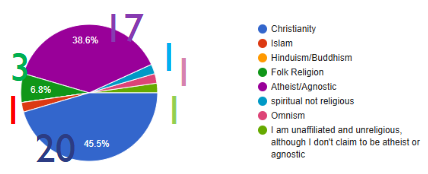
    Out of the 44 participants, 26 were born/raised in Utah, 18 were born/raised outside of Utah. I wanted to know if the participants were still in the same religion they were raised in, and 17 of the 44 answered yes, while 27 of the 44 answered no. I also asked for their current religious affiliation, and 20 answered they identified as Christian while the rest were divided as such; 17 identified as atheist/agnostic, 3 belonging to a folk religion, 1 Islam, 1 spiritual but not religious, 1 omnism, and 1 unafilliated but not agnostic. I thought it was important to understand the religious/nonreligious makeup of my participants so that I could understand the data that I was to receive from them. Emile Durkheim described religion as a vital institution that contributes to the stability and cohesion of society and so I knew I had to include him and Functionalism in my research. Karl Marx said that religion was created to distract people from the harsh realities of everyday life and so a study of religion would not be complete without his views and Conflict Theory. Max Weber suggested that individuals make rational choices about whether to practice religion based on social support and spiritual fulfillment, and so adding Rational Choice Theory was a good third option.

    To start with Emile Durkheim and Functionalism, I found a paper written by Professor A.R. Radcliffe-Brown. In his paper on religion and society, he mentions that “any religion is an important or even essential part of the social machinery, as are mortality and law, part of the complex system by which human beings are enabled to live together in an orderly arrangement of social relations. From this point of view, we deal not with the origins but with the social functions of religion, i.e., the contributions that they make to the formation and maintenance of a social order.” (Radcliffe-Brown, p.33) The key points of Functionalism when it comes to religion are social cohesion, moral framework, socialization, and that religion can provide answers or purpose in life. There are always drawbacks as religion can lead to discrimination, violence, or alienation as well.

    In my anonymous survey, I asked if religious uniformity and intolerance can marginalize and target groups from the broader society by creating division and conflict. 42 out of the 44 participants answered yes to that question. I then asked if they thought violence was caused by religious uniformity and intolerance. The answer this time was not as clear cut, but still in the same direction. Out of the 44 participants, when it came to violence and religious uniformity, 2 said yes, 23 said some of the time, 5 said most of the time, and 4 said no. For religious violence and intolerance, 22 said yes, 8 said some of the time, 14 said most of the time, and none said no. During my research I came across many different ways religious violence can play out. Some forms of religious violence are warfare, cyberattacks, witch-hunts, property damage, terrorism, mob violence, armed conflict, surveillance, forced conversations, human sacrifice, initiation rites, government force, and harassment just to name a few.

    Karl Marx saw a correlation between alienation and religion. In his book, Seven Theories of Religion, Daniel Pals said “We must notice a striking parallel between religious and socioeconomic activity. Both are marked by alienation. Religion takes qualities - moral values - out of our natural human life, and gives them, unnaturally to an imaginary and alien being we call God.” (Pals, pg.140) Some of the key concepts of Karl Marx’s conflict theory when it comes to religion are false hope and comfort, religion is used as a tool for control, it legitimizes social inequality, and it can exacerbate tensions. But Marx also saw that religious movements could be a source for change.

    Rational Choice Theory was the hardest of the three to research. Professor L.R. Iannaccone said “Most critics condemn rational choice for embracing too much or too little; too much, in that it assumes lighting powers of calculation, full information, and total self-control; too little, in that it fails to take account of preference formation, normative constraints, emotional impulses, social structures, and the like. Hence, it is said that more realistic models of human behavior must do more to acknowledge limitations of the human mind and the complexity of human culture.” (Innaccone, pg.85) Religion is very personal and emotional matter and cannot be measured in many ways. The choices people make are mainly based on costs and benefits, but emotions play a huge part as well, and that is something so personal and individual that it is tough to measure as Professor Iannaccone described in his findings above. Some of the key points of Rational Choice theory when it comes to religion are benefits, big business, social networks, costs, competition, and connections.

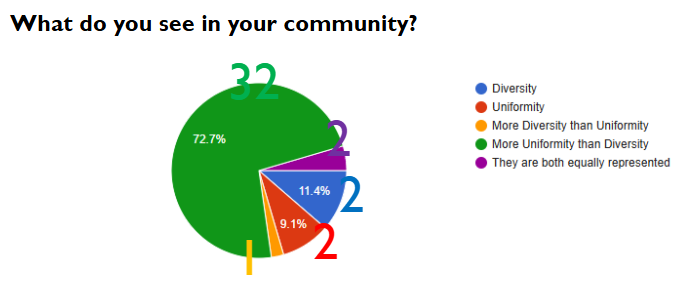
    One of the questions I was most curious about in my survey was if my participants beliefs were respected by others around them. Out of the 44 participants, 9 said yes, 19 said most of the time, 14 said some of the time, and 2 said no. When I asked them if they respected other’s beliefs, 34 said yes, 9 said most of the time, and 1 said some of the time. I wanted to know if tolerance or diversity was more important and out of the 44 participants 33 said that diversity was important while 11 said it was not. When I asked the same question about tolerance, 37 said tolerance was important while only 7 said it was not. Since all of my participants did live in Utah at the time they took my survey, I wanted to see what they thought of the community they currently lived in. I wanted to know if they thought their community was diverse and/or tolerant. I asked them what they currently saw in their community around them. Out of the 44 participants, 32 said they saw more uniformity than diversity, 2 said they saw only uniformity, 2 said they saw only diversity, 1 said they saw more diversity than uniformity, and 2 said they were equally represented.


    Utah is an interesting state when it comes to religion as there has always been a majority religion present. I found a Pew Research Study done in 2007 and then again in 2014 in Utah. Adults were asked questions about religion. 80% of adults in Utah had an absolutely certain belief in God in 2007, then in 2014 that number had dropped drastically to 61%. Another question from the Pew Research Study said that 66% of adults in Utah said that religion was very important in their lives in 2007 but by 2014 that number had dropped to 58%. In my survey, 27 out of the 44 participants mentioned that they were no longer in the same religion that they were born/raised in. Maybe it is nothing, or maybe it is individuals seeing uniformity and intolerance in religion as something they no longer want to be associated with as it is doing more harm than good to their neighbors and the community they live in.


Definitions used in my survey:
  • Uniformity: Creating an environment of sameness, silencing dissenting thoughts, opinions and beliefs.
  • Diversity: All religions are equally valid and should be tolerated and respected.
  • Intolerance: The inability to respect other people’s religious beliefs, practices, or identities.
  • Tolerance: The acceptance and understanding of different religions and their practices, and the promotion of peaceful coexistence among them. 

Sources:

Engels, Friedrich. “Speech at the Graveside of Karl Marx,” in Karl Marx and Friedrich Engels: Selected Works, tr. and ed. Marx-Engels-Lenin Institute, 2 vols. (Moscow 1951), 2:153. 

https://www.pewresearch.org/religion/2024/03/15/8-in-10-americans-say-religion-is-losing-influ ence-in-public-life/

http://www.pewresearch.org/religious-landscape-study/database/state/utah/

Iannacconne,L. R. (1995). Voodoo Economics? Reviewing the Rational Choice Approach to Religion. Journal for the Scientific Study of Religion, 34(1), 76-88. http://doi.org/10.2307/1386524

Pals, D. L. (1996). Seven Theories of Religion. Oxford Universities Press. P.140 

Radcliffe-Brown, A. R. (1945). Religion and Society. The Journal of the Royal Anthropological Institute of Great Britain and Ireland, 75(½), 33-43. http://doi.org/10.2307/2844278

Stark, R. and Finke, R. (2001). Acts of Faith: Explaining the Human Side of Religion. University of California Press. p.37

Weber, M. (1949). The Methodology of the Social Sciences. New York Free Press. p.117

[Paper written for SOC 4000 research project UVU Fall 2024]
aB . All Right Reserved . 2025

Wednesday, December 25, 2024

Latter-Day Saint Authority: Theologians and Critical Thinkers Need Not Apply.

    Inside the Latter-day Saint faith there is little room for critical thinking, individualism, or external validation. From a young age you are taught to follow the Prophet, obey your parents, study the scriptures, to learn line upon line, and to trust in God’s plan that you signed up for before you came to earth. There is no need for you to philosophize or dive deep into the unknowns as you are given your knowledge by God through a living prophet that tells you he will do the hard work for you instead. All you have to do is to just follow him, believe in him, and have faith that he is the only one with the authority to do so. In this paper I will show how authority within the LDS Church keeps its members from developing into philosophers and theologians by teaching them that theology and critical thinking will make believers more worldly and distant from the divine guidance of their religious leaders for spiritual direction.

Authority Keeps Theology on the Outside

    Theology is described in many different ways by many different authors. David Ford defines it as, “at its broadest as thinking about questions raised by and about the religions” (Ford,3) Louis Midgley describes it as, “to seek understanding of God’s reality, to describe divine things rationally, and to elaborate the present meaning of past manifestations of God, whether theoretically, practically, descriptively, or critically.” (Midgley,1475) James Faulconer on the other hand takes a different approach and calls theology prophetic revelation in his paper titled “Rethinking Theology” as he describes it as, “the continuously revealed word of God.” (Faulconer, 175-199) Latter-day Saints believe that their current Prophet continues to receive revelation from God and that this was restored to the Prophet Joseph Smith in 1829. Each prophet since Smith has been able to receive revelation from God which has been passed down to their current Prophet today. Since continuing revelation is a key part of the LDS religion, dogmatic theology really has no place inside the tradition as it can always be replaced by new revelation. Faulconer warns Latter-day Saints that, “theologizing by those who are not prophets may put the kingdom at a distance by making talk about the gospel merely talk about our own learning.” (Faulconer, 175-199)

    This opinion of Faulconer is not a new one inside the Latter-day Saint faith, it is actually one expressed often by those in authority. Keeping members disciplined and blindly following the words of their prophets and leaders, members gather to listen to their prophet and other leaders of the church twice yearly as they deliver sermons over a two day period. This event is televised all over the world to reach as many members as possible. The Prophet, and the other 14 highest ranking officers in the church also identified as prophets, will captivate the audience and each member will listen intently to each of the words that they think are written just for them. They hope revelation will come and that divine words will be spoken that they can hold onto for another six months until the next conference. They are fully aware that their current prophet can reveal new things, even if it means contradicting a prophet from the past.

    Current Latter-day prophets have not made any major revelations like the Prophet Joseph Smith did in his day. We can easily count the number of official revelations that have been added to the open canon of the LDS Church since then. Gordon B. Hickley, a Latter-day Saint prophet, gave the following quote in an interview in 1997. “Now we don’t need a lot of continuing revelation. We have a great, basic reservoir of revelation. But if a problem arises, as it does occasionally, a vexatious thing with which we have to deal, we go to the Lord in prayer.” (Hinckley) Since not a lot of new revelation has been revealed, each statement made by prophets old and new have been dissected over the years by church members. With an impressive collection of conference talks on many different topics given by many different prophets past and present, members can study their words and can easily go down rabbit holes that lead to misinformation as canon has changed over the years with no set doctrine or theology in place. In an effort to keep things current and members on the right track, the current prophet has what Robert Millet calls “prophetic prerogative” (Millet, 2009) in his paper titled “Defining Doctrine”. Millet describes this as the ability to edit sermons of the past, giving prophets divine editorship to weed out the doctrine that is no longer taught, and giving sticking power to doctrine that has, “endured the test of time, that continued to be taught by Church leaders in later generations, would generally bear the mark of truth.” (Millet, 2009)

    Some examples of this would include the Adam-God doctrine that was taught during Brigham Young's time and had to be edited out of the conversation as it was false and led to many problems as members believed it long past the time it was talked about. Nathan Oman mentions Bishop Bunker of Bunkerville Nevada in his paper titled “Truth, Doctrine, and Authority”. (Oman, 2009) This bishop was excommunicated in the 1880s for teaching the doctrine of the Adam-God theory to his congregation after the rest of the Church stopped teaching it. Because of open canon, revelation was received around 30 years later by the First Presidency and they issued a Doctrinal Exposition titled “The Father and the Son” (Improvement Era, 934-942) which replaced the Adam-God theory altogether with this new official revealed doctrine. Since revelation replaced the outdated Adam-God theory, even if it once was doctrine, it now no longer had a place in that same realm.

    Another example of doctrine that has been rewritten is the idea that people with black skin were less worthy, fence sitters in heaven, and not part of the “chosen lineage”. This was another idea that caught on during the early days of the Church and was very hard to write out of the narrative. The topic of Black people not being part of the LDS faith for a long time is a part of history most leaders would rather forget than remember. Joseph Smith let Elijah Abel, a young Black convert, join the early church in 1830, as well as Jane Manning James who joined in Illinois some years later. These two Black Latter-day Saints were not the only ones who joined the growing church as Joseph Smith and others welcomed them with open arms. Elijah Abel was given the priesthood by Joseph Smith as he himself did not see a problem with Black people having that authority. Years after the death of Joseph Smith, Latter-day Saints began to theorize about the hierarchy of lineages. With the belief that God had restored his one true Church back on the earth again through Joseph Smith also came the belief that they, Latter-day Saints, were from the chosen line that would be gathered with the gathering of Israel in the last days. Joseph Smith had taught them about life before they came to earth, a premortal life, where they were righteous, noble, and followed God’s plan for them. “To the Prophet Joseph Smith it was revealed that we are all literal spirit sons and daughters of heavenly parents. He received a revelation of information once made known to Moses. Intelligences were organized before the world was, and among these were many great and noble ones, such as Abraham and Moses. God stood in their midst, saw that they were good, and chose them for responsibilities on earth and throughout eternity.” (Brown, 1124) With this knowledge they started to see themselves, and the color of their skin, more righteous, and part of this royal blood line that God talked about in the premortal life. Brigham Young officially instituted a policy restricting Black men from holding the priesthood as opinions differed on chosen lineage and who was eligible and worthy. With this new ban in place came a lot of speculations over the years as to why Black men could not hold the priesthood. Many church leaders would share their words and opinions over the pulpit and members would take these words as doctrine and a lot of misinformation was spread this way. All of what was said by past prophets and leaders has now been rewritten to make the past history seem more like personal opinion and not prophetic infallibility. In 1978 a new revelation was given to Spencer W. Kimball, the Prophet at that time, that lifted the ban preventing Black men from holding the priesthood inside the Latter-day Saints faith.

    Joseph Smith himself declared that, “a Prophet is not always a Prophet, only when he is acting as such.” (Smith) This declaration from the original founder of the Church shows that even back then there was confusion of what was supposed to be revelation and what was opinion. Since Smith has uttered those words, other church leaders have made similar statements regarding prophetic infallibility. D. Todd Christofferson declared that, “Not every statement made by a church leader, past or present, necessarily constitutes doctrine. A single statement made by a single leader on a single occasion often represents a personal, though well-considered, opinion, but is not meant to be officially binding for the whole church.” (Christofferson, 86-90) Since the LDS Church does not have an official canon, and continuing revelation can change the wording on the canon that is currently in place, Armand Mauss, a renowned sociologist of religion who studied the LDS faith in depth, presented a “Scale of Authenticity” by which we can gauge what can be seen as official doctrine at any given time. Brian Birch explains this scale in detail in his paper titled “Beyond the Canon: Authoritative Discourse in Comparative Perspective.” (Birch)

Mauss’ Scale of Authenticity

    Canon doctrine is what is currently being taught as revelation within the Church and as such is the most important doctrine. The scriptures, this includes the Book of Mormon, the Bible, the Doctrine of Covenants, and the Pearl of Great Price, are also considered part of the most important doctrine taught within the Latter-day Saints tradition. Official doctrine would include statements from the Prophet, the First Presidency, official Church publications, and curriculum currently being taught within the Church. Since the Church has open canon the next prophet can change any of the official doctrine at will when he comes to power making this level of doctrine hold less authority on the scale. Finally there are two more categories which include authoritative doctrine and popular doctrine. Authoritative doctrine is all the literature and talks given by Church authorities and educators over the years. In 1983, a disclaimer had to be added to all books published by the Church stating that, “the views expressed in this book do not represent the official position of the Church of Jesus Christ of Latter-day Saints.” (1983 Letter) With so many books published by so many different Church leaders putting their own opinion into their work, the Church could no longer control what was being put out there for members to read. In the past prophets had to rewrite and edit doctrine that was no longer taught inside the faith with new revelation, or it had to be written out of the narrative all together. Now with this disclaimer, the Church could just say this was the personal opinion of the author and not official Church doctrine and there would be a lot less rewriting and editing later on when doctrine would change. Popular Doctrine includes all the literature containing folk theology and doctrine that circulated among the membership that was never officially adopted by the Church. This would include the racist theological beliefs that Black individuals were from the cursed line of Cain, the Adam-God theory, the three Nephites from the Book of Mormon that still wander the earth today, the opinion that God will restore the Adamic language before the second coming, the King Follett Discourse, and more. With almost 200 years of revelation and doctrinal changes that is a lot to keep track of to know which particular policy or doctrine is accurate and currently being used and which one is outdated or has been replaced. The changes alone from Joseph Smith's time to today when it comes to the Word of Wisdom, Polygamy, and the Temple ceremony are significant to name just a few. There are many other changes that are less noticeable that I want to point out just to show you how they fly under the radar. Many Church leaders gave talks on the topic of divorce such as David O. McKay, Spencer W. Kimball, and John A. Widtsoe. Their words were given during General Conference and while they were speaking as Prophets and Apostles. Back in the 60s and 70s their words on divorce were harsh and not very eloquent. For example David O. McKay wrote, “When one puts business or pleasure above his home, he that moment starts on the downgrade to soul-weakness. When the club becomes more attractive to any man than his home, it is time for him to confess in bitter shame that he has failed to measure up to the supreme opportunity of his life and flunked the final test of true manhood. No other success can compensate for failure in the home.” (McKay, 5) If you were to look up the official Church stance on divorce today all of these past Prophets and Apostles words are replaced by much more neutral wording, talks given by more recent prophets, and scripture references. Another example of this is when we look up homosexuality. J. Reuben Clark, Joseph Fielding Smith, Harold B. Lee, Boyd K. Packer, and N. Eldon Tanner, to name a few, wrote very strong words about homosexuality in the 60s and 70s. Church leaders perceived homosexuals as depressed, unhappy, sinful, and in need of repentance. (Brough,157) In 2006 the official position of the Church changed and the word homosexuality was removed and substituted by same-gender attraction. “The Church does not have a position on the causes of … susceptibility or inclinations … related to same-gender attraction. Those are scientific questions - whether nature or nurture - those are things the Church doesn’t have a position on.” (Bergera, 418) The previous statements written by the Prophets and Apostles in the 60s and 70s are no longer up on the Church website, they have been edited out of the narrative.

Follow the Prophet

    In 1980, Ezra Taft Benson, gave a talk to the membership of the church titled, “Fourteen Fundamentals in Following the Prophet.” (Benson, 1980) He would become the next Prophet five years later. Over the years the focus on listening to authority would increase even more. The very first point he mentions is that the Prophet is the only man that can speak for God in everything. He is making sure that all members stay aware of this fact as this is a very important matter within the Church as the Prophet is the man that can change doctrine and has as we have seen. The second point is that the Prophet is more vital than the scriptures. A living prophet today can rewrite and edit what was written all those years ago if God comes to him and gives him a revelation to change it. Number three on his list was that a living prophet was more important than a dead prophet. Again here the Prophet today can rewrite history if God wants him to and as we have seen by some of my examples above, a lot of prophets seem to do so in a sense. His fourth point quickly after that tells us that the Prophet can never lead his people astray. His fifth point is that a prophet is not required to have any sort of earthly training to be a prophet as God will be his mentor. He warns that there will be those out there who may feel that they may be more qualified on certain topics than the current prophet and this may be why members are not encouraged to become philosophers and theologians because they would be able to understand more than the current prophet when it comes to religion or philosophy. Number six on the list is that the Prophet does not have to say “Thus saith the Lord” for his words to become scripture. He goes on to say that some people may argue with the Prophet if they don’t agree with some of the things he is asking the members to do. This leads into number seven which is that the Prophet tells us what we need to know, not always what we want to know. He quotes Harold B. Lee here, another former prophet, “You may not like what comes from the authority of the Church. It may conflict with your political views. It may contradict your social views. It may interfere with some of your social life… Your safety and ours depends on whether or not we follow… Let’s keep our eye on the President of the Church.” A man with authority telling its members that if they don’t listen and follow everything their prophet tells them they could be in danger and put their fellow neighbors, members, and family members in danger as well is a great tactic to keep members in line and keep them from thinking for themselves. Number eight on his list is that the Prophet is not limited by man’s reasoning. Here again you are told to put your entire trust in God and the Prophet even if you might not understand why at times. Number nine and ten go together as nine is that the Prophet can receive revelation on temporal and spiritual matters and ten is that the Prophet may give advice on civic matters. I think this is an interesting idea as I personally believe in separation of Church and State and don’t believe that those two should ever mix. The Church has a lot of power and I have seen LDS authority use that power to make sure the Equal Rights Amendment was not passed in Utah in 1975. They again used that authority within the Church to rile up members to vote against proposition 8 in California in 2008 as they did not want same-sex marriage to become legal there. Number 11 on the list reads that the two groups who have the most difficulty following the Prophet are the proud who are learned and the proud who are rich. Again this is a reference to if you think you know more than the Prophet you are not in harmony with the teachings of the gospel. Number twelve reads that the Prophet will not necessarily be popular with the world or be worldly. Number thirteen just states that the Prophet and his counselors make up the First Presidency, the highest quorum in the Church. And finally number fourteen states that if you follow the Prophet and the First Presidency you will be blessed and if you reject them you will suffer. After hearing all that, who would not want to obey and follow the Prophet's words because you are told the alternative means suffering.

Theology Can Be Beneficial

    “Active Mormons are surrounded by church teachings and ideals at every turn: the time commitments required of a faithful Saint make the religious social sphere the primary sphere in his or her life, creating an arguably insular LDS culture wherein children and converts are gradually and completely oriented to social norms and regulations. At church meetings, LDS doctrine is continually taught and reinforced beginning at 18 months of age (through simplified “nursery” lessons) and continuing through adulthood, using Church-published manuals to organize lessons around pre-approved doctrine or themes. Moreover, through ubiquitous use of media such as Church-sanctioned magazines, books, pamphlets, and videos, the Church gains a pervasive presence in the lives of active members, constantly reaffirming the doctrine and standard of the Church in all areas of life.” (Avance, 12) Since philosophy, theology, and critical thinking are not part of the curriculum within the Latter-day Saint church, it always amazes me when I meet new people who discover Plato and Aristotle for the first time and are in awe. Philosophy is all about being curious about the world and asking the right questions and then trying to answer them. The most complex philosophical questions never seem to change over the years as we never seem to be able to answer them. Theology is the same in a sense where we are trying to understand God, human beings, and how it all fits together. The fact that Latter-day Saints “don’t do” theology is something they should look into as there are many conflicting issues within the faith that could benefit from some critical studies involving more than revelation. Stephen Davis wrote a paper titled “Philosophical Theology for Mormons: Some Suggestions from an Outsider.” One of the points he brings up is logical consistency. He points out that not all the doctrine within the Church is consistent with each other. There are conflicting principles and statements here and there which can make sense when you can change your doctrine at will and you have been doing this for almost 200 years. Davis points out that the Church has two ways in which it changes doctrine, officially and unofficially. When revelation is received, it can officially make a change and the new doctrine takes over for the old doctrine. Unofficially, when Church leaders decide to stop teaching something that is believed by most members, they don’t make an announcement, they just stop. I pointed this out above with my examples on divorce and homosexuality. There were never any announcements made that the views of the Church changed on those topics, you would only know this if you were to search for it. Another part of this that Davis points out is that church leaders should distinguish between normative doctrine and traditional, but not permitted doctrine. As I pointed out earlier again, Mauss has a scale for this which we can look at which would put the traditional doctrine all the way at the bottom with the folk beliefs and hopefully members will know the difference between the doctrine currently taught and doctrine that is just talk.

    Davis gives us three reasons why he thinks Latter-day Saints don’t like theology. The first is that they don’t want to concern themselves with academic problems and would rather deal with down-to-earth problems. Number two is that the scriptures are more important than dealing with theology. Third, revelation and open canon, would make theology useless as it would just override anything theology could come up with. Latter-day Saints have always been taught to study from the best books and get an education, so I don’t understand why academic problems would be a concern. In my personal opinion I believe Church leaders don’t want their members to think critically, develop theories of their own and study the deep questions that philosophers have been studying for years. But this is exactly what they should be studying because this kind of thinking would, “help Latter-day Saints understand their own religion, help settle internal disputes as to what church doctrine is and what is not, and enter into informed dialogue with non-Mormons and assist Mormon scholars whenever necessary to defend Mormonism from criticism” (Davis, 2007) according to Davis.

    James Faulconer points out in his paper titled “Performative Theology: Not Such a New Thing” that studying the scriptures inside the Latter-day Saints church, understanding the history behind them, and reflecting on them in a scholarly way, can be a form of theology. (Faulconer, 1-24) Many members read the same scriptures multiple times in their lifetime hoping to gain new insight each time they read the same passages. Benjamin Huff compares Latter-day Saint learning to Theology in a one-room schoolhouse. (Huff, 2004) Every member continues to learn throughout their life, line upon line, precept upon precept with the goal that in the end they are all unified in one faith. Each Sunday, members gather together to study the scriptures and discuss doctrine with other members who may not have their same level of knowledge. Huff calls the scriptures messy and polyphonic (layered) in his paper, and advocates for studying the scriptures together with those of all levels of knowledge to gain a better understanding than you would studying alone. This could be considered a form of philosophizing with others as you dive deeper into the meaning behind what you are reading and thus bring the scriptures into theology.

    When it comes to Davis’ third point about the LDS Church having revelation and open canon and thus not being able to have theology, he addresses that by stating that this should not be a barrier but that it should just be treated how doctrine is being treated inside the LDS Church today. When things change, the current theological statements can be indexed with the old doctrine or they can be revised alongside with the changes that were made.

Theologians and Critical Thinkers Need Not Apply

    Latter-day Saint members should be able to weigh their prophet's words and personally filter out the components they believe they want to follow in their lives. They should be able to use their own critical thinking to study their scriptures, doctrine, and other components of their religion. They should be able to raise intellectual questions about their faith and their leaders without fear of discipline. A culture wherein philosophy and intellectually stimulating conversations can be had would be beneficial as discipline, group thinking, and blind obedience only keeps members from reaching their true potential in life. Past theologians such as John Calvin, Martin Luther, Thomas Aquinas, and many theologians today are worth studying as they can enlighten us in so many ways.


Sources:


Avance, R. (2010). Worthy “Gods” and “Goddesses.” Journal of Religion & Society, 12.

Benson, Ezra T. (1980) Fourteen Fundamentals in Following the Prophet. Brigham Young University address

Bergera, G. J. (2007). Statements of the LDS first presidency: A topical compendium. Signature Books. Page 418 sexual relations

Birch, Brian D. Beyond the Canon: Authoritative Discourse in Comparative Perspective (could not locate anymore information online for citation)

Brough, R. Clayton (1980) His Servants Speak: Statements by Latter-day Saint Leaders on Contemporary Topics, chapter 32 homosexuality, page 157

Brown, Gayle O. (1992) Premortal Life. Encyclopedia of Mormonism V.3 Macmillan, page 1124.

Christofferson, D. Todd. (2012) “The Doctrine of Christ,” Ensign, May, 2012, 86-90.

“Compass Interview with Prophet Gordon B. Hinckley,” Compass, November 9, 1997, transcript at http://www.abc.net.au/compass/intervs.hinckley.htm.

Faulconer, J. E. (2020). Performative theology: Not such a new thing. Dialogue: A Journal of Mormon Thought, 53(3), 1–24.

Faulconer, J. E. (2007). Rethinking theology: The shadow of the apocalypse. The FARMS Review, 19 (2007)(1), 175–199.

Ford, David (2003) Theology: A Very Short Introduction (Oxford: Oxford University Press, 2000), 3.

Huff, Benjamin. (2004) Theology in the One-Room Schoolhouse. Society for Mormon Philosophy and Theology Conference 2004.

Joseph Smith Collection, Box 1, Folder 5 Church History Library

Letter to General Authorities, March 22, 1983, LDS Church History Library.

McKay, David, O. (1964) President of the Church, CR, April, 1964, pp 5

Midgley, Louis. C. (1992) Theology. Encyclopedia of Mormonism V.4 Macmillan, page 1475.

Millet, Robert L. (2009) Defining Doctrine: A Response to Loyd Ericson. Element Vol. 5 Issue 1 (Spring, 2009)

Oman, Nathan B. (2009) Truth, Doctrine, and Authority. Element Vol. 5 Issue 1 (Spring, 2009)

Stephen, T. Davis, (2007) Philosophical Theology for Mormons: Some Suggestions from an outsider. Element Vol 3. Issues 1 & 2 (Spring & Fall 2007)

The Father and the Son. (1916) Improvement Era, 934-42

[Written for PHIL 490R class UVU Summer 2024]
aB . All Rights Reserved . 2024