European anti-Semitism goes back many generations and is rooted mainly, but not only, in religious beliefs. The idea that Jews are responsible for the death of Jesus is a notion that has survived thousands of years, as well as the idea that Jews are shrewd moneylenders, which also stems from that same period. Nazi anti-Semitism, however, is composed of completely different beliefs about Jews and has nothing to do with religion, but everything to do with blood. The hatred, persecution, and ultimate extermination of Jews stemmed from the fact that they saw themselves as the more superior race. They answered the Jewish question by proposing to eliminate them completely through state-sponsored policies, laws, and violence fueled by eugenics.
In 1903, the Pan-German League tried to invigorate German citizens to unite and keep the awareness of themselves as “Germans” at the forefront. They wanted to make sure their ethnicity was preserved and that the next generation was being educated correctly about who they were. (Kruck, 10) Many Germans were swept up with this idea, Adolf Hitler being one of them. He gave a speech in September 1921, where he argued that Jews could not change because their qualities were inherited, and so the solution would be to separate the Jew from the rest of society to prevent corruption so that the Aryan race could be kept vibrant and healthy. “And in this characteristic, which he cannot transcend, which lies in his blood… -in this characteristic itself lies the necessity for the Jew that he must present himself as destructive to the state.” (Griech-Polelle, 67-8) Hitler was very passionate about excluding anyone from the community who could potentially disrupt the purity and health of the perfect German race, all before he was even in a high position of power.
Once Hitler assumed power he had to be careful not to alienate the German people by enforcing his agenda too fast. The Nazi party created a 25-point party program back in 1920, where they declared their intentions to segregate the Jews from the Aryan nation. (Nazi Conspiracy and Aggression, Volume IV, Document No. 1708-PS) They never tried to hide this and were vocal and public with their intentions for years. During Hitler's rise to power, they were finally able to implement many of the points of their plan, using him as their vehicle every step of the way. Hitler had to work in such a way that the German people would also come to understand his point of view when it came to the Jewish question in slow, subtle, yet powerful ways. The meticulous and carefully planned propaganda against the Jews started by including communists and socialists in the same category thus making them all seem part of a bigger problem. On April 7, 1933, the “Law for the Restoration of the Professional Civil Service” was proclaimed, announcing that you could no longer work in civil service unless you were of Aryan descent. This was the very first anti-Semitic law of Hitler’s regime and the start of a laundry list of policies and laws aimed at Jews to ruin them financially with the hopes that they would give up and leave Germany voluntarily. (Griech-Polelle, 79)
The idea that German blood and being of Aryan descent is what makes you superior was of great importance to Hitler and many others within Nazi leadership. After implementing policies and laws limiting Jews in many capacities, the Nazi party finally saw the need to define what it truly meant to be a German citizen. On September 15, 1935, the German parliament, now made up entirely of Nazi representatives, passed two new laws known as the Nuremberg Laws. “The Reich Citizenship Law” is the first of those two new laws and it defined a citizen as someone of German or kindred blood. If you were a citizen, you would be able to enjoy full political rights such as the right to vote. If you were Jewish, you were no longer considered a citizen, according to this new law, even if you came from a mixed Jewish family. This new law was a huge step backward for Jews in Germany, as they were now no longer considered citizens in a nation that many had lived in for generations. Article 2.1 of the new law states that a Reich citizen: “proves by his conduct that he is willing and fit to faithfully serve the German people and Reich.” (USHMM) Many Jews fought bravely for their country in World War I and considered themselves maybe even more German than Jewish. Now they were tossed aside like garbage because their blood on the inside mattered more than what they had contributed to their country in the past.
The second law created was the “Law for the Protection of German Blood and German Honor.” The first paragraph of that law reads: “Moved by the understanding that purity of German blood is the essential condition for the continued existence of the German people, and inspired by the inflexible determination to ensure the existence of the German nation for all time, the Reichstag has unanimously adopted the following law.” (USHMM) This law banned marriage between Jews and non-Jewish German citizens. It even criminalized a relationship between them and labeled it as race defilement. If you tried to skirt the law by getting married outside of the country, there was an addition that stated that your marriage would be invalid when you returned and that the government had the authority to annul it. Violation of this law resulted in prison time which could even include hard labor. The matter of race was taken very seriously in the eyes of the Nazi party, and the idea of defiling pure, healthy, German blood had caused them to take extreme measures such as the Nuremberg Laws.
Between 1933 and 1939 more than four hundred different regulations, policies, and laws were implemented that affected Jews in all aspects of their lives. These included the laws I already mentioned above, as well as many others, ranging from ever-changing restrictions for Jewish students at Universities to Jewish officers being expelled from the army, and so much more.
The never-ending list of anti-Semitic policies and laws were not created because of anti-religious beliefs against Jewish people. They were simply a way for the Nazi party to keep pressure on a group that already felt like they were drowning and there was nobody there to pull them to safety. With each new law restricting them even further some only saw suicide as the way out, and some paid the enormous tax and left with only the clothes on their backs, many thought this possibly could not last forever and things would eventually go back to normal again, but most could never predict that it would get much worse. The Nazi party would never see the Jewish people as citizens, and if they did not leave voluntarily after six long years of tightening restrictions and making life unbearable for them, the Nazis would have to come up with another plan, because they couldn’t have them stay and defile their superior race of strong and pure German blood. The final solution would have to involve something more sinister as expulsion was not working.
Sources:
Beth A. Griech-Polelle, Anti-Semitism and the Holocaust: Language, Rhetoric and the Traditions of Hatred (London: Bloomsbury Academic, 2023)
Alfred Kruck, Die Geschichte des Alldeutschen Verbandes 1890-1939 [The History of the Pan-German League 1890-1939] (Wiesbaden: Steiner, 1954)
Nazi Conspiracy and Aggression, Volume IV, Document No. 1708-PS, Translation of Document 1708-PS, edited by Dr. Robert Ley (Munich: Central Publishing House of the N.S.D.A.P., Franz Eher, successor).
United States holocaust memorial museum, https://encyclopedia.ushmm.org/content/en/article/nuremberg-laws.
[Written for HIST 4130 class UVU Fall 2024]
aB . All Rights Reserved . 2024

Showing posts with label Holocaust. Show all posts
Showing posts with label Holocaust. Show all posts
Monday, December 23, 2024
Tuesday, December 17, 2024
From Segregation to Extermination: The Role of Ghettos in the Holocaust
With the newly acquired Lebensraum in Poland, Heinrich Himmler, Minister of the Interior, was put in charge of bringing ethnic Germans from all over the world to live in the new German Reich territories. The plan was to have 4 to 5 million Germans settle where the Poles and Jews were currently living. (Griech-Polelle, 167) This was a huge problem with conflicting ideas on how to make this happen. Joseph Goebbels, the Minister of Propaganda, was successful in making sure the people in the Old German Reich were fully onboard with the deportations that were going to happen. Over the last few weeks, I have read many different opinions that have pointed to either a functionalist or an intentionalist view when it comes to Hitler and his persecution of the Jews. I want to take a closer look at why the Jewish people were put into ghettos by comparing and contrasting those two different points of view as they both have valid arguments and explanations. At the beginning of Hitler’s reign, he wanted the Jewish people out of the old German Reich to make room for ethnic Germans and to further his goals to achieve racial purity. Many of the early laws and policies created were supposed to force the Jews to leave on their own. When that was not as successful as originally anticipated, and with the outbreak of World War Two, the remaining Jewish population was segregated into ghettos instead. The creation of ghettos was to control and monitor the Jews, to be able to exploit them for labor, and ultimately to round them up for deportation to concentration and extermination camps.
The first point I make in my thesis statement is that Jews were put into ghettos so that the Nazis could control and monitor them more easily. From an intentionalist perspective, the ghettos would be a conscious next step before total annihilation. You round up all Jews, concentrate them together, but isolate them from the outside world so that they lose hope and see who is really in control. Starving them inside of the ghettos could have been part of the plan as well, but when the Nazis realized it would take a very long time, as the Jews were able to smuggle in food and other things to sustain themselves a little, they had to turn to more advanced measures of elimination instead. From a functionalist perspective, the ghettos could have easily been unplanned but became a necessary and temporary holding place while Himmler figured out how to move around millions of Poles, Jews, and ethnic Germans to get Hitler the Reich he wanted. Once the Nazis figured out that rounding up all Jews into more contained locations, such as ghettos, would be more beneficial, instructions were sent out by Reinhard Heydrich, Himmler's deputy, to dissolve Jewish communities into those contained ghettos instead. (Yad Vashem, 73)
My second point is that the ghettos helped the Nazis exploit the Jews for labor. At the higher levels of Nazi leadership, there were conflicting opinions when it came to rounding up the Jews. Hermann Göring, the second most powerful man in Germany at that time, “opposed the deportation of any useful manpower, especially agricultural labor.” (Browning, 13) To balance this out, at first, ghettos were open and those who worked could do so when they produced the necessary documents. Later, ghettos were closed off and life inside became much worse for everyone as nobody was allowed to leave anymore. The intentionalist argument here makes less sense to me as you would not want to starve your workforce or round them all up if they are providing much-needed labor for you during the war. The functionalist perspective is unplanned and so it makes more sense that the Nazis believed they could still benefit from the Jews even inside the ghettos, and that they could exploit them for as long as possible that way. Those that were too weak to work, because of the inadequate food supplies inside the ghettos, could just be replaced by others who were willing and still able to work for the time being. In November of 1940, all Jews between the ages of 18 and 45 were forced to complete compulsory labor (Griech-Polelle, 183) thus keeping the labor pool large for the Nazis to exploit inside and outside of the ghettos.
My third point is that the ghettos made it easier to round up the Jews for deportation to concentration and extermination camps. From an intentionalist perspective, this is their ultimate goal, and the ghettos were just a temporary resting place while they were perfecting their instruments of death and torture. The Nazis were able to observe the starvation in the ghettos and knew they needed to come up with better and faster ways to eliminate the Jews. One way they did this was by introducing gassing vans as mass shootings were taking an emotional toll on their soldiers. (Becker, 999-1000) While the functionalist perspective did not plan for the Jews to be sent to ghettos in the first place, the Nazis still did not see them as human, and so it was only natural to either shoot them all and bury them in large mass graves on site, (Poliakov, 125-126) or move them to concentration and extermination camps when the time was right.
Whether you find the intentionalist or functionalist view more compelling, both perspectives, in the end, come to the same conclusion, that the only way to answer the Jewish question at that time, was to exterminate them all. The ghettos made control over the Jews easier, and the Nazis could monitor any resistance that was potentially forming. While the Nazis differed on their ideas on timing when it came to rounding up the Jews into the ghettos, as the Jewish population was heavily involved in the workforce, they still were able to exploit them until many were too weak to work. When the Nazis were ready to move onto their next phase, having the Jews in concentrated ghettos, all the cumulative efforts up to that point resulted in a successful outcome of the final solution. The intentionalist or functionalist viewpoint in reality actually does not matter, the outcome of the ghettos, as we have seen, performed its functions and cost millions their lives. Maybe adding a perspective helps break down the damage done in some ways, or helps others sort through the indescribable horrors. Maybe it can even help some find ways to explain why this was done to an entire group of people for reasons that in today’s society would not make sense, and really in the end can not be justified.
Sources:
Dr. August Becker, SS Untersturmführer, to SS-Obersturmbannführer Rauff, May 16, 1942, in Nazi Conspiracy and Aggression, Washington, D.C.: U.S. Government Printing Office, 1946.
Christopher R. Browning, The Path to Genocide: Essays on Launching The Final Solution, Cambridge: Cambridge University Press, 1992.
Beth A. Griech-Polelle, Anti-Semitism and the Holocaust: Language, Rhetoric and the Traditions of Hatred, London: Bloomsbury Academic, 2023.
Leon Poliakov, Harvest of Hate, Syracuse, N.Y.: Syracuse University Press, 1954.
Yad Vashem, Documents on the Holocaust: Selected Sources on the Destruction of the Jews of Germany and Austria, Poland and the Soviet Union, Jerusalem: Yad Vashem, 1981, Document no. 73.
[Written for HIST 4130 class UVU Fall 2024]
aB . All Rights Reserved . 2024
The first point I make in my thesis statement is that Jews were put into ghettos so that the Nazis could control and monitor them more easily. From an intentionalist perspective, the ghettos would be a conscious next step before total annihilation. You round up all Jews, concentrate them together, but isolate them from the outside world so that they lose hope and see who is really in control. Starving them inside of the ghettos could have been part of the plan as well, but when the Nazis realized it would take a very long time, as the Jews were able to smuggle in food and other things to sustain themselves a little, they had to turn to more advanced measures of elimination instead. From a functionalist perspective, the ghettos could have easily been unplanned but became a necessary and temporary holding place while Himmler figured out how to move around millions of Poles, Jews, and ethnic Germans to get Hitler the Reich he wanted. Once the Nazis figured out that rounding up all Jews into more contained locations, such as ghettos, would be more beneficial, instructions were sent out by Reinhard Heydrich, Himmler's deputy, to dissolve Jewish communities into those contained ghettos instead. (Yad Vashem, 73)
My second point is that the ghettos helped the Nazis exploit the Jews for labor. At the higher levels of Nazi leadership, there were conflicting opinions when it came to rounding up the Jews. Hermann Göring, the second most powerful man in Germany at that time, “opposed the deportation of any useful manpower, especially agricultural labor.” (Browning, 13) To balance this out, at first, ghettos were open and those who worked could do so when they produced the necessary documents. Later, ghettos were closed off and life inside became much worse for everyone as nobody was allowed to leave anymore. The intentionalist argument here makes less sense to me as you would not want to starve your workforce or round them all up if they are providing much-needed labor for you during the war. The functionalist perspective is unplanned and so it makes more sense that the Nazis believed they could still benefit from the Jews even inside the ghettos, and that they could exploit them for as long as possible that way. Those that were too weak to work, because of the inadequate food supplies inside the ghettos, could just be replaced by others who were willing and still able to work for the time being. In November of 1940, all Jews between the ages of 18 and 45 were forced to complete compulsory labor (Griech-Polelle, 183) thus keeping the labor pool large for the Nazis to exploit inside and outside of the ghettos.
My third point is that the ghettos made it easier to round up the Jews for deportation to concentration and extermination camps. From an intentionalist perspective, this is their ultimate goal, and the ghettos were just a temporary resting place while they were perfecting their instruments of death and torture. The Nazis were able to observe the starvation in the ghettos and knew they needed to come up with better and faster ways to eliminate the Jews. One way they did this was by introducing gassing vans as mass shootings were taking an emotional toll on their soldiers. (Becker, 999-1000) While the functionalist perspective did not plan for the Jews to be sent to ghettos in the first place, the Nazis still did not see them as human, and so it was only natural to either shoot them all and bury them in large mass graves on site, (Poliakov, 125-126) or move them to concentration and extermination camps when the time was right.
Whether you find the intentionalist or functionalist view more compelling, both perspectives, in the end, come to the same conclusion, that the only way to answer the Jewish question at that time, was to exterminate them all. The ghettos made control over the Jews easier, and the Nazis could monitor any resistance that was potentially forming. While the Nazis differed on their ideas on timing when it came to rounding up the Jews into the ghettos, as the Jewish population was heavily involved in the workforce, they still were able to exploit them until many were too weak to work. When the Nazis were ready to move onto their next phase, having the Jews in concentrated ghettos, all the cumulative efforts up to that point resulted in a successful outcome of the final solution. The intentionalist or functionalist viewpoint in reality actually does not matter, the outcome of the ghettos, as we have seen, performed its functions and cost millions their lives. Maybe adding a perspective helps break down the damage done in some ways, or helps others sort through the indescribable horrors. Maybe it can even help some find ways to explain why this was done to an entire group of people for reasons that in today’s society would not make sense, and really in the end can not be justified.
Sources:
Dr. August Becker, SS Untersturmführer, to SS-Obersturmbannführer Rauff, May 16, 1942, in Nazi Conspiracy and Aggression, Washington, D.C.: U.S. Government Printing Office, 1946.
Christopher R. Browning, The Path to Genocide: Essays on Launching The Final Solution, Cambridge: Cambridge University Press, 1992.
Beth A. Griech-Polelle, Anti-Semitism and the Holocaust: Language, Rhetoric and the Traditions of Hatred, London: Bloomsbury Academic, 2023.
Leon Poliakov, Harvest of Hate, Syracuse, N.Y.: Syracuse University Press, 1954.
Yad Vashem, Documents on the Holocaust: Selected Sources on the Destruction of the Jews of Germany and Austria, Poland and the Soviet Union, Jerusalem: Yad Vashem, 1981, Document no. 73.
[Written for HIST 4130 class UVU Fall 2024]
aB . All Rights Reserved . 2024

Friday, December 13, 2024
From Reformation to Reich: The Nationalist and Anti-Semitic Legacies of Luther and Hitler
To most, William L. Shirer is considered to be the grandfather of Nazi ideology as his book titled The Rise and Fall of the Third Reich, published in 1960, is out of date, and many new scholars and authors have come onto the scene since then. He did however accurately portray what I wish to convey in that particular book when he said: “It is difficult to understand the behavior of most German Protestants in the first Nazi years unless one is aware of two things: their history and the influence of Martin Luther. The great founder of Protestantism was both a passionate anti-Semite and a ferocious believer in absolute obedience to political authority. He wanted Germany rid of the Jews. Luther’s advice was literally followed four centuries later by Hitler, Goering and Himmler.” (Shirer,236) Luther’s ideas of German nationalism and his writings, particularly his later anti-Semitic text titled On the Jews and Their Lies, served as a blueprint for the pervasive culture of hatred that had evolved over centuries, ultimately facilitating the Nazi regime’s exploitation of his ideas to justify racial ideologies. This historical trajectory culminated in horrific events such as Kristallnacht, where the dehumanization and vilification of Jews, rooted in Luther’s rhetoric, were enacted on a national scale, revealing how deeply entrenched nationalism and anti-Semitism can lead to catastrophic violence.
Martin Luther, born November 10th, 1483, was a German priest who changed Christianity with his influence during the Reformation. His criticism of the Catholic Church led to the creation of the Protestant Church and ultimately Lutheranism. “Wanting all Christians in Germany to have access to the gospel, Luther created a translation of the Bible into German, therefore allowing all Germans to read and understand it, and thereby uniting them. In every house one could find a copy of Luther’s Bible, whose teachings became an integral part of German national heritage.” (Ritter,216) Luther’s nationalism went far beyond patriotism as he wholly believed the German people were God’s chosen people and he was the one to lead them. The pride he had in his faith and country made him blind to anyone who was not a true German Christian. He fought for freedoms by taking on the Catholic Church who he believed was keeping his people oppressed. “Martin Luther and German nationalism are inextricably linked. In addition to initiating the Protestant Reformation, Luther accomplished other tasks, all for the benefit of the German people. It has been argued that Luther’s message was ‘not for Christendom, but for the German people - for he was not a Christian, he was first and foremost a German.’ Luther considered himself the Prophet of the Germans.” (Olsen,10) Luther saw that his country was in danger from many outside forces and so his national pride encouraged him to fight for the German people and to rid it of foreigners with their strange ways who did not belong there.
In 1523, Luther still tried to encourage friendly conversations between Jews and Protestants hoping that those might lead to conversion to Christianity. “If I had been a Jew and had seen such dolts and blockheads govern and teach the Christian faith, I would sooner have become a hog than a Christian. They have dealt with the Jews as if they were dogs rather than human beings; they have done little else than deride them and seize their property.” (Luther,200) Since Luther was disenfranchised by the Catholic Church and its corruption he thought he could collaborate with those of the Jewish faith and help them see the truth and light of Protestantism. “The Jews’ special status as the people that both had rejected Jesus’ revelation and had “killed” him, although they, of all people, ought to have recognized and embraced him as their messiah, was the source of the enduring and bitter hatred of Jews by the Church, the Christian clergy, and the people of Europe.” (Goldhagen,52) In 1526, Luther visited with three rabbis and one of the rabbis said to Luther, “We rejoice that you Christians learn our language and our books such as Genesis and the rest. We hope that in the future you will become Jews.” (Lamport,387) Luther replied in return that he hoped they would become Christians. By 1543, Luther had changed his tune as he realized he could not convert the Jews. He started to see them as foreigners in his country with their strange rituals and non-German ways. He started to emphasize their blindness, stubbornness, and love of lies by bringing back all the stereotypes Jews had been accused of for generations. Instead of the beautiful sermons he was known for, he wrote the treatise titled On the Jews and Their Lies which was long and very specific when it came to his new stance on how he viewed these outsiders. His words were so “violent and vulgar that they offended contemporaries and remain offensive to this day.” (Edwards,3) Part four of the treatise is known as the most infamous section of all as Luther provided advice on how to deal with the Jews back in 1543. Emily Paras in her article titled The Darker Side of Martin Luther, wrote that Luther had four reasons as to why he wrote the treatise. According to Paras, he wanted to expose their false boasts of lineage, to debate key biblical passages, to highlight medieval superstitions, and most importantly, he wanted to give recommendations for dealing with the Jews. (Paras) The treatise, On the Jews and Their Lies, in its origional German, is 135 pages long and filled with the ramblings of someone trying to sway good Christians to his point of view. The part that is the most severe and shocking are the seven recommendations that he gave about dealing with the Jews, and while they were powerful and full of hate they only filled 5 of those 135 pages.
“Next to the Devil, you have no more bitter, more poisonous, more vehement an enemy than a real Jew who earnestly desires to be a jew.” (Luther,28) Luther gave his council in the form of warnings to all Christians. He painted the Jews as liars and blasphemers who were disgracing God by what they did inside their buildings. “Moses writes in Deuteronomy that where a city practiced idolatry, it should be entirely destroyed with fire and leave nothing. If he were living today he would be the first to put fire to the Jew schools and houses.” (Luther,40) While this is a pretty straightforward paragraph from Luther he made sure to mention that this destruction should be done to the glory of God and Christendom. Burning synagogues and homes was not a new concept and Luther encouraged Christians to perform that act in the name of God as he believed they were defiling his country with their strange new ways. To be a good German you needed to be Christian and do everything you could for love of country. Luther’s second piece of council was to not let Jews own their own homes. “For they practice the same thing in their houses as they do in their schools. Instead, you might place them under a roof, or stable, like the Gypsies, to let them know that they are not lords in our country as they boast, but in exile as captives.” (Luther,40) Again, Luther warned his fellow Christians that the Jews were foreigners in his country and that they should not have been allowed to feel like they belong. Comparing them to Gypsies made them second class citizens and not worthy of the equality that real Germans received even if some had lived in Germany their entire lives. Third, Luther counciled that all the prayer books of the Jews should be taken away as that is where the lying and blaspheming was being taught from. His translation of the Bible into German was seen as a tremendous gift to the German people so why would these outsiders scoff at that and read from other religious books. (Luther,41) Fourth, Luther counciled that Rabbis should be prohibited from teaching. Being German meant Christian and reading the Bible, if rabbis could not teach anymore and their books were taken away, then maybe the German people stood a chance at getting their country back. (Luther,41) Fifth, Luther counciled that the Jews should no longer be protected and if you did protect them you would be a partner of their abomination. (Luther,41-42) Sixth, all their currency, silver, and gold should be taken away as everything the Jews had was probably something they had stolen. (Luther,42) Luther relied on stereotypes from centuries past as that stigma had followed the Jews through generations. Finally, the last council Luther gave was that Jews were lazy and should be put to work. “That young, strong Jews be given flail, ax, spade, spindle, and let them earn their bread in the sweat of their noses as imposed upon Adam’s children.” (Luther,45) This again was a stereotype that had not changed over centuries and so Luther knew just how he could use it to rile people up. The treatise continued on for many more pages after the council defaming the Jews with more harsh and violent words.
The German people believed in Luther’s nationalism and faith and built on that for years following his death. “If we wish to find a scapegoat on whose shoulders we may lay the miseries which Germany has brought upon the world - I am more and more convinced that the worst evil genius of that country is not Hitler or Bismarck or Frederick the Great, but Martin Luther.” (Paras,1) Only a few months after the Nazi’s seized power in Germany it was the 450th anniversary of Luther’s birth. Gauleiter Erich Koch, a political official governing a district under Nazi rule, testified in 1949: “I held the view that the Nazi idea had to develop from a basic Prussian-Protestant attitude and from Luther’s unfinished Reformation.” (Steigmann-Gall,275) Koch truly believed that the National Socialists were the true inheritors of Luther’s legacy. “Only we can enter into Luther’s spirit [...] Human cults do not set us free from all sin, but faith alone. With us the church shall become a serving member of the state. We struggle for the completion of the highest good of the nation: truth and right, freedom and honor. There is a deep sense that our celebration is not attended by superficiality, but rather by thanks to a man who saved German cultural values.” (Steigmann-Gall,284) There were many other officials in the Nazi party that held on to the religious ideals of Luther and combined them with the national ideals of Hitler. Gauleiter Hans Schemm, head of the National Socialist Teachers League, was known for his slogan: “Our religion is Christ, our politics Fatherland.” (Steigmann-Gall,276) Schemm praised Luther by saying: “Luther’s engagement against the decomposing Jewish spirit is clearly evident not only from his writing against the Jews; his life too was idealistically, philosophically antisemitic. Now we Germans of today have the duty to recognize and acknowledge this. Only in this way will we do justice to Luther’s life.” (Kahl-Furthmann,126) Schemm was an avid follower of Luther but also believed wholehearedly in Hitlers idea of race. “The spiritual for us always remains primary, blood and race secondary. The cause of all things is and remains the Creator [...] Race, Volk and nation represent only instruments which lead to God.” (Kahl-Furthmann,127) Walter Buch was Chairman of the Party’s Investigation and Consilation Commitee and President of the Party’s Supreme Court. He was also an ardent Lutheran and made direct comparisons between Luther and Hitler. “We have all seen how, in our movement and in the work of our fuhrer, the same ideas can live in many people, that the same spirit is produced. Many people confess their amazement that Hitler preaches ideas which they have always held. [...] From the Middle Ages we can look to the same example in Martin Luther. What stirred in the soul and spirit of the German people of that time, finally found expression in his person, in his words and deeds.” (Steigmann-Gall,278) Bernard Rust, the Prussian (and later Reich) Education Minister, was another ardent Luther and Hitler supporter. He believed that Hitler and Luther were one and the same. “Since Martin Luther closed his eyes, no such son of our people has appeared again. It has been decided that we shall be the first to witness his reappearance. The poor orphan from a broken home in Braunau, the worker from the big city of Vienna, the rifleman from the World War, has had to arrive in order for the people once again to raise the flag before their son from its midst and to hear its voice [...] I think the time is past when one may not say the names of Hitler and Luther in the same breath. They belong together; they are of the same old stamp.” (Steigmann-Gall,136-7)
Hitler was a staunch nationalist just as Luther had been in his day. We can see evidence of this just by reading Mein Kampf where Hitler mentioned that “my nationalistic entusiasm was no empty obsession.” (Hitler,47) We can also see that Hitler was a follower of Luther and very familiar with writtings. He called Luther a great warrior in Mein Kampf and said: “Among them must be counted the great warriors in this world who, though not understood by the present, are nevertheless prepared to carry the fight for their ideas and ideals to the end. They are men who some day will be closest to the heart of the people; it almost seems as though every individual feels the duty to compensate in the past for the sins which the present one commited against the great. Their life and work are followed with admiring gratitude and emotion, and especially in days of gloom they have the power to raise up broken hearts and despairing souls.” (Hitler,213) Hitler admired this great warrior and followed Luther’s council from 400 years earlier almost exactly. “Hitler is without a doubt considered the most prominent and most fanatical anti-Semite in the history of the world. He, however, would presumably have given Martin Luther that honor.” (Olsen,27)
In the treatise written by Luther in 1543, Luther counciled that Jewish synagogues and homes should be burned to stop blasphemy. “On November 10, 1938, on Luther’s birthday, the synagogues are burning in Germany. The German people ought to heed these words of the greatest antisemite of his time, the warner of his people against the Jews.” (Nellessen,265) These were the words of Bishop Martin Sasse of Thuringia as he wrote a short summary after Kristallnacht in which he praised the violence that occured that night. Hitler and the Nazi party followed the first council of Luther’s treatise by burning the synagogues and homes of Jews. The fact that it happened on Luther’s birthday could be a coincidence or planned event to emulate the person that wrote down those exact instructions 400 years earlier. Diarmaid MacCulloch said, “Luther’s writings of 1543 is a blueprint for the Nazi’s Kristallnacht of 1938” in his book titled The Reformation. He continues, “it recommends that in retaliation for Jewish obstinancy, synagogues should be burned, Jewish literature confiscated, Jewish teachings forbidden, and vengeance taken for the killing of Christ.” (MacCulloch,666) Kristallnacht became the shift when anti-Semitism became state-sanctified and outwardly acceptable. It was a coordinated attack on Jews in Hitler’s Reich that left 91 Jews dead, over 30,000 Jewish men arrested, over 1000 synagogues burned and destroyed, and tens of thousands of Jewish businesses and homes damaged or destroyed. (Gilbert,13) During the two days of the 10th and 11th of November, Jewish men between the ages of sixteen and sixty were taken to concentration camps. They ended up in Dachau, Sachsenhausen, and Buchenwald. Henny Prilutzky’s father was one of the men taken to Dachau where conditions were horrific. When he came back from Dachau he told her to never ask about what he had seen inside the concentration camp. Fifty years later Henny asked him, “Can you tell me now?” and again he told her, “No.” (Gilbert,139) Hitler had just talked about peace with Chamberlain and was not at war. “The detailed accounts of the scale and virulance of the attacks on Jews and Jewish property during Kristallnacht created shock waves in all democratic countries and effectively ended whatever attractions Nazism had earlier held for ordinary people and their governments.” (Gilbert,14) Propaganda and centuries of hate had led up to many followers of Hitler accepting an all out war against an entire group of people all because they were not Christian nor Aryan. Ulrich von Hassel, a German diplomat noted in his diary five days after Kristallnacht that “organizers were shameless enough to mobilize school classes (in Feldafing, on the Starbergersee, they even armed the pupils with bricks)”. (Gilbert,38) While the violence was widespread across the entire German Reich, a lot of it took place in Berlin. Hugh Green, the Berlin correspondent of the Daily Telegraph wrote: “I have seen several anti-Jewish outbreaks in Germany during the last five years, but never anything as nauseating as this. Beginning in the early hours of the morning, and continuing far into tonight, the pogrom puts the final seal to the outlawry of German Jewry. German women who remonstrated with children who were running away with toys from a wrecked Jewish shop were spat upon and attacked by the mob” (Gilbert,42) A prominent Nazi official told a correspondent of the British Press: ”We began seizing goods from Jewish shops because sooner or later they would have been nationalized anyways. The goods thus seized, the official added, will be used to compensate us for at least part of the damage which the Jews have been doing for years to the German people.” (Gilbert,59) Years of nationalism and anti-Semitism had turned ordinary civilians into propaganda-believing individuals who believed the Jews were responsible for everything that was going wrong in Germany. They believed the same stereotypes Jews had been labeled with for centuries and blamed them for Germany’s economic woes. Lassar Brueckheimer remembered trying to get help from the police during Kristallnacht. “They told us to go away, the matter had nothing to do with them. This, too, proves that the police had their instructions well beforehand. Probably we were one of the few families who were still innocent enough to believe that the police would be even-handed.” (Gilbert,105)
Hitler followed Luther’s second council as well when Luther mentioned to not let them own their own homes. The Nazi’s created ghettos and rounded up all the Jews and took away their property. “To the largest of those ghettos, that of Warsaw, 10,000 German Jews were deported. In the first six months of 1941, 13,000 Jews died of starvation in the Warsaw ghetto, including many of the deportees from Germany.” (Gilbert,240) They created new laws that restricted what they could own taking away more rights each time. “Hatred as intense as Luther’s and Hitler’s toward the Jews was not only unprecedented and has rarely been duplicated since. While the anti-Jewish sentiments were not unique to Luther and Hitler, the extremes to which both men went to spread their beliefs and call upon others for action was unparalleled. The level of bitter loathing and anti-Jewish ideology was virtually the same, despite a four century gap. The similarities shared between Luther and Hitler were not limited to hatred for anything Jewish, however. Both men were led by a strong sense of German nationalism and a yearning for unity among their fellow Germans.” (Olsen,36) Hitler implemented more restrictions and laws and followed Luther’s council by restricting professions for Jews. He took away all their silver, gold, and other possessions as well. He put every young, strong, Jew to work by placing them all into concentration camps where they slowly starved and withered away. Joseph Goebbels, Reich Minister of Propaganda, wrote in his diary: “We are now definitely pushing the Jews out of Berlin. They were rounded up last Saturday and are to be carted off to the East as quickly as possible. Unfortunately our better circles, especially the intellectuals, once again have failed to understand our policy about the Jews and in some cases have even taken their part. As a result, our plans were disclosed prematurely, and a lot of Jews slipped through our hands. But we will catch them. I certainly won’t rest until the capital of the Reich, at least, has become free of Jews.” (Gilbert,263)
Hitler built on the list that Luther had created and added more items of his own. He prohibited marriage between Aryans and Jews, he forced sterilization of those not part of his master plan, and in the end, when other avenues had failed to rid Germany of the Jews, he turned to extermination. January 20th 1942, a large group of senior German government officials met in Wannsee, just outside Berlin, to discuss the Final Solution of the Jewish question. Hermann Goering, one of the most powerful men in Nazi leadership, had entrusted Reinhard Heydrich, one of the masterminds of Kristallnacht, with the implementation of elimination of Jewish life in Germany. Arresting and deporting all Jews to death camps became a Nazi priority after this meeting as there were still a large number of Jews in Germany and Austria. Those that had survived Kristallnacht and stayed behind in Germany would face greater dangers coming their way. Serem Freier wrote: “My uncle was in the habit of saying that he would leave Germany in the last carriage of the last train. Instead he was in the first train to leave for Buchenwald.” (Gilbert,254) The Jews that had lived in Germany considered themselves to be German. Rita Braumann turned 12 on November 10th 1938, and remembered her father receiving a warning call to get their family out of town. “The synagogue and the Jewish schools have been set on fire. Jewish homes are being wrecked and the men arrested but we did not go. My usually pessimistic father was full of confidence, maintaining that nothing would happen to us because he had fought at the front during the war and had even been decorated.” (Gilbert,78) German Jews had believed they would be safe in their own country since Luther’s time and continued to do so in Hitler’s time. Some had fought bravely for the Fatherland in World War I, spoke German, and believed they had a right to be there even if Hitler never did. “The Jews, although they are a good people whose core is not entirely uniform in terms of race, are nevertheless a people with certain essential particularities that distinguish it from all other people living on earth. Judaism is not a religious community; rather, the religious ties between the Jews are in reality the current national constitution of the Jewish people. The Jews has never had his own terretorially defined state like the Aryan states. Nevertheless, his religious community is a real state because it ensures the preservation, propagation, and future of the Jewish people.” (Hitler,229-230) Hitler never saw those Jews living in Germany as real Germans as they did not belong to the land. He saw them as Gypsies as Luther had and did not see them belonging in his future vision of Germany. He believed that eliminating all Jews from his Reich would finally get him the Aryan country he and Luther had dreamed of. Luther had said something similar 400 years earlier. “They live among us in our homes, under our protection, use land and highways, market and streets. Princes and government sit by, snore and have their mugs open, let the Jews take from their purse and chest, steal and rob whatever they will. That is, they permit themselves and their subjects to be abused and sucked dry and reduced to beggars with their own money, through the usury of the Jews. For the Jews, as foreigners, certainly should have nothing; and what they have certainly must be ours.” (Luther,28) Luther considered the Jews to be foreigners just as Hitler did and both did not want them to be a part of Germany. The strong national pride that both men held can be seen even 400 years apart in the way they talked about Jews and their actions that followed those words. “The positive spirit of nationalism typically brings forth a sense of pride in one’s country; but on the opposite side, a destructve nationalism can create disdain for other cultures.” (Olsen,39)
We can learn several lessons from kristallnacht according to Martin Gilbert. If we let prejudice dictate our actions “a whole people can be demolished; a whole nation can be turned totally and obscenely against a decent, hard-working, creative, loyal and integral part of its own society.” (Gilbert,267) Those who had fought bravely for their country clung to the hope that they would be accepted by their fellow countrymen as equals and not seen as outsiders anymore. After Kristallnacht a lot of those hopes were dashed when even war veterans were treated with disrespect and rounded up to be taken to concentration camps. More than a quarter of a million Jews left their homes and their homeland after Kristallnacht because they no longer felt safe in a country that they had sacrificed much for. Their own government turned their backs on them when they needed it most, and made them feel like foreigners in a country they should have felt they belonged in. Kristallnacht shocked many other governments who were inundated with requests for immigration and only a few countries opened their borders while many others shut out thousands pleading for help. “Kristallnacht taught the Nazi administrators and planners that they must in future act with silence and secrecy, hiding what they were doing to the Jews and the eyes of world indignation. The less the outside world knew or saw, the more efficient would be whatever policy they chose, and the less liable to outside concern or interference.” (Gilbert,268) As the extermination of the Jews escalated after Kristallnacht, the Nazi’s knew to not leave survivors to draw attention to their heinous acts. They perfected many of their ways and were able to accomplish mass killings away from public scrutiny in secrecy. “Kristallnacht taught, in hindsight, a historical lesson, that what begins as something finite in destruction and limited in time can quickly develop into a monster of mass murder; that evil has graduations, but is also a process, and can move smoothly, effortlessly forward to greater evil.” (Gilbert,268-269)
Luther’s blueprint was a starting point for Hitler as he used their combined sense of nationalism as justification and duty to country. “The Third Reich and in its wake the whole Western world capitalized upon Luther, the fierce Jew-baiter.” (Oberman,292) Hitler used Germany’s love for country and faith to elevate himself to a position of power as he promised to take up Luther’s mantle to finish what he had started. Luther was a German hero not only to Hitler but also to many Germans. Nationalism was the driving force behind many to rid Germany of all foreigners. Hitler’s powerful speeches enthralled many and invigorated nationalism to a new level. Violence and villification were justified as patriotism and loyalty. After the dust of World War II settled, and the truly horrifying scenes were laid bare, the world was shocked at how far the Nazi’s had strayed for Hitler. While blaming a singular person for those catstrophic events such as Kristallnacht, many forgot to include the person that influenced Hitler. “Martin Luther’s antisemitism was ferocious and influential enough to have earned him a place in the pantheon of antisemites.” (Goldhagen,53) Hitler built upon ideas that had evolved over centuries even before Luther. He exploited human weaknesses such as fear and envy and turned them into utter hatred and disdain for the Jews who had always been at the center of exploitation. Hitler convinced millions by preying on their faith and love of country that had been rooted in Luther’s rhetoric to justify his racial ideologies. The catastrophic violence that followed was because of deeply entrenched nationalism that over centuries had turned into a pervasive culture of hatred.
Martin Luther, born November 10th, 1483, was a German priest who changed Christianity with his influence during the Reformation. His criticism of the Catholic Church led to the creation of the Protestant Church and ultimately Lutheranism. “Wanting all Christians in Germany to have access to the gospel, Luther created a translation of the Bible into German, therefore allowing all Germans to read and understand it, and thereby uniting them. In every house one could find a copy of Luther’s Bible, whose teachings became an integral part of German national heritage.” (Ritter,216) Luther’s nationalism went far beyond patriotism as he wholly believed the German people were God’s chosen people and he was the one to lead them. The pride he had in his faith and country made him blind to anyone who was not a true German Christian. He fought for freedoms by taking on the Catholic Church who he believed was keeping his people oppressed. “Martin Luther and German nationalism are inextricably linked. In addition to initiating the Protestant Reformation, Luther accomplished other tasks, all for the benefit of the German people. It has been argued that Luther’s message was ‘not for Christendom, but for the German people - for he was not a Christian, he was first and foremost a German.’ Luther considered himself the Prophet of the Germans.” (Olsen,10) Luther saw that his country was in danger from many outside forces and so his national pride encouraged him to fight for the German people and to rid it of foreigners with their strange ways who did not belong there.
In 1523, Luther still tried to encourage friendly conversations between Jews and Protestants hoping that those might lead to conversion to Christianity. “If I had been a Jew and had seen such dolts and blockheads govern and teach the Christian faith, I would sooner have become a hog than a Christian. They have dealt with the Jews as if they were dogs rather than human beings; they have done little else than deride them and seize their property.” (Luther,200) Since Luther was disenfranchised by the Catholic Church and its corruption he thought he could collaborate with those of the Jewish faith and help them see the truth and light of Protestantism. “The Jews’ special status as the people that both had rejected Jesus’ revelation and had “killed” him, although they, of all people, ought to have recognized and embraced him as their messiah, was the source of the enduring and bitter hatred of Jews by the Church, the Christian clergy, and the people of Europe.” (Goldhagen,52) In 1526, Luther visited with three rabbis and one of the rabbis said to Luther, “We rejoice that you Christians learn our language and our books such as Genesis and the rest. We hope that in the future you will become Jews.” (Lamport,387) Luther replied in return that he hoped they would become Christians. By 1543, Luther had changed his tune as he realized he could not convert the Jews. He started to see them as foreigners in his country with their strange rituals and non-German ways. He started to emphasize their blindness, stubbornness, and love of lies by bringing back all the stereotypes Jews had been accused of for generations. Instead of the beautiful sermons he was known for, he wrote the treatise titled On the Jews and Their Lies which was long and very specific when it came to his new stance on how he viewed these outsiders. His words were so “violent and vulgar that they offended contemporaries and remain offensive to this day.” (Edwards,3) Part four of the treatise is known as the most infamous section of all as Luther provided advice on how to deal with the Jews back in 1543. Emily Paras in her article titled The Darker Side of Martin Luther, wrote that Luther had four reasons as to why he wrote the treatise. According to Paras, he wanted to expose their false boasts of lineage, to debate key biblical passages, to highlight medieval superstitions, and most importantly, he wanted to give recommendations for dealing with the Jews. (Paras) The treatise, On the Jews and Their Lies, in its origional German, is 135 pages long and filled with the ramblings of someone trying to sway good Christians to his point of view. The part that is the most severe and shocking are the seven recommendations that he gave about dealing with the Jews, and while they were powerful and full of hate they only filled 5 of those 135 pages.
“Next to the Devil, you have no more bitter, more poisonous, more vehement an enemy than a real Jew who earnestly desires to be a jew.” (Luther,28) Luther gave his council in the form of warnings to all Christians. He painted the Jews as liars and blasphemers who were disgracing God by what they did inside their buildings. “Moses writes in Deuteronomy that where a city practiced idolatry, it should be entirely destroyed with fire and leave nothing. If he were living today he would be the first to put fire to the Jew schools and houses.” (Luther,40) While this is a pretty straightforward paragraph from Luther he made sure to mention that this destruction should be done to the glory of God and Christendom. Burning synagogues and homes was not a new concept and Luther encouraged Christians to perform that act in the name of God as he believed they were defiling his country with their strange new ways. To be a good German you needed to be Christian and do everything you could for love of country. Luther’s second piece of council was to not let Jews own their own homes. “For they practice the same thing in their houses as they do in their schools. Instead, you might place them under a roof, or stable, like the Gypsies, to let them know that they are not lords in our country as they boast, but in exile as captives.” (Luther,40) Again, Luther warned his fellow Christians that the Jews were foreigners in his country and that they should not have been allowed to feel like they belong. Comparing them to Gypsies made them second class citizens and not worthy of the equality that real Germans received even if some had lived in Germany their entire lives. Third, Luther counciled that all the prayer books of the Jews should be taken away as that is where the lying and blaspheming was being taught from. His translation of the Bible into German was seen as a tremendous gift to the German people so why would these outsiders scoff at that and read from other religious books. (Luther,41) Fourth, Luther counciled that Rabbis should be prohibited from teaching. Being German meant Christian and reading the Bible, if rabbis could not teach anymore and their books were taken away, then maybe the German people stood a chance at getting their country back. (Luther,41) Fifth, Luther counciled that the Jews should no longer be protected and if you did protect them you would be a partner of their abomination. (Luther,41-42) Sixth, all their currency, silver, and gold should be taken away as everything the Jews had was probably something they had stolen. (Luther,42) Luther relied on stereotypes from centuries past as that stigma had followed the Jews through generations. Finally, the last council Luther gave was that Jews were lazy and should be put to work. “That young, strong Jews be given flail, ax, spade, spindle, and let them earn their bread in the sweat of their noses as imposed upon Adam’s children.” (Luther,45) This again was a stereotype that had not changed over centuries and so Luther knew just how he could use it to rile people up. The treatise continued on for many more pages after the council defaming the Jews with more harsh and violent words.
The German people believed in Luther’s nationalism and faith and built on that for years following his death. “If we wish to find a scapegoat on whose shoulders we may lay the miseries which Germany has brought upon the world - I am more and more convinced that the worst evil genius of that country is not Hitler or Bismarck or Frederick the Great, but Martin Luther.” (Paras,1) Only a few months after the Nazi’s seized power in Germany it was the 450th anniversary of Luther’s birth. Gauleiter Erich Koch, a political official governing a district under Nazi rule, testified in 1949: “I held the view that the Nazi idea had to develop from a basic Prussian-Protestant attitude and from Luther’s unfinished Reformation.” (Steigmann-Gall,275) Koch truly believed that the National Socialists were the true inheritors of Luther’s legacy. “Only we can enter into Luther’s spirit [...] Human cults do not set us free from all sin, but faith alone. With us the church shall become a serving member of the state. We struggle for the completion of the highest good of the nation: truth and right, freedom and honor. There is a deep sense that our celebration is not attended by superficiality, but rather by thanks to a man who saved German cultural values.” (Steigmann-Gall,284) There were many other officials in the Nazi party that held on to the religious ideals of Luther and combined them with the national ideals of Hitler. Gauleiter Hans Schemm, head of the National Socialist Teachers League, was known for his slogan: “Our religion is Christ, our politics Fatherland.” (Steigmann-Gall,276) Schemm praised Luther by saying: “Luther’s engagement against the decomposing Jewish spirit is clearly evident not only from his writing against the Jews; his life too was idealistically, philosophically antisemitic. Now we Germans of today have the duty to recognize and acknowledge this. Only in this way will we do justice to Luther’s life.” (Kahl-Furthmann,126) Schemm was an avid follower of Luther but also believed wholehearedly in Hitlers idea of race. “The spiritual for us always remains primary, blood and race secondary. The cause of all things is and remains the Creator [...] Race, Volk and nation represent only instruments which lead to God.” (Kahl-Furthmann,127) Walter Buch was Chairman of the Party’s Investigation and Consilation Commitee and President of the Party’s Supreme Court. He was also an ardent Lutheran and made direct comparisons between Luther and Hitler. “We have all seen how, in our movement and in the work of our fuhrer, the same ideas can live in many people, that the same spirit is produced. Many people confess their amazement that Hitler preaches ideas which they have always held. [...] From the Middle Ages we can look to the same example in Martin Luther. What stirred in the soul and spirit of the German people of that time, finally found expression in his person, in his words and deeds.” (Steigmann-Gall,278) Bernard Rust, the Prussian (and later Reich) Education Minister, was another ardent Luther and Hitler supporter. He believed that Hitler and Luther were one and the same. “Since Martin Luther closed his eyes, no such son of our people has appeared again. It has been decided that we shall be the first to witness his reappearance. The poor orphan from a broken home in Braunau, the worker from the big city of Vienna, the rifleman from the World War, has had to arrive in order for the people once again to raise the flag before their son from its midst and to hear its voice [...] I think the time is past when one may not say the names of Hitler and Luther in the same breath. They belong together; they are of the same old stamp.” (Steigmann-Gall,136-7)
Hitler was a staunch nationalist just as Luther had been in his day. We can see evidence of this just by reading Mein Kampf where Hitler mentioned that “my nationalistic entusiasm was no empty obsession.” (Hitler,47) We can also see that Hitler was a follower of Luther and very familiar with writtings. He called Luther a great warrior in Mein Kampf and said: “Among them must be counted the great warriors in this world who, though not understood by the present, are nevertheless prepared to carry the fight for their ideas and ideals to the end. They are men who some day will be closest to the heart of the people; it almost seems as though every individual feels the duty to compensate in the past for the sins which the present one commited against the great. Their life and work are followed with admiring gratitude and emotion, and especially in days of gloom they have the power to raise up broken hearts and despairing souls.” (Hitler,213) Hitler admired this great warrior and followed Luther’s council from 400 years earlier almost exactly. “Hitler is without a doubt considered the most prominent and most fanatical anti-Semite in the history of the world. He, however, would presumably have given Martin Luther that honor.” (Olsen,27)
In the treatise written by Luther in 1543, Luther counciled that Jewish synagogues and homes should be burned to stop blasphemy. “On November 10, 1938, on Luther’s birthday, the synagogues are burning in Germany. The German people ought to heed these words of the greatest antisemite of his time, the warner of his people against the Jews.” (Nellessen,265) These were the words of Bishop Martin Sasse of Thuringia as he wrote a short summary after Kristallnacht in which he praised the violence that occured that night. Hitler and the Nazi party followed the first council of Luther’s treatise by burning the synagogues and homes of Jews. The fact that it happened on Luther’s birthday could be a coincidence or planned event to emulate the person that wrote down those exact instructions 400 years earlier. Diarmaid MacCulloch said, “Luther’s writings of 1543 is a blueprint for the Nazi’s Kristallnacht of 1938” in his book titled The Reformation. He continues, “it recommends that in retaliation for Jewish obstinancy, synagogues should be burned, Jewish literature confiscated, Jewish teachings forbidden, and vengeance taken for the killing of Christ.” (MacCulloch,666) Kristallnacht became the shift when anti-Semitism became state-sanctified and outwardly acceptable. It was a coordinated attack on Jews in Hitler’s Reich that left 91 Jews dead, over 30,000 Jewish men arrested, over 1000 synagogues burned and destroyed, and tens of thousands of Jewish businesses and homes damaged or destroyed. (Gilbert,13) During the two days of the 10th and 11th of November, Jewish men between the ages of sixteen and sixty were taken to concentration camps. They ended up in Dachau, Sachsenhausen, and Buchenwald. Henny Prilutzky’s father was one of the men taken to Dachau where conditions were horrific. When he came back from Dachau he told her to never ask about what he had seen inside the concentration camp. Fifty years later Henny asked him, “Can you tell me now?” and again he told her, “No.” (Gilbert,139) Hitler had just talked about peace with Chamberlain and was not at war. “The detailed accounts of the scale and virulance of the attacks on Jews and Jewish property during Kristallnacht created shock waves in all democratic countries and effectively ended whatever attractions Nazism had earlier held for ordinary people and their governments.” (Gilbert,14) Propaganda and centuries of hate had led up to many followers of Hitler accepting an all out war against an entire group of people all because they were not Christian nor Aryan. Ulrich von Hassel, a German diplomat noted in his diary five days after Kristallnacht that “organizers were shameless enough to mobilize school classes (in Feldafing, on the Starbergersee, they even armed the pupils with bricks)”. (Gilbert,38) While the violence was widespread across the entire German Reich, a lot of it took place in Berlin. Hugh Green, the Berlin correspondent of the Daily Telegraph wrote: “I have seen several anti-Jewish outbreaks in Germany during the last five years, but never anything as nauseating as this. Beginning in the early hours of the morning, and continuing far into tonight, the pogrom puts the final seal to the outlawry of German Jewry. German women who remonstrated with children who were running away with toys from a wrecked Jewish shop were spat upon and attacked by the mob” (Gilbert,42) A prominent Nazi official told a correspondent of the British Press: ”We began seizing goods from Jewish shops because sooner or later they would have been nationalized anyways. The goods thus seized, the official added, will be used to compensate us for at least part of the damage which the Jews have been doing for years to the German people.” (Gilbert,59) Years of nationalism and anti-Semitism had turned ordinary civilians into propaganda-believing individuals who believed the Jews were responsible for everything that was going wrong in Germany. They believed the same stereotypes Jews had been labeled with for centuries and blamed them for Germany’s economic woes. Lassar Brueckheimer remembered trying to get help from the police during Kristallnacht. “They told us to go away, the matter had nothing to do with them. This, too, proves that the police had their instructions well beforehand. Probably we were one of the few families who were still innocent enough to believe that the police would be even-handed.” (Gilbert,105)
Hitler followed Luther’s second council as well when Luther mentioned to not let them own their own homes. The Nazi’s created ghettos and rounded up all the Jews and took away their property. “To the largest of those ghettos, that of Warsaw, 10,000 German Jews were deported. In the first six months of 1941, 13,000 Jews died of starvation in the Warsaw ghetto, including many of the deportees from Germany.” (Gilbert,240) They created new laws that restricted what they could own taking away more rights each time. “Hatred as intense as Luther’s and Hitler’s toward the Jews was not only unprecedented and has rarely been duplicated since. While the anti-Jewish sentiments were not unique to Luther and Hitler, the extremes to which both men went to spread their beliefs and call upon others for action was unparalleled. The level of bitter loathing and anti-Jewish ideology was virtually the same, despite a four century gap. The similarities shared between Luther and Hitler were not limited to hatred for anything Jewish, however. Both men were led by a strong sense of German nationalism and a yearning for unity among their fellow Germans.” (Olsen,36) Hitler implemented more restrictions and laws and followed Luther’s council by restricting professions for Jews. He took away all their silver, gold, and other possessions as well. He put every young, strong, Jew to work by placing them all into concentration camps where they slowly starved and withered away. Joseph Goebbels, Reich Minister of Propaganda, wrote in his diary: “We are now definitely pushing the Jews out of Berlin. They were rounded up last Saturday and are to be carted off to the East as quickly as possible. Unfortunately our better circles, especially the intellectuals, once again have failed to understand our policy about the Jews and in some cases have even taken their part. As a result, our plans were disclosed prematurely, and a lot of Jews slipped through our hands. But we will catch them. I certainly won’t rest until the capital of the Reich, at least, has become free of Jews.” (Gilbert,263)
Hitler built on the list that Luther had created and added more items of his own. He prohibited marriage between Aryans and Jews, he forced sterilization of those not part of his master plan, and in the end, when other avenues had failed to rid Germany of the Jews, he turned to extermination. January 20th 1942, a large group of senior German government officials met in Wannsee, just outside Berlin, to discuss the Final Solution of the Jewish question. Hermann Goering, one of the most powerful men in Nazi leadership, had entrusted Reinhard Heydrich, one of the masterminds of Kristallnacht, with the implementation of elimination of Jewish life in Germany. Arresting and deporting all Jews to death camps became a Nazi priority after this meeting as there were still a large number of Jews in Germany and Austria. Those that had survived Kristallnacht and stayed behind in Germany would face greater dangers coming their way. Serem Freier wrote: “My uncle was in the habit of saying that he would leave Germany in the last carriage of the last train. Instead he was in the first train to leave for Buchenwald.” (Gilbert,254) The Jews that had lived in Germany considered themselves to be German. Rita Braumann turned 12 on November 10th 1938, and remembered her father receiving a warning call to get their family out of town. “The synagogue and the Jewish schools have been set on fire. Jewish homes are being wrecked and the men arrested but we did not go. My usually pessimistic father was full of confidence, maintaining that nothing would happen to us because he had fought at the front during the war and had even been decorated.” (Gilbert,78) German Jews had believed they would be safe in their own country since Luther’s time and continued to do so in Hitler’s time. Some had fought bravely for the Fatherland in World War I, spoke German, and believed they had a right to be there even if Hitler never did. “The Jews, although they are a good people whose core is not entirely uniform in terms of race, are nevertheless a people with certain essential particularities that distinguish it from all other people living on earth. Judaism is not a religious community; rather, the religious ties between the Jews are in reality the current national constitution of the Jewish people. The Jews has never had his own terretorially defined state like the Aryan states. Nevertheless, his religious community is a real state because it ensures the preservation, propagation, and future of the Jewish people.” (Hitler,229-230) Hitler never saw those Jews living in Germany as real Germans as they did not belong to the land. He saw them as Gypsies as Luther had and did not see them belonging in his future vision of Germany. He believed that eliminating all Jews from his Reich would finally get him the Aryan country he and Luther had dreamed of. Luther had said something similar 400 years earlier. “They live among us in our homes, under our protection, use land and highways, market and streets. Princes and government sit by, snore and have their mugs open, let the Jews take from their purse and chest, steal and rob whatever they will. That is, they permit themselves and their subjects to be abused and sucked dry and reduced to beggars with their own money, through the usury of the Jews. For the Jews, as foreigners, certainly should have nothing; and what they have certainly must be ours.” (Luther,28) Luther considered the Jews to be foreigners just as Hitler did and both did not want them to be a part of Germany. The strong national pride that both men held can be seen even 400 years apart in the way they talked about Jews and their actions that followed those words. “The positive spirit of nationalism typically brings forth a sense of pride in one’s country; but on the opposite side, a destructve nationalism can create disdain for other cultures.” (Olsen,39)
We can learn several lessons from kristallnacht according to Martin Gilbert. If we let prejudice dictate our actions “a whole people can be demolished; a whole nation can be turned totally and obscenely against a decent, hard-working, creative, loyal and integral part of its own society.” (Gilbert,267) Those who had fought bravely for their country clung to the hope that they would be accepted by their fellow countrymen as equals and not seen as outsiders anymore. After Kristallnacht a lot of those hopes were dashed when even war veterans were treated with disrespect and rounded up to be taken to concentration camps. More than a quarter of a million Jews left their homes and their homeland after Kristallnacht because they no longer felt safe in a country that they had sacrificed much for. Their own government turned their backs on them when they needed it most, and made them feel like foreigners in a country they should have felt they belonged in. Kristallnacht shocked many other governments who were inundated with requests for immigration and only a few countries opened their borders while many others shut out thousands pleading for help. “Kristallnacht taught the Nazi administrators and planners that they must in future act with silence and secrecy, hiding what they were doing to the Jews and the eyes of world indignation. The less the outside world knew or saw, the more efficient would be whatever policy they chose, and the less liable to outside concern or interference.” (Gilbert,268) As the extermination of the Jews escalated after Kristallnacht, the Nazi’s knew to not leave survivors to draw attention to their heinous acts. They perfected many of their ways and were able to accomplish mass killings away from public scrutiny in secrecy. “Kristallnacht taught, in hindsight, a historical lesson, that what begins as something finite in destruction and limited in time can quickly develop into a monster of mass murder; that evil has graduations, but is also a process, and can move smoothly, effortlessly forward to greater evil.” (Gilbert,268-269)
Luther’s blueprint was a starting point for Hitler as he used their combined sense of nationalism as justification and duty to country. “The Third Reich and in its wake the whole Western world capitalized upon Luther, the fierce Jew-baiter.” (Oberman,292) Hitler used Germany’s love for country and faith to elevate himself to a position of power as he promised to take up Luther’s mantle to finish what he had started. Luther was a German hero not only to Hitler but also to many Germans. Nationalism was the driving force behind many to rid Germany of all foreigners. Hitler’s powerful speeches enthralled many and invigorated nationalism to a new level. Violence and villification were justified as patriotism and loyalty. After the dust of World War II settled, and the truly horrifying scenes were laid bare, the world was shocked at how far the Nazi’s had strayed for Hitler. While blaming a singular person for those catstrophic events such as Kristallnacht, many forgot to include the person that influenced Hitler. “Martin Luther’s antisemitism was ferocious and influential enough to have earned him a place in the pantheon of antisemites.” (Goldhagen,53) Hitler built upon ideas that had evolved over centuries even before Luther. He exploited human weaknesses such as fear and envy and turned them into utter hatred and disdain for the Jews who had always been at the center of exploitation. Hitler convinced millions by preying on their faith and love of country that had been rooted in Luther’s rhetoric to justify his racial ideologies. The catastrophic violence that followed was because of deeply entrenched nationalism that over centuries had turned into a pervasive culture of hatred.
Bibliography
Scott C. Dixon, Martin Luther and the Reformation in Historical Thought, 1517–2017. Studies: An Irish Quarterly Review 106, no. 424, 2017: 404–16. https://www.jstor.org/stable/90015885.
Mark U. Edwards, Luther’s Last Battles: Politics and Polemics 1531-46, Minneapolis: Fortress Press, 2004.
Martin Gilbert, Kristallnacht: Prelude to Destruction, New York: HarperCollins, 2006.
Daniel J. Goldhagen, Hitler’s Willing Executioners: Ordinary Germans and the Holocaust, New York: Alfred A. Knopf, 1996.
Cormac O. Graga, The Hidden Victims: Civilian Casualties of the Two World Wars, New York: Palgrave Macmillan, 2023.
Martin Hauger. Martin Luther and the Jews: How Protestant Churches in Germany Deal with the Reformer’s Dark Side. Theology Today, 74(3), 2017: 225-234. https://doi.org/10.1177/0040573617721913
Adolf Hitler, Hitler’s Second Book: The Unpublished Sequel to Mein Kampf, Translated by Gerhard L. Weinberg, New York: Enigma, 2003.
Adolf Hitler, Mein Kampf, trans. Ralph Manheim, Boston: Houghton Mifflin, 1971.
Gertrud Kahl-Furthmann (ed.) Hans Schemm spricht: Seine Reden und sein Werk, Bayreuth 1935.
Isaac Kalimi, The Position of Martin Luther toward Jews and Judaism: Historical, Social, and Theological Avenues. Journal of Religion 103, no. 4, October 1, 2023: 431–81. doi:10.1086/727124.
Thomas Kaufmann, Luther and the Jews. Antisemitism Studies 3, no. 1, 2019: 46-65. https://dx.doi.org/10.2979/antistud.3.1.03.
Ian Kershaw, The “Hitler Myth”: Image and Reality in the Third Reich, Oxford: Oxford University Press, 2001.
David I. Kertzer & Gunnar Mokosch, In the Name of the Cross: Christianity and Anti-Semitic Propaganda in Nazi Germany and Fascist Italy. Comparative Studies in Society and History, 62(3), 2020: 456-486. https://doi.org/10.1017/S0010417520000146.
Mark A. Lamport, ed., Encyclopedia of Martin Luther and the Reformation, Lanham, MD: Rowman & Littlefield, 2017.
Martin Luther, On the Jews and Their Lies, ed. Helmut T. Lehmann, trans. Martin H Bertram vol. 47, Philadelpiha: Fortress Press, 1971.
Martin Luther, That Jesus Christ was Born a Jew, ed. Helmut T. Lehmann, trans. Walther I. Brandt, vol. 45, Philadelphia: Fortress Press, 1962.
Diarmaid, MacCulloch, The Reformation: A History, New York: Viking, 2003.
Karl Marx, Selected Writings, ed David McLellan, Oxford: Oxford University Press 2000.
Robert Michael, Holy Hatred: Christianity, Antisemitism, and the Holocaust. New York: Palgrave Macmillan, 2006.
Bernd Nellessen, "Die schweigende Kirche: Katholiken und Judenverfolgung," in Büttner (ed), Die Deutschen und die Judenverfolgung im Dritten Reich.
Heiko A. Oberman, Luther: Man Between God and the Devil, trans. Eileen Walliser-Schwarzbart, New Haven: Yale University Press: 1989.
Daphne M. Olsen, Luther and Hitler: A Linear Connection between Martin Luther and Adolf Hitler’s Anti-Semitism with a Nationalistic Foundation, 2012. Master of Liberal Studies Theses. http://scholarship.rollins.edu/mls/20
Emily Paras, The Darker Side of Martin Luther: Constructing the Past, Vol. 9: Iss. 1, Article 4, Spring 2008. https://digitalcommons.iwu.edu/cgi/viewcontent.cgi?article=1012&context=constructing
Roy Pascal, Martin Luther and His Times. Science & Society 2, no. 3 (1938): 332–47. http://www.jstor.org/stable/20699275.
Christopher J. Probst, An Incessant Army of Demons: Wolf Meyer-Erlach, Luther, and the Jews in Nazi Germany. Holocaust and Genocide Studies 23, no. 3, December 15, 2009: 441–60. https://research-ebsco-com.uvu.idm.oclc.org/linkprocessor/plink?id=51411997-9920-394c-aaa1-aac45d9e7818.
Gerhard Ritter, Luther: His Life and Work, New York: Harper & Row, 1963.
William L. Shirer, The Rise and Fall of the Third Reich, New York: Simon and Schuster, 1960.
Richard Steigmann-Gall, Furor Protestanticus: Nazi Conceptions of Luther, 1919-1933. Kirchliche Zeitgeschichte 12, no. 1 (1999): 274–86. http://www.jstor.org/stable/43751599.
Richard Steigmann-Gall, The Holy Reich: Nazi Conceptions of Christianity, 1919-1945, New York: Cambridge University Press, 2003.
Hans Tiefel, The German Lutheran Church and the Rise of National Socialism. Church History 41, no. 3, 1972: 326–36. https://doi.org/10.2307/3164219.
Peter F. Wiener, Martin Luther: Hitler’s Spiritual Ancestor, Cranford, New Jersey: American Atheist Press, 1999.
[Written for HIST 4130 class UVU Fall 2024]
aB . All Right Reserved . 2024
Thursday, December 12, 2024
Auschwitz: a Doctor's Eyewitness Account
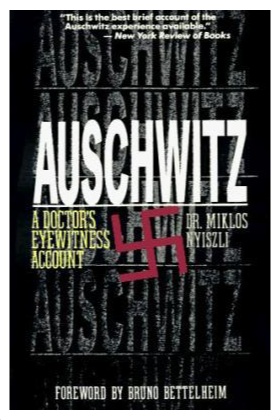
Dr. Nyiszli, by pure luck or grim fate, was spared the harsh realities of life in Auschwitz when he volunteered his expertise as a medical pathologist to the “Angel of Death” Dr. Josef Mengele not realizing what was laid in store for him. “Among malefactors and criminals, the most dangerous type is the ‘criminal doctor’ especially when he is armed with powers such as those granted to Dr. Mengele. He sent millions of people to death merely because, according to a racial theory, they were inferior beings and therefore detrimental to mankind.” (Nyiszli, 60) Nyiszli was put to work performing autopsies on twins and dwarfs all so that Mengele could send their findings on to a larger Nazi research institution. Nyiszli’s attention to detail and skills made him a valuable asset to Mengele who in return gave him more freedoms and luxuries than any other Jewish prisoner experienced while at Auschwitz.
Nyiszli learned the intimate details of the crematoriums and the men that were forced to work inside. He described in detail the liquidation of entire camps and the emotional toll it took on all involved. While he tried to do what he could to help those around him, he knew he also had to be careful to watch his own back as he was not immune to the endgame of all those who entered the gates of Auschwitz. He was able to share medicine, cigarettes, blankets, and more with others to make their short time in Auschwitz a little better. With the help of Mengele, he was able to find his wife and daughter and warn them to transfer to another camp before their entire section was liquidated. He befriended soldiers, guards, and prisoners alike and treated them all with the same respect. The constant fear that his turn was next as he saw comrades come and go kept him vigilant and determined to somehow survive. The Sonderkommando’s life expectancy was short at Auschwitz, and that terror hovered over their heads daily. They experienced a few months of better living conditions, but in the end their fate was the same as everyone else. “Death stalked our every move, in the form of the lethal machine guns manned by our guards. We wanted to live. We wanted to get out of there. But even if most of us failed to make it, even if only one or two escaped, we would still have won out, for there would be someone to tell the world about the dark mysteries of these death factories.” (Nyiszli,130) Outside of Auschwitz other survivors described similar experiences. “After the second mass-murder all of us were certain that the Germans made no difference between one Jew and another... They deceived the Judenrat and the Jewish Police when they promised them that they would stay alive if they helped to carry out the slaughter, and in the end they killed them too.” (Jaffe, 24-25, 70-72) A short reprieve for some that eventually ended in a similar fashion.
With the end of the war in sight, many German troops were unsure what their orders were. We can read about this from survivor Edi Weinstein: “Several days passed without transports. The workers cleaned the platform, covered it with ashes, and laid fresh branches along the fence. But the stench of charred corpses hung in the air. In the barracks at night we bolstered one another’s morale, trying to construe the changes as an indication that the ordeal was about to end and our release was imminent.” (Weinstein, 51) Feelings of uncertainty and fear were widespread as many were still unsure of what their future was supposed to look like. Nyiszli talks about this same uncertainty when he explained his recollection of events towards the end. “A new life began in the KZ. There were no more violent deaths, but the bloody past had to be hidden. The crematoriums had to be demolished, the pyre ditches filled in, and any witnesses to or participants in the horrors perpetrated here had to disappear.” (Nyiszli, 191) Nyiszli was able to cheat death once again when he escaped the annihilation of every man working the crematoriums at that time. As the Allies drew closer, Mengele had fled, the SS had fled, and the Russian saviors were still too far away, so Nyiszli decided to join the other prisoners and lose himself in the crowd fleeing Auschwitz. “My eyes had followed countless innocent souls to the gas chambers, witnessed the unbelievable spectacle of the funeral pyres. And I myself, carrying out the orders of a demented doctor, had dissected hundreds of bodies, so that a science based on false theories might benefit from the deaths of those millions of victims.” (Nyiszli, 220-221) After eight months, Nyiszli was able to physically walk away from it, but mentally he would never be able to hold a scalpel again.
While I have read the many great words of Viktor Frankl, Anne Frank, Edith Eger, Corrie Ten Boom, Art Spiegelman, and William Styron, Dr. Miklos Nyiszli took me on a different journey altogether. He was able to take me behind the scenes and into the mind of Dr. Mengele. He was able to describe in frightening detail the innerworkings of the crematoriums at Auschwitz. His attention to detail when it came to the emotional way he described his interactions with his comrades showed his empathy for them and his desire to compasionatly portray even the worst of them. His determination to not give up hope, to try to make it home - not knowing if anyone would be there to greet him - all so that he could be the one to tell the world about the death factory called Auschwitz. While it must have been very hard for Nyiszli to write down his story and relive all those moments of terror and emotional trauma, his words need to be out there as a reminder of what happens when we allow prejudice and hatred to go unchecked.
Sources:
J. Jaffe, Partizanim ("Partisans"), Tel Aviv, 1951.
Miklos Nyiszli, Auschwitz: A Doctor’s Eyewitness Account (New York: Arcade Publishing, 1993).
Edi Weinstein, Quenched Steel. The Story of an Escape From Treblinka, Yad Vashem, Jerusalem 2002.
[Written for HIST 4130 class UVU Fall 2024]
aB . All Right Reserved . 2024
Subscribe to:
Posts (Atom)