
Thursday, December 12, 2024

Auschwitz: a Doctor's Eyewitness Account

 
    Many of the readings this semester have stuck with me, but none as much as the one of Dr. Miklos Nyiszli. Reading books where the stories are non-fiction are a lot easier for me. I am reading actual events that someone describes in their own words, and I can usually picture the events happening in my head as I cannot seem to turn the pages fast enough. The words written by those who experienced the events hold power that no one can take away from them, but only if they choose to write them down. In class, we discussed how difficult it was for survivors of the Holocaust to talk about their experiences after the war. Many never mentioned what they went through or only gave a glimpse of the brutality they suffered as it was too difficult to relive it all again. Those who were brave enough to write down what they went through in detail gave the generations after them a history that they would have otherwise never have been able to gain an indepth understanding of. While we read many short accounts of survivors during class, and I personally have read multiple other stories over the years, Dr. Nyiszli’s words were different in many ways. Reading his account during the course of this class enlightened me to outrageous ideas of a demented doctor Mengele, the innerworkings of concentration camps such as Auschwitz, and the determination that led some to hold on for as long as possible to survive in unspeakable conditions until help arrived.

    Dr. Nyiszli, by pure luck or grim fate, was spared the harsh realities of life in Auschwitz when he volunteered his expertise as a medical pathologist to the “Angel of Death” Dr. Josef Mengele not realizing what was laid in store for him. “Among malefactors and criminals, the most dangerous type is the ‘criminal doctor’ especially when he is armed with powers such as those granted to Dr. Mengele. He sent millions of people to death merely because, according to a racial theory, they were inferior beings and therefore detrimental to mankind.” (Nyiszli, 60) Nyiszli was put to work performing autopsies on twins and dwarfs all so that Mengele could send their findings on to a larger Nazi research institution. Nyiszli’s attention to detail and skills made him a valuable asset to Mengele who in return gave him more freedoms and luxuries than any other Jewish prisoner experienced while at Auschwitz.

    Nyiszli learned the intimate details of the crematoriums and the men that were forced to work inside. He described in detail the liquidation of entire camps and the emotional toll it took on all involved. While he tried to do what he could to help those around him, he knew he also had to be careful to watch his own back as he was not immune to the endgame of all those who entered the gates of Auschwitz. He was able to share medicine, cigarettes, blankets, and more with others to make their short time in Auschwitz a little better. With the help of Mengele, he was able to find his wife and daughter and warn them to transfer to another camp before their entire section was liquidated. He befriended soldiers, guards, and prisoners alike and treated them all with the same respect. The constant fear that his turn was next as he saw comrades come and go kept him vigilant and determined to somehow survive. The Sonderkommando’s life expectancy was short at Auschwitz, and that terror hovered over their heads daily. They experienced a few months of better living conditions, but in the end their fate was the same as everyone else. “Death stalked our every move, in the form of the lethal machine guns manned by our guards. We wanted to live. We wanted to get out of there. But even if most of us failed to make it, even if only one or two escaped, we would still have won out, for there would be someone to tell the world about the dark mysteries of these death factories.” (Nyiszli,130) Outside of Auschwitz other survivors described similar experiences. “After the second mass-murder all of us were certain that the Germans made no difference between one Jew and another... They deceived the Judenrat and the Jewish Police when they promised them that they would stay alive if they helped to carry out the slaughter, and in the end they killed them too.” (Jaffe, 24-25, 70-72) A short reprieve for some that eventually ended in a similar fashion.

    With the end of the war in sight, many German troops were unsure what their orders were. We can read about this from survivor Edi Weinstein: “Several days passed without transports. The workers cleaned the platform, covered it with ashes, and laid fresh branches along the fence. But the stench of charred corpses hung in the air. In the barracks at night we bolstered one another’s morale, trying to construe the changes as an indication that the ordeal was about to end and our release was imminent.” (Weinstein, 51) Feelings of uncertainty and fear were widespread as many were still unsure of what their future was supposed to look like. Nyiszli talks about this same uncertainty when he explained his recollection of events towards the end. “A new life began in the KZ. There were no more violent deaths, but the bloody past had to be hidden. The crematoriums had to be demolished, the pyre ditches filled in, and any witnesses to or participants in the horrors perpetrated here had to disappear.” (Nyiszli, 191) Nyiszli was able to cheat death once again when he escaped the annihilation of every man working the crematoriums at that time. As the Allies drew closer, Mengele had fled, the SS had fled, and the Russian saviors were still too far away, so Nyiszli decided to join the other prisoners and lose himself in the crowd fleeing Auschwitz. “My eyes had followed countless innocent souls to the gas chambers, witnessed the unbelievable spectacle of the funeral pyres. And I myself, carrying out the orders of a demented doctor, had dissected hundreds of bodies, so that a science based on false theories might benefit from the deaths of those millions of victims.” (Nyiszli, 220-221) After eight months, Nyiszli was able to physically walk away from it, but mentally he would never be able to hold a scalpel again.

    While I have read the many great words of Viktor Frankl, Anne Frank, Edith Eger, Corrie Ten Boom, Art Spiegelman, and William Styron, Dr. Miklos Nyiszli took me on a different journey altogether. He was able to take me behind the scenes and into the mind of Dr. Mengele. He was able to describe in frightening detail the innerworkings of the crematoriums at Auschwitz. His attention to detail when it came to the emotional way he described his interactions with his comrades showed his empathy for them and his desire to compasionatly portray even the worst of them. His determination to not give up hope, to try to make it home - not knowing if anyone would be there to greet him - all so that he could be the one to tell the world about the death factory called Auschwitz. While it must have been very hard for Nyiszli to write down his story and relive all those moments of terror and emotional trauma, his words need to be out there as a reminder of what happens when we allow prejudice and hatred to go unchecked.

Sources:

J. Jaffe, Partizanim ("Partisans"), Tel Aviv, 1951.

Miklos Nyiszli, Auschwitz: A Doctor’s Eyewitness Account (New York: Arcade Publishing, 1993).

Edi Weinstein, Quenched Steel. The Story of an Escape From Treblinka, Yad Vashem, Jerusalem 2002.


[Written for HIST 4130 class UVU Fall 2024]
aB . All Right Reserved . 2024

Wednesday, December 11, 2024

GRIT Garden at UVU

    I have driven past the GRIT garden many times over the years, but never realized what it was until we paid it a visit for class.

    I have tried, unsuccessfully, to start my own small garden many times in Utah, and so it was validating to hear that some of the times it was not my fault. The soil in Utah is hard to plant in, and I think I have been trying to grow some of the wrong things most of the times I tried. We also moved around a lot, and so starting over gets exhausting and giving up on a garden is much easier with kids.

    Learning about the natural pesticides (marigolds) and planting certain crops together so that they help each other, was so much good information to learn. While I now live in a small townhome with a concrete backyard (no room for a garden), I do have a sister with a big garden with whom I will share my newfound wisdom. I love the fact that there are opportunities to volunteer in the GRIT garden for those of us who do not have a garden at home anymore, or for those who may want to benefit from the free food that comes out of the garden each week. While students are not required to spend their time in the garden in exchange for the free food, they are more than welcome to come learn some tips and tricks for their own future gardens.

    Seeing the GRIT garden was a great addition for this class as food is a major part of our environment. Knowing where our food comes from, how it has been processed, which chemicals have been used, how many hands/companies were involved before we purchase it, and what kind of damage it has done to our environment in the meantime, is all part of environmental sociology. Taking the middle man (or in some cases many middle men) out, and growing your own produce, or going to the farmers market and supporting those local to you by buying produce from them, can eliminate some of those environmental concerns. Food, and knowing where it comes from, or which company is responsible for it, has always been a big thing for me. I try to be very conscious of what I eat. I am picky about where I shop, and seldom eat animal products because of countless books and documentaries I have read and seen about the processes that go on there. Our country's consumption of meat is outrageous, and don’t even get me started on what that industry adds to the effects on the environment, because that is a soap box I will never get down from.


[Written for SOC 3520 class UVU Fall 2024]
aB . All Right Reserved . 2024

Tuesday, December 10, 2024

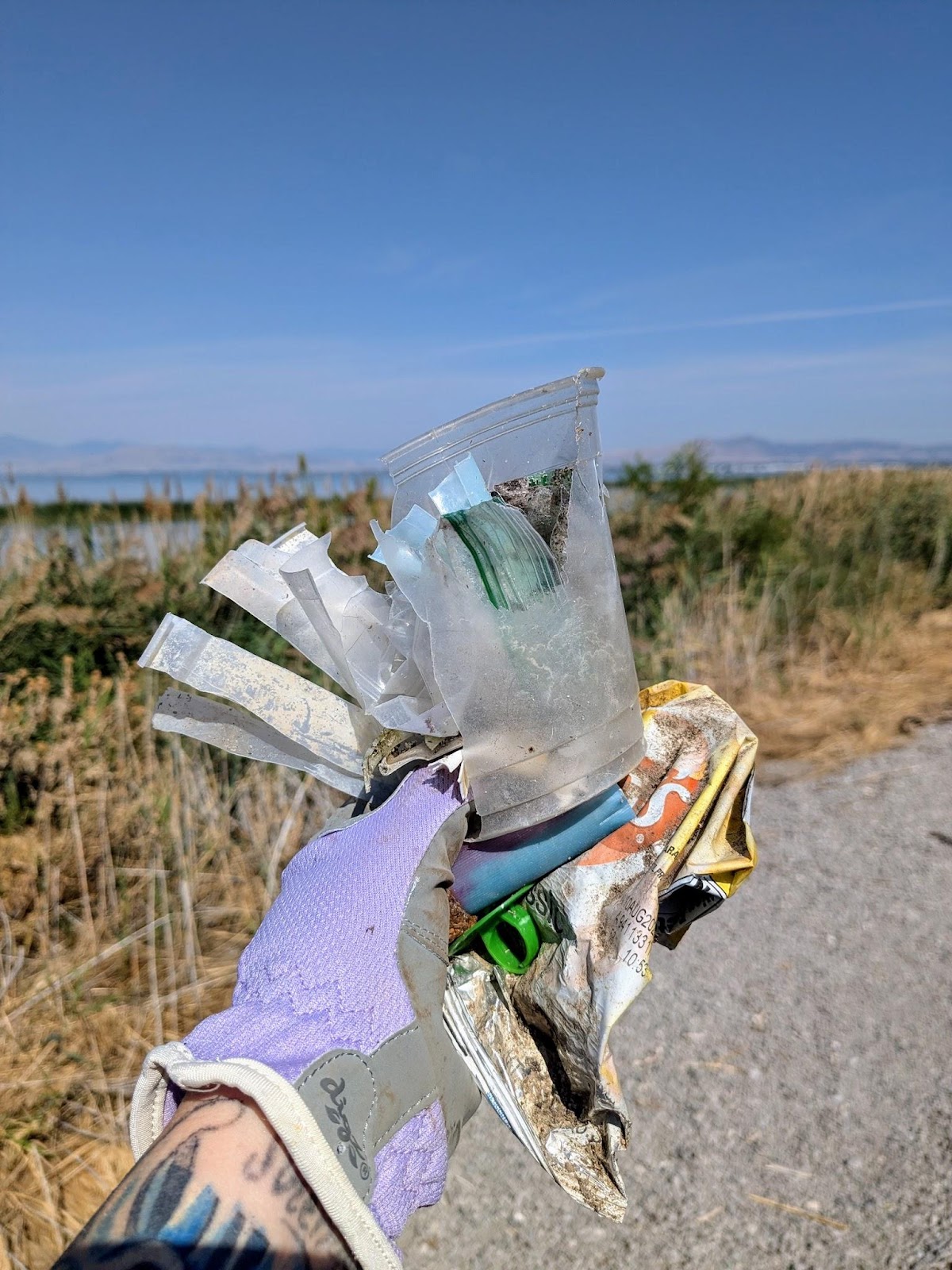
Utah Lakeshore Cleanup at Sunset Beach Park, Vineyard.

     Environmental problems are social problems and since we are the ones that have created the problem, we should be the ones to go out to clean up our mess.

    Environmental sociology is the study of community in the largest sense possible as we are studying the community for all. We really are in a new period of life where humans impact climate and the ecosystem more than we have ever before. So much so, that they decided to switch to a new era and name this one we are in right now the anthropecene.

    I can see the effects of our impact on the world all around me, and so when I had the opportunity to come help for an hour on a Saturday, even if it was to only find a handful of trash, I knew it was worth it.

    I have tried to be aware of my footprint on this earth for a long time and know that my personal attempts to be more mindful is small in the larger scheme of things, but still valuable. I try to be conscious of my energy use at home by replacing outdated appliances with energy efficient ones when possible. I own a fuel efficient vehicle and use public transportation or my bike when I can. I change my air filters in my home regularly, and open my windows instead of running the air conditioner if I can. I have a low-flow shower head and try not to use any single plastic items when I can. I sort all my garbage and take my recycling to the recycling center in town every few weeks among many other things.

    My efforts are but a small drop in the bucket, and I am not sure how impactful they are. As far as I am concerned, I feel I am making a difference, and I feel better about how I am leaving this world behind for my kids.


[Written for SOC 3520 class UVU Fall 2024]
aB . All Right Reserved . 2024
Monday, December 9, 2024

Treadmill of Destruction

How does a sociological viewpoint give us a unique insight into the material environments surrounding us? And how does environmental awareness shape our sociological perspective?

    If we look at nature from a biological perspective we can refer to it as being the physical world including the plants, animals, landscapes, and other features not created by human hands. When we bring a sociological perspective into it, we start to look at human interaction with nature and how we have introduced things like pollution and scarcity of resources because of our disregard for the environment around us.

    Gregory Hooks and Chad Smith examine the environmental inequalities endured by the Native American populations living on the reservations assigned to them by the United States government in the paper titled “Treadmill of Destruction.” They provide evidence in this paper that the U.S. military knowingly used Native American land as a dumping ground for hazardous material and a place to “produce, test, and deploy weapons of unprecedented toxicity.” (Hooks and Smith, 558–75)

    The forced relocation of Native Americans onto reservations came without their consent and choice of land. To many, the new land was unfamiliar and vastly different from their original homelands which meant having to adapt to a new climate, landscape, and ecosystem. The land quality was poor making it difficult for traditional agricultural practices and hunting which led to food shortages and economic hardships. The reservations were also isolated and far away from any other signs of civilization.

    Starting in the 1940s, Uranium has been mined on Native American land leading to environmental contamination and severe health problems to those living in the area. (Nuclear War) During World War II, the United States military used Native American land for their bombing ranges in places such as Alaska, Arizona, California, Minnesota, Nevada, New Mexico, and South Dakota. (On Dangerous Ground) From 1951 to 1992 the United States government did nuclear testing on Native American lands in Nevada releasing radioactive plumes into the air affecting nearby tribes. (EJ Atlas) In the 1960s, the U.S. Government tested dioxin (a component of Agent Orange) on Native American land in Arizona. (Sanjana Manjeshwar) All of these military activities have resulted in significant impacts on the environment, major health issues for the Native Americans occupying the land, and disruptions to life on the reservations in general.

    Native American tribes have tried to combat all the issues that have stemmed from the years of neglect and abuse they faced as they were seen as second-class citizens living in areas the U.S. military also deemed appropriate to use for the manufacturing of weapons of mass destruction. They are still trying to address the long-term health affects many are suffering from after being exposed to so many hazardous materials. Being part of a minority and marginalized community they already suffer from access to healthcare which now adds additional pressure of educating those still living on the reservations of the existing health hazards around them as well. While it should not be the tribes responsibility to restore the damages done to the environment on their lands, they are also trying to engage in clean up efforts to restore and preserve the natural resources that exist on their land for future generations. The Navajo Nation has also filed lawsuits against the United States government to seek compensation and cleanup for uranium contamination as this is something they can’t clean up themselves.

    The treadmill of destruction is a social issue because it leads to environmental harm that affects all of us. While in the example above the harm is mostly done to those living on Native American reservations, this should be an issue that impacts all humans as we all inhabit this earth together. The environmental impacts and livelihoods of communities are destroyed at the expense of military activities. Marginalized communities such as the Native American populations were already looked on as second class citizens and because of this no safety measures were taken into account during all the years the military used their land with serious repercussions. Suppression of information and lack of transparency from the military created immense health risks for many who had no idea what kind of testing or toxins were released into their communities.

    Another example of this is when the United States military decided to conduct nuclear tests in the Marshall Islands between 1946 and 1958 which displaced the entire local population on the island of Bikini Atoll. They were forcibly relocated, just like the Native Americans, which created severe hardships as their lives were disrupted. The nuclear tests vaporized some of the smaller islands close by and left behind radioactive contamination. The water around the islands became dangerous as well affecting the fishing and farming that the inhabitants were used to. (Hodson, Watson, and Sanchez) The environmental impact of the testing for those years created ripple effects still felt in that area today.

    Sociologists study how human activities contribute to environmental degradation. Awareness of environmental issues and concepts like environmental racism and social inequality are key to understanding how different groups experience environmental hazards differently.

Sources:

EJ Atlas. Available at https://ejatlas.org/conflict/nuclear-testing-in-newe-segobia-western-shoshone-lands-in-nevada-us.

From Issue:  Fall 2023  /  Vol. 24 No. 3 et al., “On Dangerous Ground: Oglala Lakota Land Used as a Bombing Range in World War II Is Still Perilous,” NMAI Magazine. Available at https://www.americanindianmagazine.org/story/Badlands-bombing-range.

Gregory Hooks and Chad L. Smith, “The Treadmill of Destruction: National Sacrifice Areas and Native Americans,” American Sociological Review 69, no. 4 (August 2004) Available at https://doi.org/10.1177/000312240406900405.

Nuclear War: Uranium Mining and Nuclear Tests on Indigenous Lands,” Cultural Survival. Available at https://www.culturalsurvival.org/publications/cultural-survival-quarterly/nuclear-war-uranium-mining-and-nuclear-tests-indigenous.

Simon Hodson Tara Watson and Gabriel R. Sanchez, “Mass Displacement Caused by Conflicts and One-Sided Violence: National and International Responses,” Brookings, July 28, 2016. Available at https://www.brookings.edu/articles/mass-displacement-caused-by-conflicts-and-one-sided-violence-national-and-international-responses/.

Sanjana Manjeshwar “The Lasting Harms of Toxic Exposure in Native American Communities - Berkeley Political Review,” Berkeley Political Review - UC Berkeley’s only nonpartisan political magazine, July 13, 2021.Available at https://bpr.studentorg.berkeley.edu/2021/07/10/the-lasting-harms-of-toxic-exposure-in-native-american-communities/.


[Written for SOC 3520 class UVU Fall 2024]
aB . All Right Reserved . 2024

Thursday, December 5, 2024

Smart Wheels: The Ecomodernist Approach to Car Travel

    Ecomodernism is a way of thinking about our impact on the environment and using technology and innovation to improve it. Instead of reducing our impact by doing less, ecomodernists believe they can find new ways by involving technology such as renewable energy and carbon-neutral travel to help the environment and still meet our human needs. It is a fine balance between progress and conservation without harming the Earth more than we already have.

    Roughly 27% of US greenhouse gas emissions are transportation-related. If you look back on history and the development of our cities, you can see that we drive in today’s society because our urban environments require it. While some places have great alternatives such as public transit available to many different locations, Utah County is lagging as there are entire parts not accessible unless you have a car.

    Cities such as Provo have made great strides to add multiple bike paths and the UVX bus system that routes through there while other cities have a lot of catching up to do. As the population of Utah County increases and more homes are built West of Utah Lake, public transportation would only be a benefit to those living there. The two main roads leading out to that area are always congested as more homes are built further away from the I15 corridor and the Frontrunner train.

    Utah County already has an air pollution problem and adding another bus system similar to UVX for the West side of the County could help congestion, greenhouse gas emissions, and air pollution as those buses could potentially replace multiple cars on the road daily. Transferring from the bus to the Frontrunner train could help those living on the West side of the lake reach the Salt Lake Valley and North without having to use their own cars. Michael Carolan mentions in Chapter 7 of his book that commuting to work cuts into community time and weakens social ties in the communities where you live. He says the less time you spend in your zip code, the less involved you are in local politics, attendance at public meetings, or vote for representatives.

    Michael Carolan also talks about solutions in Chapter 7. While it is hard to change the structure of cities, especially those that have been around for a long time, adding walking and biking paths, and public transportation options is a great way to give people different alternatives besides taking their car everywhere. Carolan mentions that many individuals would still choose their car in many cases unless some more drastic changes were made where you would see your car as a last resort. Currently, we are being incentivized to drive as we don’t pay taxes on fuel for our cars and we get to park for free in many places. If we wanted people to leave their car at home more we would need to incentivize them to do so. No more free parking, taxes on gas, pay-as-you-drive auto insurance where you would only pay for the actual miles you drive and not the same amount as everyone else, increased vehicle registration costs, and more.

    I would love to leave my car at home daily and use public transportation to UVU. I have my UVU ID card that gets me access to public transportation for free, and parking is a nightmare on campus anyway. The reason I still drive my car to campus every day and fight to find a parking spot is that currently, public transportation stops running at midnight. The library on campus closes at midnight and after I have everything locked up and walk out the door it is usually 12:15 am. The last Frontrunner train had already left the station at 12:03 am and there is not another train after that. The last UVX bus back to Provo leaves in front of the Keller building at 12:17 am but it is a 10-minute walk to get there so I can’t make that one in time either. When the weather is nice I have taken my bike to work on the Frontrunner train and then ridden it home at night. It is a 7-mile bike ride through Orem and Provo with a limited amount of cars on the road. I have bike paths the entire way so it is a relatively safe ride. When I do this it takes me a lot longer to get home than the typical 15-minute drive in my car, so I can see the appeal for many to keep using their cars when they have them. It would take an increase in registration costs, gas tax, and no more free parking for me to probably take my bike to work every day as right now it is easier and faster to just hop into my car and drive the 15 minutes to UVU and back home again every day.

Source:

Carolan, Michael S. Society and the Environment: Pragmatic Solutions to Ecological Issues. Boulder: Westview Press, 2013.


[Written for SOC 3520 class UVU Fall 2024]
aB . All Right Reserved . 2024

Wednesday, December 4, 2024

A Home of My Own: Triumph After Divorce

    I spend a lot of time either at my home or on UVU campus as I work there full-time and take classes full-time, but I decided that my home was the environment I wanted to focus on for this critical essay. I was very proud of myself when I was able to buy my very first home four years ago after thinking that would never become a reality as I had just gotten divorced, was now only working with my income, and was a single mother of two teenagers.

    My home is socially constructed in many ways. The design and layout of my home were not planned by me as I was not able to buy a brand new home and had to buy one that was about 22 years old at the time I purchased it. It is a small townhome with an open floor concept which is what many people like as there is that cultural emphasis on family togetherness and having get togethers to socially interact with others. The main floor has that with a living room and dinning room combo without any walls separating the two and then a kitchen in the back that has a window cut out in the wall so it doesn’t feel closed off but rather part of the open concept feel as well. While the entire first floor is only 500 square feet, the open concept design makes it feel bigger and more spacious. The upstairs is also 500 square feet and has 2 bedrooms and a bathroom. Again, I had no say in the layout as the home was already built, but since the home has two bedrooms, socially we can agree that this home was built most likely for a small family.

    While my home was not brand new when I purchased it, I saw the potential to change things later on if I wanted to. The downstairs was more updated and had nicer hardwood floors, and so I knew I would need to eventually do some work to make the upstairs reflect current social trends. I was not able to start big right away but I could do little improvements over time as my economic status changed. Simple things such as paint were easy to do on the inside of the home and the outside door to update the curb appeal. A new large planter box under my bay window out front was noticed by my neighbors as I built it myself outside one summer and filled it with new plants, mulch, and decorative rocks. The neighbors complimented my efforts and worked on their own planter areas throughout the summer as well creating a cohesive look to our row of homes. While our HOA (Homeowners Association) does not require us to keep to a certain standard within the community when it comes to our planter boxes, they do however make sure that when the paint on your front door starts to fade, you put a nice fresh coat of paint back on to keep all the doors looking good.

    I was finally able to start a more substantial renovation project this year as I was able to purchase hardwood floors for the 500 square feet of the upstairs in my home. So far I have torn out the now 26 year old carpet in one of the rooms and have started to lay down the new flooring all by myself. In doing this I can hopefully bring the value of my home up as social trends and expectations have changed over time when it comes to the type of flooring we see in homes today. I grew up in Europe and have missed seeing hardwood floors in all the rooms, and this will be a breath of fresh air when I finish as this is a much cleaner, more modern look that is more my taste than carpet. I also have 3 cats and think cleaning up after them on hardwood floors is a lot easier than carpet. I have not decided what to do with the stairs yet and have watched a lot of home improvement shows without any ideas so far.

    My economic status at the time I wanted to purchase a home prevented me from purchasing in certain locations in Utah and it also prevented me from purchasing above a certain price range. The exact same townhome I bought in Provo (down to the age it was built) was $35,000 more expensive in American Fork where I was currently living. While homeowner status changed the way I viewed myself (it gave me more self esteem among other things) I had to move 30 minutes South to achieve this dream.

    The neighborhood my home is in is also socially constructed. I live in a community that has an HOA and with that come rules that all of us must abide by to be good citizens of the community. The role of being a neighbor, especially since I live in a townhome which shares a wall on both sides, is especially important as socially you should be courteous and respectful to those living around you anyways. There are even laws in place that protect citizens against neighbors who are in violation of community or social guidelines such as when a neighbor is violating noise ordinances at 3 a.m by having a loud party on a random Tuesday. Getting to know your neighbors and interacting with them occasionally can build social relationships and avoid miscommunications in the future.

    The way my home engages with my neighbors and community (HOA) contributes to the overall aesthetic. By making sure the outside of my home is clean, kept up, and well maintained, I am making sure my relationship is not sour and my home has a good place among the rest of the homes in the area. By also making sure the inside of my home is updated and in good working condition, by replacing outdated appliances and such, I can make sure my home fosters social bonds inside as well because my kids will want to come over to visit me. Friends and acquaintances can come over and feel at ease inside of a home that is clean, organized, put together, and see the space where I can showcase my cultural art and personal identity creating many different topics of conversation.


[Written for SOC 3520 class UVU Fall 2024]
aB . All Right Reserved . 2024

Friday, July 5, 2024

The Stigma Surrounding Single Parenthood

 Introduction

    A stereotype is defined as a set of simple, rigid and overgeneralized beliefs about the personal characteristics of a group of people. In this paper I will show that the stereotype of single parent in the United States has been stigmatized to the point that while many believed those holding that title to be inferior as a parent, a drain on societies resources, and part of “the problem” in the past, today those views are slowly changing as many choose alternative lifestyles and family dynamics so very different from what society once viewed as the norm.

Measurement

    I wanted a glimpse into each participant's homelife growing up to see if they already had a preconceived notion of what life with a single parent was like. Either they had a happy homelife with two attentive parents, they had one attentive parent and one non-attentive parent, they had a single parent, or they were raised by someone other than their parent. I then wanted to know if they were happy with their homelife growing up and if they wanted something similar for their future family. I could then possibly see if they had attentive parents and wanted a similar homelife that things were probably better for them than for those that had non-attentive parents who would then say they wanted a different life for their future family. My big question was the list of stigmas as I was hoping that all participants had heard at least of some of them even if they had attentive parents and good homelives. The rest of the questions were just to receive more background and answers from different individuals who were raised differently and how they saw parenthood and the idea of single parenthood in today’s world.

Data Collection

    The survey consisted of eight questions to understand what these individuals had been taught about single parents growing up, and if they could identify some of the stigmas associated with single parenthood in the world today. An additional four questions were used for demographic purposes to show the diversity in the participants. In order to get a diverse group of individuals for the survey, I knowingly sent it to four male and four female participants. I also wanted a wider age range and so I made sure to include individuals from ages 18 to 65 in the sample pool. Education in this instance was very important and so I made sure to include individuals with higher and lower levels of completed education degrees as another factor to consider. After coming up with 8 individuals who fit my criteria of diversity on all levels, I sent out the surveys and waited for the results so that I could analyze their answers for this paper. All research ethics guidelines were followed during the data collection process.

Findings

    The survey consisted of eight questions that each of the participants were asked. All eight were asked the exact same questions in the exact same order as part of an online survey. Some questions were as simple as checking a box and others required a written out answer where each participant could elaborate as much or as little as they wanted to.

    Question 1: What was your family dynamic growing up? Single parent, Both parents home and attentive, One parent attentive other one there but not as involved, Raised by someone other than my parents. (This was a multiple choice question where they were able to click one option) I had a great mix of answers and so I knew I had picked the right group of people to send the survey to as they all had different stories to tell me. Three participants were raised by two attentive parents, three participants were raised in a home with both parents but only one was attentive and the other one was rarely there. One was raised in a single parent household, and one was raised by someone other than their parents.

    Question 2: What is your outlook for your future/current household? (This was a multiple choice question with two options. They could either choose “I want/have a similar dynamic to what I had growing up”, or “I want/have a completely different household.”) Five of the participants chose that they either wanted or had a completely different household than what they had growing up while three participants chose they want/have a similar dynamic to what I had growing up. This led me to believe that those who were raised in a more attentive home most likely wanted a similar home and those who were raised in a less attentive home now were looking for something different for their future family.

    Question 3: What were you taught about single parent households growing up? I added a list of stigmas about single parents and I asked if any of them had ever heard these stigmas before. Almost all of them checked the boxes on every stigma I listed. Here are the stigmas listed from the survey.
1. Mostly women, unmarried, poor, no future.
2. Personal choice, did not want to get married, career oriented.
3. Mostly people of color, down on their luck, living on welfare.
4. Children would grow up to do bad in school and have behavior problems.
5. Usually a result from divorce, death, or abuse.
6. Children would grow up to have emotional and relationship problems.
7. Children would lack a role model growing up.
8. Most single parents come from low income families.
Every single participant checked the box for number one as that was the most common stigma they had all heard. The next most common stigmas were number 7 and 8 on the list with seven out of the eight participants saying they had heard that stigma and then stigmas three, four, five, and six came in third with six out of eight of the participants hearing about that and three out of the eight participants said they had heard about stigma number 2 before.

    Question 4: Do you think kids should be raised in a two parent home? This is where I received some interesting answers. Many elaborated on their yes or no answers by explaining why they chose to answer either yes or no. Some who were raised by two parents but one who was not attentive made sure to point out that they believed that kids needed to have two attentive parents that both needed to be present to make choices for the kids. Another participant who was raised by a single parent pointed out that there was no required number for parents and that kids have more than just parents around them as they also should be raised in communities including grandparents, aunts/uncles, and more. This question provided a very mixed reaction and left the answer somewhere in the middle for this particular sample of participants.

    Question 5: What is your definition of family? This question however brought some great answers and did not give me nuclear family vibes at all. I received answers such as: “Any group of people willing to trust, care for, and depend on one another.” to “A collection of people bound together by commitment and love for each other that support each other throughout different stages of life.”

    Question 6: Should single people be allowed to become parents? This question was answered yes by all 8 participants. Some of the longer answers included “I don’t believe it is my place to delegate whether a single parent can have kids” to “You shouldn’t need a partner to have a child.”

    Question 7: Which Continent do you think has the highest number of single mothers in the world? (This was a multiple choice question with the 4 possible answers being Africa, South America, Russia, and North America.) I wanted to see if my participants were aware that the United States has the most single mothers in the world. Seven out of eight participants chose North America while one chose Africa, and so in my personal opinion I think most of my participants are aware that our country has a larger group of single parents than other countries out there which could also play into the stigmas surrounding single parenthood.

According to a Pew Research Study done in 2019 of 130 different countries and territories, the United States does in fact have the world’s highest rate of kids living with a single parent. With 23% it beats out countries like the UK, Russia, Denmark, France, Kenya, and Ireland who are not too far behind them. (Kramer, 2019)

    Question 8: Which minority group do you think has the highest number of single mothers in the United States? (This was another multiple choice question with 5 possible answers being African American, Hispanic, Pacific Islander, Asian American, and Native American.) Here my participants were not as confident as they were with the last question. While four participants selected Hispanics as their answer, three chose African American, and one chose Native American.

    13% of the U.S. population is African American and according to the statistics listed in The Marriage and Family Experience Textbook they are less likely to get married, more likely to live in poverty, more likely to be unemployed, and children are highly valued. 19.1% of the U.S population is Hispanic and in the same book by Strong is described as a minority that places a high emphasis on childbearing and child rearing, with a third of all children living with a single parents, and the fastest growing ethnic group in the U.S. Native Americans are 2.9% of the U.S. population and are described to be twice as likely to be unemployed and twice as likely to be below the poverty line. Two-thirds of all children born to Native American mothers are born to unwed mothers making them extremely disadvantaged. (Strong, 2021)

All three of these minorities have a higher rate of single motherhood in the United States because of many other underlying issues and so we easily point them out when asked who we think is at the top of this stigma.

Conclusion

    While many people still believe the stigmas surrounding single parenthood and the negative effects it can have on children that are raised in homes lacking two adults, there have been many studies done that show the positive effects as well. Children can thrive in loving homes where they receive attention and care even if there is only one caretaker present. The close-knit familial relationships of larger family groups should not be discounted if they are all present to help raise children together. Grandparents, aunts, uncles, cousins, and close family friends can be a source of family and community when there is only one parent in the home that needs to go out and work as well. The ideal nuclear family that once was the American dream is now replaced with having people around you that you can count on, care for, and that can be there for each other when you need it.


References


Kramer, S. (2019, December 12). U.S. has world’s highest rate of children living in single-parent households. Pew Research Center.

https://www.pewresearch.org/short-reads/2019/12/12/u-s-children-more-likely-than-children-in-other-countries-to-live-with-just-one-parent/

Strong, B., & Cohen, T. F. (2021). The marriage and family experience: Intimate relationships in a changing society. Cengage.

[Written for SOC 1200 class UVU Summer 2024]
aB . All Right Reserved . 2024